
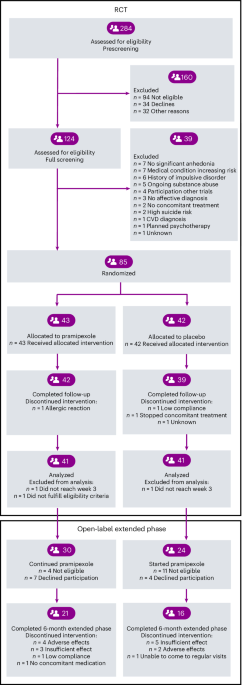
Comprehensive information on the study protocol was previously published38.
Trial design
This was an academic single-center trial conducted in Lund, Sweden. Patients were randomized to receive either add-on flexible dose pramipexole or identical placebo for 9 weeks, followed by an open-label extension phase for six additional months. The primary outcome measure was absolute change in the SHAPS total score between baseline and week 9, calculated using the Likert scale (1–4 points per item, total scores 14−56). All patients were asked to wear an accelerometer during the trial period with the option to opt out if inconvenient.
Optional substudies were conducted in a subset of participants at baseline and week 9, including 7-Tesla fMRI with the MID task, cognitive assessments, the PRT and blood and CSF sampling. Participation in these substudies was voluntary and associated with monetary compensation. Patients could take part in one or more of these substudies. The PRT was introduced in 2024, approximately halfway through the study.
Intervention
Extended-release pramipexole tablets from STADA Nordic were labeled and repackaged consistent with European Union guidelines and Good Manufacturing Practice (GMP). Identical placebo tablets were produced by Ardena in line with GMP. All tablets were packed in boxes and assigned randomized numbers. Only Ardena and an unblinded research nurse (who was not involved in patient assessments) had access to the code list connecting the randomization numbers to treatment allocation. Pramipexole tablets were taken once daily, preferably at nighttime. Patients, research physicians and nurses involved in patient assessments were blinded for treatment allocation. Because both pramipexole and placebo were packaged by Ardena, eight different logs for the study medication were created, and four different strengths were ordered and combined to achieve the correct dosing. For each strength, both pramipexole and placebo were available. These logs were accessible only to the unblinded staff members who packed and labeled all boxes with the participants’ randomization numbers. The unblinded staff members were not involved in symptom assessments. Blinded study personnel then administered these to the patients using a flexible dosing schedule (Supplementary Table 5). An unblinded statistician at Clinical Studies Sweden Forum South prepared the random allocation sequence and established the randomization list. Apart from the preparation of the allocation sequence, the statistician was not involved in the study. The block size varied randomly between 4 and 6, and the order within the blocks was generated randomly using a computer-based algorithm. Only the statistician who created the randomization list was aware of the random variation in block size and was also the only person who had access to the randomization list. At the week 9 visit, after clinical ratings, patients were asked if they thought that they had been allocated to pramipexole or to placebo. At the start of the study, participants had only two options: pramipexole or placebo. During the study, several patients described their guess as a ‘coin toss’. We, therefore, added the possibility of answering ‘unsure’.
To maintain blinding in the RCT, a separate team of study physicians and nurses conducted the open-label extension phase. Thus, none of the physicians responsible for patient assessments in the RCT participated in the open-label phase, ensuring that they remained unaware of any side effects or efficacy signals that could compromise blinding during the randomized phase. All study medication used during the follow-up study was purchased from the pharmaceutical company STADA.
We used an individually tailored dose titration schedule based on recommended dose escalation strategies for Parkinson’s disease but adjusted according to side effects and efficacy (Supplementary Table 5). We increased pramipexole doses weekly and decreased the dose in the event of intolerable side effects and waited approximately 1 week before a new attempt of dose escalation was made. If patients had a Clinical Global Impression (CGI) Severity score of ≤2, dose escalation was discontinued for the remainder of the study, provided they did not show increased symptom burden at subsequent visits.
Patient population
Patients were recruited via advertisements or clinical referrals from psychiatric or primary care units. They were prescreened via telephone and then screened on site to determine if they fulfilled eligibility criteria.
Inclusion criteria were age 18–75 years; a current diagnosis of MDD, dysthymia or bipolar disorder with a depressive episode; ongoing treatment with at least one antidepressant or mood-stabilizing medication for ≥4 weeks; and a history of at least one adequate antidepressant trial without remission. All participants provided written informed consent prior to study participation.
In addition, participants were required to have clinically significant anhedonia, defined as scores of 3 or 4 on at least three items of the SHAPS13.
This recruitment strategy aligns with the conceptualization of anhedonia as a cross-diagnostic symptom with a potentially shared pathophysiology involving reward circuit dysfunction and reduced dopaminergic activity.
Study participants underwent psychiatric and somatic evaluations including standard laboratory screening. Primary diagnoses were determined through diagnostic interviews conducted by psychiatry residents or specialists, combining relevant sections of the structured Mini International Neuropsychiatric Interview (MINI) with a review of each patient’s clinical history39. Exclusion criteria included pregnancy, breastfeeding or planned pregnancy; high suicide risk based on clinical assessment; substance use disorder within the past 6 months; current psychotic disorder; emotionally unstable personality disorder; compulsory psychiatric care; impulse control disorders (including binge-eating disorder) or attention-deficit/hyperactivity disorder with hyperactivity; and cognitive impairment (including intellectual disability or dementia) affecting the ability to provide informed consent.
Participants with significant medical comorbidities were excluded, including renal impairment (estimated glomerular filtration rate (eGFR) <50 ml min−1 1.73 m−2), symptomatic cardiovascular disease (New York Heart Association (NYHA) class II or higher), hepatic insufficiency, Parkinson’s disease, active cancer not in remission for more than 1 year or previous bariatric surgery affecting drug absorption.
Additional exclusions included recent initiation of psychotherapy (<6 weeks) or planned initiation during the trial; ongoing electroconvulsive therapy (ECT), ketamine or repetitive transcranial magnetic stimulation (except maintenance treatment); use of medications affecting pramipexole pharmacokinetics or with similar or antagonistic dopaminergic mechanisms (except low-dose quetiapine ≤150 mg per day40); known hypersensitivity to the study drug; participation in other interventional studies; and any condition judged by the investigators to compromise safety, compliance or evaluability.
Patients were eligible for the 6-month open-label extension phase if they had received pramipexole during the RCT phase, wanted to continue treatment and were still not meeting any exclusion criteria. Participants who had received placebo in the RCT could also enter the extension and receive pramipexole, provided they continued to meet all original RCT eligibility criteria, and no exclusion criteria, at the end of the randomized phase. Participants who were already receiving pramipexole continued at the same dose unless dose reduction was warranted due to adverse events or dose escalation was indicated based on insufficient clinical response with a maximum dose of 4.5-mg salt. Participants who had previously received placebo underwent dose titration with pramipexole, in accordance with the titration schedule used in the RCT. These participants were followed-up by an additional phone call after 2 weeks to assess tolerability.
Assessments
At all study visits (both the RCT phase and the open-label extended phase), participants were assessed on site by a study physician. At each in-person visit, the physician conducted clinical evaluations and participants completed self-rating scales, with a focus on both efficacy and tolerability of the intervention as well as any need for dose adjustments.
Rating scales
For clinical rating scales, data were collected from baseline, week 3, week 6 and week 9 during the randomized controlled phase and monthly during the extension open-label phase. The SHAPS41 was scored from 1 to 4 on each item, with a total score of 56. The SHAPS is a commonly used self-rating scale that mainly covers the consummatory phase of anhedonia. Response (≥50% reduction in SHAPS scores) was evaluated using the original dichotomized method (1–2 = 0, 3–4 = 1). Remission was defined according to the dichotomized scoring method, with a score of <3 indicating remission. We used the self-rating version of MADRS-S, and response was defined as ≥50% improvement and remission as ≤10 (ref. 42) at week 9. The HDRS-6 (ref. 43) is an expert rating scale including six core depression items from the HDRS: ‘depressed mood’, ‘feelings of guilt’, ‘work and interest’, ‘psychic anxiety’, ‘general somatic symptoms’ and ‘retardation’. This subscale has shown higher sensitivity for antidepressant signals than the full HDRS44. In addition to the SHAPS, anhedonia was also evaluated using the DARS45 as it includes additional anhedonia domains and separates the motivational and consummatory phases of anhedonia. The AES-S is a self-rating scale evaluating apathy symptoms that are conceptually related to anhedonia46. Generalized anxiety symptoms were assessed with the GAD-7 (ref. 47). Insomnia symptoms were evaluated with the ISI48. Quality of life was measured with the BBQ49.
Accelerometry
Physical activity outcomes were assessed using accelerometers (ActiGraph GT3X-BT; ActiGraph) as further described in the study protocol38. The accelerometers were initialized to sample three-dimensional acceleration data at 30 Hz, with ActiGraph’s idle sleep mode enabled. Study participants were instructed to wear the accelerometer day and night for 10 weeks in total, on the non-dominant wrist. The first week was used as a baseline measure before the intervention started. During the remaining 9 weeks, raw data were extracted every third week using ActiLife software version 6.13.4 (ActiGraph). During the open-label follow-up phase, participants who consented received an accelerometer at the month 3 and month 5 visits and wore it for seven consecutive days on each occasion, following the same instructions as in the RCT phase. Data were extracted as gt3x files and processed in R (version 4.5.0) with the R package GGIR (version 3.2.6) as previously described50. Data were aggregated using the Euclidean Norm Minus One g (ENMO)51 metric and averaged over 1-second epochs. A day was considered valid if it included at least 16 hours of wear time across the full 24-hour period and covered a minimum of two-thirds of waking hours52. Non-wear and awake time were estimated using the default algorithms in GGIR51,53. Data were analyzed for weekly physical activity. Patients having fewer than four valid days during one of the weeks did not reach the valid week criteria and were excluded from physical activity analyses at that timepoint, consistent with established practice14. To estimate SED and physical activity at various intensities during awake time, ENMO cutpoints developed for the non-dominant wrist by Hildebrand et al.54,55 were applied (SED < 44.8 mg; LPA: 44.8−100.6 mg; MVPA > 100.6 mg). For physical activity analysis, a measurement day was defined as the period from wake-up to wake-up. A configuration file with all settings used for GGIR data processing is available as Supplementary Data 1.
In addition to the accelerometry outcomes reported in this paper, the protocol also specified the following secondary variables that are not reported here: detailed sleep parameters (for example, sleep latency, wake after sleep onset, deep sleep and sleep efficiency), step count and distributional measures of movement patterns.
fMRI and MID task
Our a priori aim was to assess treatment effects on ventral striatal activity during reward anticipation. To accomplish this, we employed a simplified MID task focusing on appetitive processing9,56,57. The task design followed earlier simplified incentive delay paradigms: on each trial, participants viewed one of two cues signaling either a high (€0.50) or a low (€0.01) potential reward. Reward delivery depended on response speed to a subsequent target cue, with rewards administered on 75–80% of trials. Scans were acquired using a 7-Tesla whole-body magnetic resonance scanner (Philips Achieva; Philips Medical Systems) using a 32-channel head coil (Nova Medical). Anatomical three-dimensional T1-weighted images were acquired with the following parameters: repetition time (TR) = 5.0 ms, echo time (TE) = 1.97 ms, inversion time (TI) = 1,200 ms, shot interval = 3,500 ms, Turbo factor = 450, flip angle = 6°, voxel size = 1.0 × 1.0 × 1.0 mm3. BOLD fMRI was collected using a simultaneous multislice echo-planar imaging (SMS-EPI) sequence with the following parameters: TR = 1,500 ms, TE = 25 ms, flip angle = 5°, voxel size = 2.0 × 2.0 × 2.0 mm3, slice gap = 0.2 mm, slices = 50, multislice acceleration factor = 2, SENSE acceleration factor = 3. In addition, a fluid-attenuated inversion recovery (FLAIR) sequence (TR = 6,000 ms, TE = 316 ms, TI = 1,825 ms, flip angle =55°, voxel size = 1.0 × 1.0 × 1.0 mm3) was acquired and read by an experienced neuroradiologist; no relevant lesions were detected. Moderate white matter lesions thought to represent small vessel disease were present in two individuals (placebo, n = 1; pramipexole, n = 1) and more severe in one individual (pramipexole).
Preprocessing was performed using fMRIPrep 23.1.4 (ref. 58) (RRID: SCR_016216), which is based on Nipype 1.8.6 (ref. 59) (RRID: SCR_002502) (see Supplementary Data 2 for details). Modeling of BOLD activity was performed using SPM12 (SPM12, https://fil.ion.ucl.ac.uk/spm/software/spm12/). Volumes were first smoothed using a 6-mm full width at half maximum (FWHM) Gaussian filter. First-level models were then estimated for each individual and session with six movement parameters as well as onsets and durations of all stimuli presentations (high-reward and low-reward cues and outcomes, target presentation and reward anticipation) convolved with the canonical hemodynamic response function from SPM12. The contrast between activity during the anticipation phase for high-reward cues versus low-reward cues was used for group-level analysis. For each participant, average activation statistics were extracted from a bilateral ROI encompassing the ventral striatum (Fig. 3) before and after treatment. The ROI was created using the accumbens region from the probabilistic Harvard-Oxford Subcortical Atlas. Given the spatial uncertainty of fMRI activation patterns, we chose to use a liberal definition of this brain region by employing non-thresholded ROI similar to a previous study by Krystal et al.21.
Cognitive assessments
Testing was administered by trained staff in a standardized, quiet setting, and scoring followed established test manuals.
Cognitive function was assessed using the RBANS60 and the CWIT61 from the DKEFS. The RBANS evaluates multiple cognitive domains, including memory, attention, language and visuospatial abilities, and alternate forms (A and B) were used to minimize practice effects. Several RBANS subtests showing substantial ceiling effects were excluded from analyses. Executive function was assessed using CWIT, including contrast scores to isolate inhibition and cognitive flexibility.
The protocol also included the Wechsler Adult Intelligence Scale, Fourth Edition (WAIS-IV62), the Conners Continuous Performance Test (CPT) and the Perceived Deficits Questionnaire (PDQ); however, results from these measures are not presented in this paper. WAIS-IV was only assessed at baseline to ensure that groups were similar in general cognitive ability. WAIS-IV scores and education history showed that groups were balanced with regard to education and general cognitive ability. CPT data were not collected due to technical difficulties. PDQ results are not reported because the Swedish version of this scale has not been validated.
PRT
Reward responsiveness was assessed using the PRT63. In each trial, participants discriminated between two visually similar stimuli (short versus long mouth) by pressing one of two buttons. Correct identification of one stimulus (‘rich’) was rewarded three times more frequently than the other (‘lean’), leading to the development of a response bias toward the more frequently rewarded stimulus. Reward learning was operationalized as the change in response bias from the initial to the final block (delta response bias), reflecting sensitivity to reward.
Biomarkers
Blood and CSF samples were collected in the morning under fasting conditions. Dopamine metabolites HVA and DOPAC were quantified at Pronexus Analytical AB using ultra-high-performance liquid chromatography coupled with electrospray tandem mass spectrometry, a validated method described in detail elsewhere64. Calibration curves were constructed over a range of 2.5–2,000 ng ml−1, with limits of quantification of 8 ng ml−1 for DOPAC and 7 ng ml−1 for HVA. The coefficient of determination (R2) for the calibration curves within this range was 0.9945 for DOPAC and 0.9927 for HVA.
Plasma CRP levels were measured in duplicate using a high-sensitivity electrochemiluminescence-based multiplex immunoassay (U-PLEX Human CRP Assay; Meso Scale Discovery). The intra-assay coefficient of variation was 19.74%, and the lower limit of detection (LLOD) was 0.66 pg ml−1.
Safety assessments
At each visit, including telephone follow-ups, participants were systematically asked about adverse events. All reported adverse events were documented in an individual patient log. Each adverse event was evaluated by the study physician with regard to (1) severity, (2) likelihood of relatedness to pramipexole and (3) whether it met criteria for a serious adverse event. The study physicians regularly discussed adverse event assessments to promote consistent and harmonized evaluation across patients. Adverse events that were ongoing at the end of the RCT were prospectively followed throughout the open-label follow-up phase until resolution or until study completion in cases of non-resolution.
To evaluate adverse events related to impulsivity, gambling behavior and mood instability, we extracted relevant self-rating items from the QUIP65, the PGSI66 and the YMRS67. Modifications were implemented to reduce administration time and improve compatibility, and the prefix ‘M-’ was added to each scale to denote these changes. Study physicians reviewed self-ratings of these items and, if there were positive responses, conducted interviews to determine if these symptoms were of clinical relevance.
M-QUIP
The original QUIP contains four domains assessing different impulsive−compulsive behaviors. In our adaptation, the final question from each domain, specifically targeting Parkinson-related medication, was removed. Additionally, the entire fourth domain concerning hobbyism (behavioral addictions) and punding (non-goal-oriented and repetitive behaviors) was excluded. Furthermore, the response format was simplified by reducing the number of response options from five to four.
M-PGSI
In the modified PGSI, items 3, 4, 6 and 8 were omitted to avoid repetition. The remaining items were retained in their original format.
M-YMRS
The YMRS was adapted both in structure and mode of administration. Items 3, 7, 9 and 11 were excluded. Additionally, the scale was administered as a self-report rather than through clinician interview, and the number of response options per item was reduced from five to four.
Oversight
The study was preregistered at ClinicalTrials.gov (NCT05355337 and NCT05825235) and was approved by the Swedish Ethical Review Authority (reference number 2023-01927-02) and the Swedish Medical Products Agency (EudraCT 2022-001563-26 and 2022-502270-17-00). Clinical Studies Sweden Forum South monitored the study in accordance with Good Clinical Practice. Patients signed an informed consent form after receiving oral and written information about the study. The Department of Psychiatry at Skåne University Hospital was the sponsor.
Statistical analyses
An independent statistician performed the analyses of the primary and secondary outcomes that were assessed using rating scales.
In our original power calculation, which was performed for MMRM treatment main effect from week 3 to endpoint, we estimated an effect size for pramipexole of 0.27, based on reports from other antidepressant studies68. This corresponds to a clinically significant MADRS score improvement of approximately 4 points, which aligns with a ≥4-point change on the SHAPS. We based the correlation coefficient between repeated MADRS measures on data from our previous pilot study (r = 0.5). To achieve 80% power with an α of 0.05, we initially calculated that 74 participants were necessary. Considering an estimated 5% dropout rate from our pilot data, we aimed to recruit 80 participants to start treatment. A prespecified interim analysis was conducted by an independent statistician in June 2024. The number of dropouts was controlled, and the sample size was recalculated with an updated standard deviation. Based on these results, the recruitment target was increased by five participants. The interim analysis did not affect any other methodological decisions. Eighty patients with complete efficacy data through week 9 were needed. The power calculation was based on the SHAPS as the primary outcome and was not specifically tailored to the secondary accelerometry or fMRI analyses, which were conducted in smaller subsamples.
Statistical analyses of longitudinal outcome data were conducted using MMRM, including fixed effects, treatment group (placebo versus pramipexole), time (week) and their interaction (group × time) plus the baseline value of the respective outcome to adjust for individual differences at study entry. The unstructured covariance structure was chosen. Hedges’ g value effect size was calculated. Pairwise comparisons between treatment groups at each timepoint were performed on change scores (delta from baseline), using EMMs derived from the fitted mixed-effects model. The primary estimand was the between-group difference in change in SHAPS total score from baseline to week 9, as prespecified in the statistical analysis plan (SAP). The MMRM treatment main effect was reported as a secondary, supportive estimand, making use of all available longitudinal data.
Because no treatment effect was expected before week 3, accelerometry data were analyzed using both data from all weeks and models excluding weeks 1 and 2.
The fMRI MID task outcome was analyzed using an MMRM, including pairwise between‑group comparisons with adjustment for baseline differences. PRT, RBANS and DKEFS outcomes were analyzed using the same MMRM framework. CRP and dopamine metabolite biomarkers were analysed using Wilcoxon signed‑rank tests, as prespecified in the protocol. In the open-label extension phase, we report descriptive statistics for the primary and secondary outcomes at each timepoint.
No formal adjustment for multiple testing was applied to secondary or exploratory outcomes, in accordance with the SAP.
In the SAP, we prespecified that primary and secondary efficacy outcomes for pramipexole would be analyzed in a modified ITT population, defined as all randomized patients with at least one follow-up assessment (that is, all patients who completed the week 3 visit). In accordance with this definition, two participants without any post-baseline data and one randomized but ineligible participant were excluded from the primary efficacy analyses. All three are, however, included in the CONSORT flow chart. The two participants who did not complete the week 3 assessment contributed no information to the primary endpoint, as no follow-up data for any of the outcome measures are available from which a change score could be derived.
Non-parametric correlation analyses (Spearman) were conducted to examine associations between ventral striatal activation and SHAPS change scores.
SPSS Statistics versions 28 and 30 (IBM Corporation), SAS Enterprise Guide 8.3 with SAS PROC MIXED and R (version 4.5.0) with the nlme (version 3.1-168) and emmeans (version 1.11.2-8) packages were used for statistical analysis. Data visualization was performed in R using ggplot2 (version 4.0.3). The statistical significance level was set to P < 0.05 using two-tailed tests.
Reporting summary
Further information on research design is available in the Nature Portfolio Reporting Summary linked to this article.



