
In this randomized phase 2 study, the combination of once-weekly elraglusib/GnP demonstrated a statistically significant improvement in survival, a 2.9-month improvement in OS in the elraglusib/GnP arm (median OS of 10.1 months versus 7.2 months with GnP; HR 0.63; P = 0.01). The 1-year landmark survival rate was 44.1% with elraglusib/GnP versus 22.3% with GnP in previously untreated mPDAC. A survival benefit was observed with elraglusib/GnP as early as 2 months and persisted throughout the study. Survival benefit was consistent across subgroups evaluated for the presence of liver metastases, ECOG status, CA 19-9 levels at baseline and others.
Additional numerical benefits without significance favored elraglusib/GnP over GnP across multiple endpoints, including median TTF, DOR, ORR and DCR. The OS advantage with elraglusib/GnP was observed in the absence of a significant PFS benefit (Tables 2 and 3) and persisted regardless of subsequent therapy (Extended Data Fig. 3), suggesting durable benefit beyond active treatment. Similar to many trials in advanced cancer evaluating immunomodulators, where OS benefit is often observed in the absence of a PFS benefit, this may be related to the immunomodulatory mechanism of action of GSK-3 inhibitors including elraglusib30,31,32. This disconnect may reflect delayed clinical responses but sustained OS benefit of the immune-based therapies, which often take time to mount an adequate immune response to a tumor33,34. This result also suggests that the survival benefit is a consequence of elraglusib’s activity rather than the receipt of more doses in the elraglusib/GnP arm as the survival benefit was observed beyond treatment termination with elraglusib. For agents that mediate antitumor immunity—such as immune checkpoint inhibitors—traditional endpoints like PFS and ORR often correlate poorly with OS33,35,36,37.
Our study reported a lower median OS in the GnP arm compared to historical randomized trials, where GnP typically shows an OS of approximately 8 to 10 months8,10,13,14. However, this finding is consistent with real-world data, where median OS is closer to 7 months when summarized across multiple studies12. Several factors may explain this discrepancy. Unlike many mPDAC trials, our exploratory study used broader eligibility criteria, enrolling a cohort more reflective of real-world diversity. Notably, we included patients with low albumin (<3 g dl−1) and substantial tumor burden with over 25% of patients having baseline CA 19-9 > 8,000 U ml−1 (the upper threshold of the range reported in NAPOLI-3), features typically linked to poor prognosis10. Early mortality was significantly higher in the GnP arm (17.9 % within the first 2 months versus 10.9% in NAPOLI-3), probably driven by these high-risk baseline characteristics10 (Supplementary Table 6). This early mortality probably affected both arms equally because of well-balanced baseline factors, contributing to lower median OS in the elraglusib/GnP arm also. Importantly, despite early declines, Kaplan–Meier curves diverged early and remained separated, indicating a sustained survival benefit in the elraglusib/GnP arm (Fig. 2). These results highlight the importance of considering baseline patient heterogeneity and real-world factors when interpreting survival outcomes relative to prior randomized trials and highlight the importance of including a control arm in the study to account for anticipated heterogeneity in this patient population.
In this study, the patients had similar median relative dose intensities for nab-paclitaxel (70% with once-weekly elraglusib/GnP and 72% with GnP) and gemcitabine (74% with elraglusib/GnP and 78% with GnP) (Supplementary Table 1). These median relative dose intensities for GnP in our study were slightly lower than the median relative dose intensity for nab-paclitaxel (81%) and similar to the median relative dose intensity for gemcitabine (75%) achieved in the MPACT study13. The median number of treatment cycles was four in both treatment arms. To evaluate whether the observed OS benefit reflected a true treatment effect or was confounded by differential treatment duration, we performed exploratory efficacy analyses stratified according to treatment exposure as fewer than four versus four or more cycles. While the OS was shorter among patients receiving fewer than four cycles, the relative treatment benefit of elraglusib/GnP compared with GnP alone was preserved regardless of treatment duration, as reflected by similar HRs across exposure subgroups (Extended Data Table 4). These findings indicate that the OS benefit associated with elraglusib/GnP is not dependent on prolonged therapy.
Several complementary observations support that the OS improvement reflects a treatment effect rather than confounding according to treatment exposure. First, the treatment arms were well balanced at baseline and representative of a pragmatic, real-world mPDAC population, where early attrition is common. Approximately 56% of patients in the GnP arm and 50% in the elraglusib/GnP arm did not receive subsequent therapy (Extended Data Table 1). Notably, even among patients who did not proceed to second-line treatment, a numerical OS advantage was observed with elraglusib/GnP despite a relatively short treatment duration.
Second, fewer early deaths occurred within the first 2 months with elraglusib/GnP versus GnP (16.1% versus 23.1%; Supplementary Table 6), and Kaplan–Meier curves began to diverge after approximately two treatment cycles, with sustained separation thereafter (Fig. 2). Importantly, patients in the GnP arm received a similar or greater number of treatment cycles through cycle 7 (Supplementary Table 1), yet an OS advantage favoring elraglusib/GnP was already evident early in treatment, arguing against cumulative dose exposure as the primary driver of survival differences.
In addition, the OS and PFS were discordant, with no significant difference in PFS despite a statistically significant improvement in OS. Given that PFS is closely linked to treatment duration, this dissociation further supports that prolonged survival cannot be explained solely by longer exposure to therapy.
To address potential immortal time and responder biases, a landmark analysis was performed at 6 months from treatment initiation, including only patients alive at the landmark. As expected, patients remaining on treatment at 6 months demonstrated longer subsequent survival within each treatment arm. However, OS from the landmark remained longer in the elraglusib/GnP arm compared with the GnP arm, supporting a treatment effect beyond time on therapy alone (Supplementary Fig. 7). Taken together, these exploratory analyses consistently demonstrate that the OS benefit observed with elraglusib/GnP cannot be attributed to differential treatment duration, cumulative dosing or survivor bias, and instead support a true treatment-associated survival benefit in this broadly representative mPDAC population.
Overall, elraglusib/GnP provides a manageable safety profile, but elraglusib may exacerbate AEs associated with GnP. Visual impairment (attributed to elraglusib) remains the most common TEAE with elraglusib/GnP, which aligns with findings in earlier studies with elraglusib27,28. Most visual impairment has mild severity and primarily alters perception of contrast and color tones. This TEAE is transient (typically lasting less than 1 h) and reversible. The complete ophthalmological workup during the phase 1 study showed that elraglusib-related visual impairment did not result in any structural changes to the eye or any permanent effects on vision27.
Furthermore, elraglusib appears to exacerbate the neutropenia associated with GnP as grade 3 or 4 neutropenia is reported more frequently with elraglusib/GnP than with GnP. To date, neutropenia has been observed primarily with elraglusib/GnP and not with elraglusib monotherapy27,28. The concomitant administration of elraglusib with GnP did not increase plasma levels of nab-paclitaxel or gemcitabine (Supplementary Fig. 5). Our hypothesis is that elraglusib may stimulate the proliferation of neutrophils; GnP preferentially kills these rapidly proliferating cells. In an in vivo study, the administration of a GSK-3 inhibitor improved neutrophil and megakaryocyte recovery, increased progenitors from hematopoietic stem cells (HSCs), and enhanced proliferative reconstitution of HSCs in mice transplanted with human or mouse HSCs38. In humans, use of lithium, an inhibitor of GSK-3, contributes to neutrophilia, which is consistent with this hypothesis39.
Two or greater episodes of treatment-induced grade 3 to 4 neutropenia significantly correlated with better survival in the elraglusib/GnP arm but not in the GnP arm (Supplementary Table 3). Our previous study demonstrated that grade 4 neutropenia significantly correlated with objective clinical response in patients with mPDAC who received elraglusib/GnP28. Most patients who developed grade 3 or 4 neutropenia experienced it during cycle 1 (73.1% with elraglusib/GnP and 60.7% with GnP), which suggests a therapeutic effect rather than a dose accumulation or dose intensity effect affecting the OS.
Mechanistically, GSK-3β inhibition modulates hematopoietic progenitor differentiation but is not associated with direct marrow suppression. Accordingly, the higher rates of neutropenia observed with elraglusib/GnP probably reflect the additive myelosuppressive effects of combination therapy and longer treatment exposure among responders, rather than a specific toxicity or pharmacodynamic marker of elraglusib. Importantly, this association is exploratory and hypothesis-generating; early-onset neutropenia may serve as a pharmacodynamic correlate of adequate drug exposure or biological activity, rather than a consequence of prolonged treatment duration.
mPDAC has multiple immunomodulatory defects that lead to tumor immune resistance, including reduced infiltration with cytotoxic T and NK cells and a microenvironment dominated by helper T cells40,41. These defects indicate increased exhausted T cell populations, increased MDSCs, reduced ability for antigen presentation and increased immune checkpoint expression. Optimal treatments involve a combination of agents that exerts both tumor cytotoxicity (direct antitumor effect) and immune modulation (indirect antitumor effect). Elraglusib has demonstrated the ability to inhibit growth and survival of cancer cells, attenuate the unfavorable tumor immune microenvironment and decrease tumor cell resistance in a variety of preclinical models24,30.
Targeting myeloid progenitor cells by GnP leads to a decreased number of MDSCs and neutropenia42. In pancreatic cancer, intratumoral MDSCs suppress the activity of T and NK cells and thus contribute to tumor resistance to immunotherapy43,44,45,46. Although the number of MDSCs decreased in posttreatment tumors in both elraglusib/GnP and GnP arms, the depletion of MDSCs in the elraglusib/GnP arm occurred along with concomitant increases in the percentage of tumor-infiltrating cytotoxic T cells, granzyme B+ cells and NK cells. Given the limited number of tumor samples analyzed and the heterogeneity of PDAC, these immunophenotyping findings are exploratory and hypothesis-generating rather than statistically inferential. Nonetheless, these observations are consistent with prior preclinical and early clinical data suggesting that elraglusib may favorably modulate the tumor immune milieu when combined with GnP and warrant further evaluation in larger, prospectively designed studies.
CCSG analysis identified high levels of TRAIL (numerical benefits without statistical significance) and CXCL2 as predictors for improved survival in the elraglusib/GnP arm but not in the GnP arm. Systemic cytokines can reflect both the systemic immune/inflammatory environment and the immune status of the tumor microenvironment. Thus, identifying several pre-dose cytokine markers that predict for survival in only patients who received elraglusib/GnP is a unique finding of this study. Further, the cytokines and chemokines identified as correlating with improved survival29 are known to mediate tumor immune suppression. For example, CXCL2 has been shown to increase intratumoral MDSC recruitment47, which may promote resistance to checkpoint inhibitors48. These associations are presented descriptively with intentions to generate hypotheses regarding potential immunomodulatory effects of elraglusib, rather than to establish causal or mechanistic conclusions.
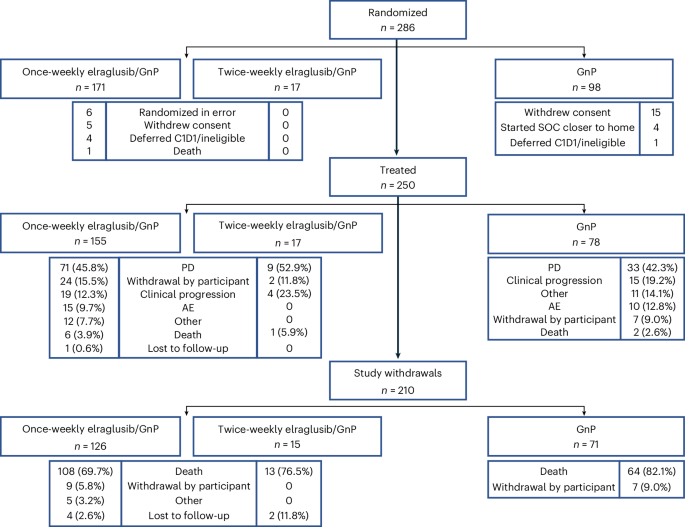
Initial limitations of this study were its open-label design and regional treatment access as several patients withdrew from the study once randomized to the control arm to pursue alternative treatment options closer to home. Patients who withdrew after randomization were asked to consent to survival follow-up, which allowed for control of selection bias relative to the primary endpoint. Despite the mITT/safety population being selected as the primary analysis set and the best suited population to represent treatment benefit, the ITT population, which includes all patients like those who withdrew after randomization and before receiving treatment, showed a statistically significant improvement in median OS and 1-year survival (Table 3). By design, the trial allowed for the inclusion of patients with poor prognostic features, which potentially led to a higher rate of early deaths across both arms, and consequently, lower median OS for GnP compared with other randomized trials.
This open-label, randomized, phase 2 study revealed improved OS with elraglusib/GnP as first-line treatment in mPDAC when compared to the standard of care (SOC) first-line treatment, GnP. A manageable safety profile of elraglusib/GnP was confirmed and mirrors safety findings from the previous studies with elraglusib27,28. We hypothesize that the survival benefit will be maintained relative to the control group; therefore, direct comparison of the median OS in the elraglusib/GnP arm with other studies or other regimens (for example, FOLFIRINOX or NALIRIFOX) is inherently difficult. Although the median OS of elraglusib/GnP is relative to the median OS of GnP in this study and may shift if the median OS of GnP differs in another study, the 2.9-month survival advantage would be preserved. Supportive analysis in patients who received at least one cycle of treatment (approximately 75% of patients in this study) demonstrated that this survival improvement margin is maintained in the elraglusib/GnP arm even as survival shifts in the GnP arm (Extended Data Table 5).
Elraglusib’s benign safety profile as monotherapy, and a unique mechanism of action with a multifaceted immunomodulatory component, position it as an ideal backbone agent for combination with other first-line chemotherapy regimens such as FOLFIRINOX and NALIRIFOX and immune modulators such as checkpoint inhibitors that have shown little activity to date in mPDAC49. A phase 2 investigator-initiated trial (NCT05077800) is exploring the combination of elraglusib with FOLFIRINOX in previously untreated mPDAC. Preliminary data on six patients treated with elraglusib/FOLFIRINOX/losartan demonstrated a PR of 20 or more months in three of six patients with extensive liver metastases and 100% DCR50. Other studies are underway to explore elraglusib in combination with immune checkpoint inhibitors, and phase 1 studies are being designed for an oral dosage form of elraglusib. The phase 1 study RiLEY (NCT06896188) will investigate the combination of retifanlimab, an anti-PD-1 monoclonal antibody, with elraglusib and FOLFIRINOX in advanced PDAC. Because of PDAC having multiple defects contributing to resistance to immune modulatory drugs40,41, combinations of elraglusib with RAS or MEK inhibitors could also be potentially explored as therapeutic strategies to overcome tumor resistance and improve clinical outcomes in mPDAC. Additionally, based on the results of this phase 2 study, a phase 3 study is being planned.



