
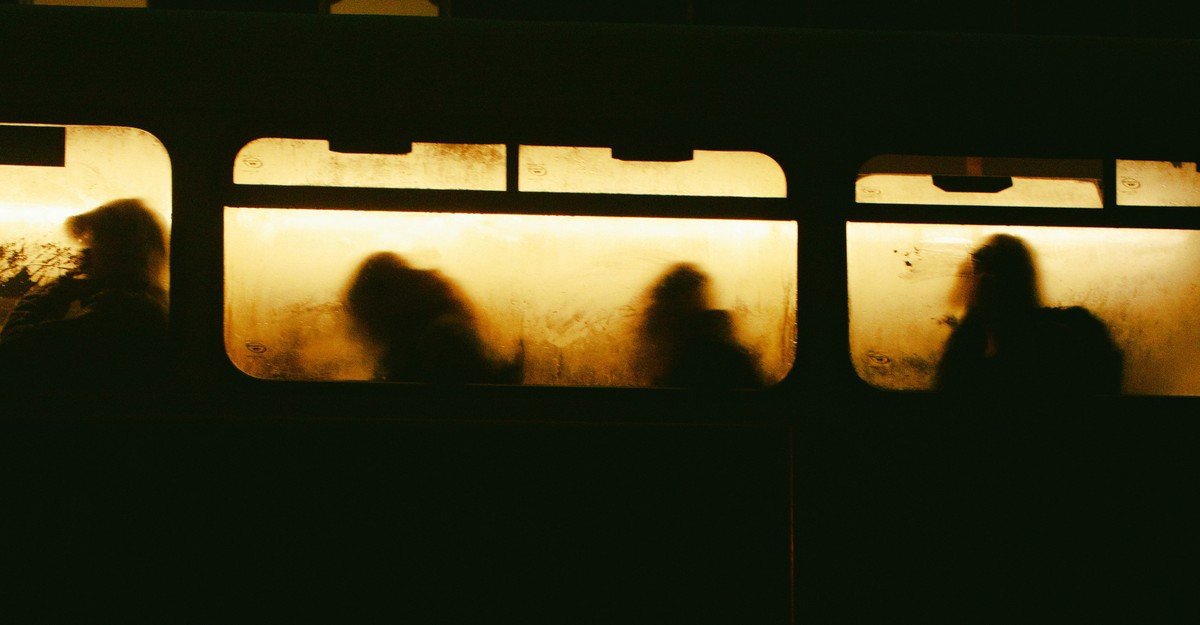
Vandals have done some senseless stuff on Bay Area Rapid Transit. They have removed the fire extinguishers from the station walls and sprayed them all over the place, for example. But what particularly vexed Alicia Trost, the chief communications officer for the train system that connects San Francisco, Oakland, and San Jose, was their destruction of map display cases at stations across the system: “You could not see the maps for years.”
Now you can. In August, BART completed the installation of new fare gates at station entrances and exits: Six-foot-tall saloon-style doors, made of plexiglass with metal frames, have replaced the waist-high barriers of the 1970s that were easy to duck or jump. The new gates have compelled more riders to pay their fare—revenue is projected to rise by $10 million a year. They have also led to an enormous drop in vandalism. Workers spent nearly 1,000 fewer hours cleaning up after unruly passengers in the six months following the gates’ installation, compared with the six months before. Crime on BART fell by 41 percent last year. Most fare beaters may be just trying to get a free ride, but most vandalism was apparently committed by fare beaters.
This is a success story with lessons for all types of public spaces. Call it “fare-gate theory”: To protect the shared rooms of communal life, human intervention isn’t always necessary, affordable, or desirable. Instead, physical and technological obstacles—an architecture of good behavior—can keep out bad actors and deter the worst impulses of everyone else.
It might seem obvious that addressing fare evasion is an important priority for mass-transit systems struggling with both revenue and a perception of disorder. But in San Francisco and other cities, the question of how riders access the subway—and how they behave on it—has been ensnared by vitriolic debates about fairness, poverty, mobility, social standards, and policing. One left-wing argument is that fare enforcement of any kind is a waste of money that instead could be spent improving commutes and helping low-income residents access the city. That’s part of the logic behind New York Mayor Zohran Mamdani’s pledge to make city buses free. Many transit officials, however, insist that fare enforcement is necessary not just to generate revenue but to maintain standards of decorum that make riders feel safe.
The contours of this debate are nearly identical in conversations about bathrooms, benches, and other public facilities. How do we negotiate the ideals of universal access against the needs of the system and the comfort of its users?
BART first tried to design its way out of the problem in 2019, with a pair of retrofit prototypes. One featured metal fins that shot out of the waist-high gate; the second introduced an additional, higher gate at shoulder height. The experiment did not go well: KQED reported that the new gates were panned as “anti-poor, anti-homeless, and ableist” design. Even a BART board member concluded the agency had piloted “a guillotine fare gate that will live forever in some infamy.” Criminal-justice-reform advocates also pushed back on fare-beating enforcement; the state legislature voted in 2023 to decriminalize fare evasion, though the bill was vetoed by Governor Gavin Newsom.
The politics of fare evasion have changed in recent years, and not only because BART settled on a fare-gate design that does not seem intended to physically harm people. The post-pandemic violent-crime wave and the concurrent public-transit-funding crisis helped legitimate the two reasons BART said a crackdown on fare-evasion was necessary in the first place. The state legislature required the agency to tackle fare beating as a condition of receiving pandemic aid. A low-income-rider discount, established last year after a series of pilots, helped take the edge off the anti-poverty accusation. BART leaders think the success of the new fare-gates will shore up support among voters in November, when a sales tax to fund public transit is on the ballot. If the vote fails, the agency says it will have to close some subway stations entirely.
BART’s fare-gate experiment seems to have delivered the system from both disorder and worry about the justice and efficacy of police intervention. A BART-funded review last year found that fare checks on the system disproportionately affected people of color and the homeless, and recovered “minimal revenue.” “We had pressure on us that interaction between police and the public, because of fare evasion, could lead to racial profiling,” Trost, BART’s communications officer, told me. “Once the fare gates were in place, we’re limiting those interactions. It’s not discretionary; there’s less enforcement.”
A similar logic has been used to defend roadway speed cameras, which target lawbreakers without requiring traffic stops that can be dangerous for both police and civilians, and without relying on human judgment that may be influenced by racial bias. In San Francisco, speed cameras have almost entirely supplanted the old traffic-enforcement fines meted out by the San Francisco Police Department. More importantly, they have a powerful deterrent effect: Speeding on streets with cameras has dropped by 72 percent.
Public toilets are also places where a little friction may be necessary to make the system function. The United States is notorious for its lack of public bathrooms, but it once had a flourishing network of pay toilets. In the 1970s, a coalition of well-meaning activists launched the Committee to End Pay Toilets in America, which eventually succeeded in all but abolishing pay toilets, in part through laws prohibiting them in cities such as Chicago and in states such as California and Florida. As a result, pay toilets are rare nowadays—but a network of free public toilets has not emerged in their absence.
In most cities, Starbucks became the de facto public option, a reputation that the company formalized with a “third place policy” in 2018 after two Black men were arrested in a Philadelphia Starbucks for trying to use the bathroom. Last year, however, the coffee chain announced that it was reversing course: A new code of conduct restricts the bathroom to paying customers. Many “third spaces” have set up similar barriers in the form of keypads or grimy keys held behind the register.
Now some bathroom advocates have proposed a return to pay toilets, a “fare gate” to maintain a good state of repair. Other types of “gates” are being tested out too: The start-up Throne Labs has placed toilets in cities including Washington, D.C., and Los Angeles that are free but require a phone number or an electronic tap card to access them. Make a mess and you get a warning; make another and you won’t get to use their bathrooms again. That’s a small barrier to entry, but one that keeps the facilities in shape: Less than 1 percent of users are repeat offenders. Jess Heinzelman, a co-founder of Throne, told me that she regularly visits one of the toilets at MacArthur Park in Los Angeles, which is also used by many residents of a nearby homeless encampment and hasn’t had more maintenance issues than any other Throne toilet. “It shows the power of giving someone something nice and making them feel they’re worthy of it,” Heinzelman said. The restroom becomes what the architect Oscar Newman once called “defensible space”—one over which everyday users take ownership.
Sometimes, however, intentional frictions become abrasive. To prevent shoplifting, many stores have sequestered high-value products in locked cases, a source of endless frustration for shoppers. The Philadelphia-based journalist Diana Lind declared 2024 the “year of shopping behind plexiglass,” arguing that the plastic barriers represented a kind of social breakdown akin to BART’s broken station maps—“the penalty we all pay when a small percentage of people inflict their misbehavior on the rest of us.” Last year, Walmarts in Anchorage, Alaska, locked up Spam. The CVS in Dupont Circle in Washington, D.C., locks up candy. At many chain drugstores, these types of changes have coincided with replacing cashiers with self-service checkout machines.
“It’s the opposite of universal design,” says Tobias Armborst, an architect and one of the authors of The Arsenal of Exclusion & Inclusion, a 2016 atlas of design and policy techniques that keep people in and out of buildings, parks, and neighborhoods. Universal design is the idea that improving things for one group makes things better for everyone. A popular example is the curb cut, which was meant for residents with disabilities but made life better for parents with strollers, bike riders, and so on. “It’s that idea turned on its head,” Armborst told me. “You’re trying to fight one specific person and making life miserable for everybody.”
One common criticism of hostile architecture is that it amounts to an attempt to chase the homeless from public life, couched in vague talk of “crime prevention through environmental design.” So much of the harsh furniture found in public spaces, born to discourage loitering, has been made less comfortable to keep away homeless people. The armrests on public benches that stop people from lying down are a notorious example of this; New York’s brand-new benches on Central Park’s Harlem Meer go a step further—they are angled to permit people to lean, but not to sit. In October, The New York Times went so far as to declare the “slow death” of the New York City bench.
Defensive designs like these can seem cynical, even cruel—especially when the targeted behavior is something as fundamentally human as sitting, sleeping, or using the bathroom. In his 1980 book, The Social Life of Small Urban Spaces, the sociologist William H. Whyte argues that this tactic might also be counterproductive, noting that antisocial people tend to prefer empty spaces—which in turn draws attention to their presence. “The best way to handle the problem of ‘undesirables’ is to make a place attractive to everyone else,” he writes. “Places designed with distrust get what they were looking for.” Get rid of a bench and someone will sleep on the ground. Get rid of a bathroom and, well …
Whyte’s advice is limited in its application. Not every park can be his beloved plaza in front of the Seagram Building; public toilets and subway stations are often empty and in any case would not benefit from being better places to hang out. Besides, the perception of disorder isn’t always produced by individuals whose conduct is far outside the norm but by the subtle shifting of the norms themselves. New York City’s Metropolitan Transportation Authority (which is also adapting its longtime turnstile design) has regretfully concluded, for instance, that fare beating is simply not considered “as ‘bad’ as it once was.” In Chicago, smoking on the train has become so common that the mayor issued an executive order to address it. Shoplifting is reportedly in fashion as well. And, to take a more innocuous example, why do so many people refuse to wear headphones these days?
Maybe better design can shift some norms back. Otherwise, if some kind of friction is necessary to keep public space functioning, then the alternative to the cut-and-dried logic of the gate, the lock, the camera, or the case, is the human—which, in most places, means the police. But rarely are police officers a cost-effective, or even policy-effective, solution to controlling subway systems and other shared spaces. “Transit agencies are up against the mathematical impossibility of solving this problem with personnel,” Jarrett Walker, a transit planner in Portland, Oregon, told me. “Most people don’t understand how expensive security labor is, and it is the nature of transit to be open to the world in so many places.”
Bryant Simon, a historian at Temple University and author of the forthcoming book For Customers Only: Public Bathrooms and the Making of American Inequality, says we are missing a class of human supervisors who have a slightly more formal role than a benevolent bystander, but are vested with little legal authority. “A doorman, an usher in a movie theater, a bathroom attendant—in other moments of American history, we had a relatively wide investment in these agents of observation,” he told me. “Everyone knew they didn’t have a ton of authority, or policing power, but it was the way in which their presence created a kind of uniform behavior.”
These “agents of observation” know the regulars and their routines, and can discern the difference between loitering and menace. A public-bathroom attendant might collect a fee from a tourist but wave through a man who sleeps in the park. A subway-station agent might choose not to stop a turnstile jumper, but the agent’s presence may discourage someone from smoking a cigarette on the platform. Los Angeles has introduced “ambassadors” in subway stations to play a similar role, updated for contemporary city life: de-escalating arguments and administering Narcan.
Every city in the world struggles to balance the provision of truly public infrastructure with the maintenance of its quality. But America is unique. It’s a country with high levels of violence, disorder, and inequality, but unlike most societies with those characteristics, its high wages make deploying an army of bathroom attendants or station agents difficult. That’s the economic logic behind a lot of this architecture of good behavior. Even if we could find someone with the right level of authority and training to be a just and compassionate arbiter of public space, we wouldn’t be able to afford them.



