
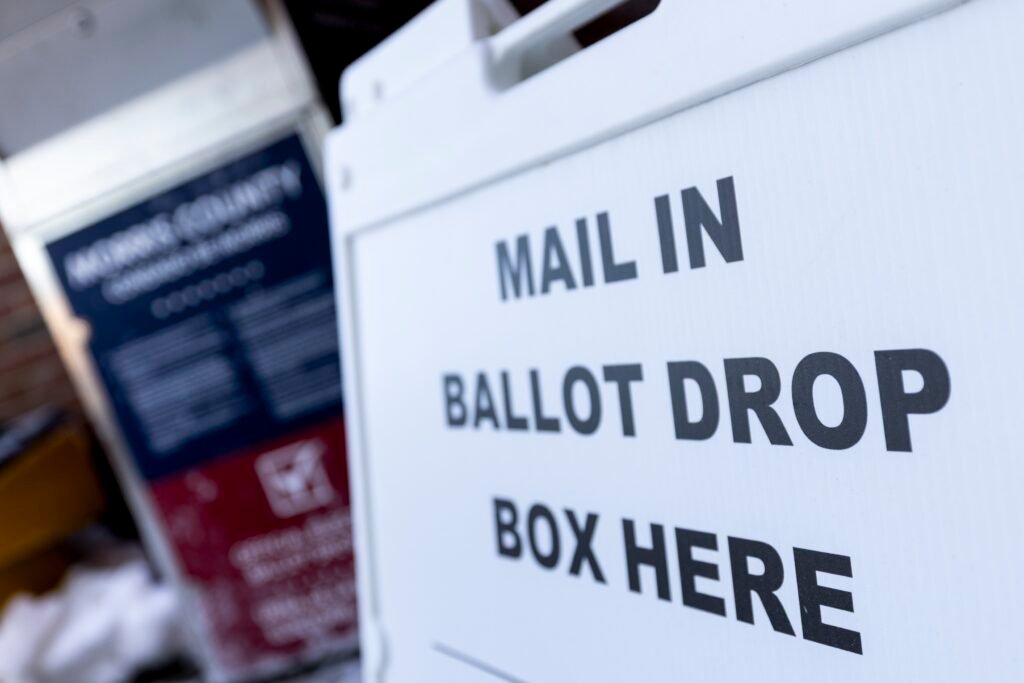
A sign directs voters to a ballot dropbox in Morristown on Thursday, Feb. 5, 2026. (Photo by Anne-Marie Caruso/New Jersey Monitor)
By Jiyue Wang
In late March, President Donald Trump signed an executive order directing the federal government to tighten the rules around mail and absentee voting. The U.S. Postal Service soon proposed a rule that would require states to notify the agency before mailing ballots and to hand over lists of their mail and absentee voters, each tied to a unique barcode on the ballot envelope. Supporters call it a matter of election integrity.
Critics warn the order would let the Postal Service refuse to deliver ballots to voters who are not on a federally approved list. On June 24, Postmaster General David Steiner confirmed that intent, telling a Senate committee that under the proposed rule the agency would not deliver ballots in states that refused to hand over their voter lists. The fight has already reached New Jersey directly. The U.S. Department of Justice sued the state in February after it declined to turn over its full voter file. New Jersey was also among the states that challenged the president’s order, and in late June a federal judge blocked key parts of it for those states, though the administration can still appeal. Whatever the courts ultimately decide, the intent is plain: Voting by mail is now a target. In New Jersey, that is not an abstract worry.
New Jersey lets any registered voter cast a ballot by mail, without offering an excuse, and a growing share of residents now do. Data from the U.S. Election Assistance Commission show how far the practice has spread here. In the 2018 midterm elections, about 1 in 8 ballots cast in the state, close to 12%, came by mail. By the 2022 midterms, that share had nearly doubled, to better than 1 in 5. In 2020, when New Jersey ran its general election almost entirely by mail, it reached 94%. This November, New Jerseyans will choose a United States senator and all 12 of their members of the House of Representatives. If the new federal restrictions take effect, that election could be among the first conducted under them.
A rule that makes mail voting harder does not land on everyone equally. Casting a ballot in person on a fixed weekday carries costs that are easy to miss if you do not face them and decisive if you do. Consider the hourly worker who cannot step away from a shift, the parent with no childcare, the person without a car or paid time off, the adult caring for a sick relative. For them, a ballot that arrives in the mailbox can be the difference between voting and sitting the election out. Those barriers fall most heavily on lower-income residents, who already vote at much lower rates than wealthier ones, and they weigh especially heavily in midterm elections, which draw fewer voters to begin with than presidential years. Take mail voting away, and you place those costs back on the shoulders least able to carry them.
The predictable result is not a small, even dip in turnout. It is a wider gap between who votes and who does not, sorted by income. That is the opposite of what the rules of an election should do, and it is a reason for New Jersey to pay attention now rather than later.
New Jersey does not have to wait for the courts to act, and on the most important point it does not have to build anything new. The state already runs the kind of system this federal rule would undercut. It offers no-excuse mail voting, prepaid return postage, secure drop boxes, and online tracking that lets a voter confirm a ballot was received and accepted. It already prints election materials in the languages New Jerseyans speak, and it is already in court as one of the states challenging the president’s order. The task now is to protect that system rather than retreat from it, and to refuse any step, taken in the name of compliance or anything else, that would keep ballots from reaching eligible voters.
Where the state can still do more is narrower than it might seem, because New Jersey already does more than mail a notice. When a ballot is rejected over a signature issue, the law requires the county to reach the voter by mail or email and to try a phone call when a number is on file, and it gives voters until 11 days after a general election to fix the problem. The thinner spots are practical ones. Voters who left no phone or email, and who may have since moved, are still hard to reach. Cure letters and forms do the most good when they come in the languages voters actually read. And counties vary in how fully they carry this out. Tightening those would save more valid ballots than any new program. Beyond that, the most consequential step is the one already underway in court: resisting the federal demands for voter data behind both the Postal Service’s rule and the Justice Department’s lawsuit.
The link between losing income and losing a voice at the ballot box is not a law of nature. It follows from choices about how easy or how hard we make it to vote. Mail voting is one of the levers that narrows that gap. A federal rule that restricts it pulls the other way. New Jersey still gets to decide which direction it takes.
Jiyue Wang holds a master’s degree in sport management from the University of Florida and a master’s degree in economics from the University of Wisconsin-Milwaukee. He is an incoming PhD student in political science at Rutgers, The State University of New Jersey, New Brunswick.



