
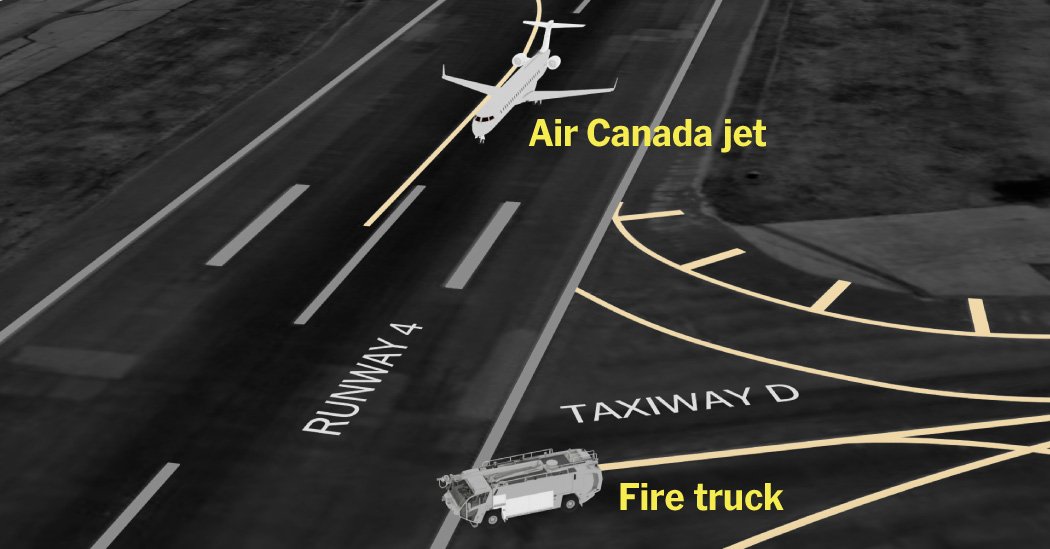
The rapidly approaching plane that collided with a fire truck at New York’s LaGuardia Airport last month was most likely hard for the firefighters to see, a New York Times analysis has found.
They were navigating in the rain on a taxiway that was angled away from the oncoming plane. Because the plane had just touched down, the pilots and the firefighters were left with very little time to react.
The collision killed both pilots and was the first deadly crash at the airport in over three decades. The two firefighters, who were rushing to another emergency, survived with injuries.
The Times built a 3-D model, interviewed aviation experts and analyzed flight data, video footage of the crash and air traffic control audio — all to answer a critical question: What could the firefighters see?
The truck’s dispatch
The two firefighters were driving on Taxiway D in the lead vehicle of a convoy that had been dispatched to assist with an emergency on the other side of the airport from the fire station.
Their fire truck, a type that can weigh upward of 60,000 pounds when fully loaded, is designed with the driver’s seat in the center, in part to offer better visibility. The other firefighter typically sits to the right of the driver.
The air traffic control tower had cleared an Air Canada Express jet to land on Runway 4. About two minutes later, the tower cleared the truck to cross the same runway using Taxiway D. Eleven seconds later, the tower called back with an urgent warning to stop, but the truck kept moving. It is unclear if the firefighters in the truck heard the warnings.
Each firefighter had a disadvantage
Even in an optimal scenario in which the driver was looking directly toward the oncoming plane in the moments before collision, it’s likely that his view of the approaching plane would have been obstructed by the second firefighter.
If the driver had leaned forward slightly with his head turned about 90 degrees to the right before looking straight again, the plane would have most likely been obstructed:
The second firefighter would have had a better view, but for him, the plane would most likely not have stood out as a moving object until it grew closer to the truck. Even as the plane was approaching, it would have stayed in roughly the same position in his field of view — making the plane more difficult to track than if it had been moving across his line of sight.
This is a familiar phenomenon documented in aviation and maritime navigation, in which an object approaching on a collision course can appear to be stationary until the last moment, when it seems to suddenly grow in size.
Here is what the view for the second firefighter could have been if he had been leaning forward slightly with his head turned about 90 degrees to the right and looking toward the plane:
Crash footage shows that there was one vehicle in the convoy initially traveling alongside the fire truck, and it may also have blocked the firefighters’ view of the runway before it came to a stop about seven seconds before the crash.
Based on the available evidence, there is no way to know with certainty where the firefighters were looking in the seconds before the crash. The runway where the crash occurred is bidirectional, meaning planes can approach one at a time for landing in both directions. As a result, the firefighters would not necessarily have been able to assume the direction of oncoming planes.
The two firefighters, Sgt. Michael Orsillo and Officer Adrian Baez, who were hospitalized along with about 40 others, did not respond to requests for comment. The Port Authority of New York and New Jersey, which runs LaGuardia Airport and its fire rescue unit, declined to comment.
The taxiway was angled away from the oncoming plane
The lead fire truck had been driving along a taxiway that was angled away from the direction of the oncoming plane. This means that the plane was approaching off the right rear section of the truck — where it would have been difficult for the firefighters to see — instead of its direct right-hand side.
As a result of the angle, the driver would have had a difficult time spotting the plane, regardless of where he was looking. If he had turned to the right, toward the plane, his view might have also been obstructed by the firefighter beside him:
The plane would have appeared in the right corner of the second firefighter’s field of view, but only if he had leaned forward slightly, turned his head to the right and looked in the plane’s direction. Here is what he might have seen right before the truck entered the runway about two seconds before collision:
The analysis of the crash footage also shows that the truck turned slightly toward the left as it entered the runway. It is unclear whether it turned because the firefighters saw the plane, but the change in direction angled the firefighters farther away from the approaching plane, making it even harder to see.
Airports use these slanted taxiways because they allow planes to exit the runway more quickly, instead of having to make a sharp 90-degree turn at a slower speed.
That said, the Federal Aviation Administration urges airports to use intersections configured at 90-degree angles because they give pilots and drivers the best visual perspectives to see other aircraft and vehicles, said Michael O’Donnell, a retired F.A.A. official and a former airport firefighter.
The truck did not slow down or stop before entering the runway
The Times analysis of the crash footage indicates that the truck did not stop or slow down before entering the runway and that it was traveling at a relatively steady speed of about 30 miles per hour from the moment the air traffic controller first gave the warning to stop until the collision.
Slowing down or stopping entirely may have given the firefighters more time to look and assess any oncoming traffic on the runway.
Seconds after the controller first warned the truck to stop, about seven seconds before the crash, the convoy of vehicles that was following the lead truck slowed down and stopped while the lead truck continued.
Once the tower clears an emergency response vehicle to cross a runway, the vehicle’s drivers are not expected to obey the stop marks on the pavement, Mr. O’Donnell said. But they are expected to look for aircraft before crossing and proceed with caution, he said.
Other distractions
It’s also likely that there were other visual distractions. The airport runway and taxiways are lined with lights. The night of the crash was rainy and misty, and the rain-slicked surface of the runway could have given it the appearance of a glaring light show.
“At night, it’s basically like driving through a lit-up Christmas tree,” said Bobby Egbert, a spokesman for the Port Authority Police Benevolent Association, the officer’s union. “You have so many lights and the crew has to know exactly what those lights mean.”
What the firefighters could have seen or not seen “with that equipment, at that time of night, with that illumination,” is one of the many components of the National Transportation Safety Board’s investigation, said Peter Knudson, a spokesman for the board, who said the preliminary report would be released later this month. He declined to answer questions about the crash, citing the ongoing investigation.
According to safety board officials, the airport’s runway status lights, set in the pavement at taxiways and runway crossings to warn of planes on or approaching the runway, were functional that night. Video analysis of the crash shows that the truck may have entered the runway around the same time as the lights went from red to dark, which they are designed to do a couple seconds before a plane passes.
What the jet’s pilots may have seen
For the pilots, Captain Antoine Forest and First Officer Mackenzie Gunther, the truck was most likely in their field of vision from the cockpit, if they were looking down the runway:
About the same time that the fire truck entered the runway, the Air Canada jet dropped its speed sharply below what is typical after touchdown, according to a Times analysis that compared the jet’s flight data with hundreds of other landings on Runway 4 by the same aircraft model. The plane reduced its speed to about 100 miles per hour from about 140 miles per hour in about three seconds.
The firefighters’ limited visibility is only one factor among many that the authorities are investigating as possibly contributing to the crash. They are also looking into any potential problems with air traffic controller staffing, radio miscommunications and vehicle tracking technology.
How we analyzed the crash footage
The Times estimated the position and speed of the lead fire truck by analyzing video of the crash, flight path data from Flightradar24, satellite imagery and the manufacturer’s dimensions of the vehicle.
First, we geolocated the camera in the crash video by matching landmarks in the footage (buildings, runway markings and lights) to their real-world positions in satellite imagery. From that fixed vantage point, we measured the span of the truck in each video frame. Those measurements — combined with the truck’s physical dimensions, its path along the taxiway and its position relative to the runway lights — allowed us to estimate its position frame by frame. From those positions and the video’s timestamps, we then calculated the truck’s speed. Our estimates of the truck’s position are within three feet, and its speed is within five miles per hour.
We placed the positional data of the truck into a georeferenced 3-D model of the airport, where we programmatically animated the vehicles along their paths. We tested our analysis by overlaying the video frames on the 3-D model rendered from the camera’s position, as seen in the video below.
The Times also obtained flight data showing landings at LaGuardia Airport from several hundred aircraft — the same model as the Air Canada Express jet. The data helped us understand how the plane’s speed on the runway compared with that of other planes slowing down after a typical touchdown.



