
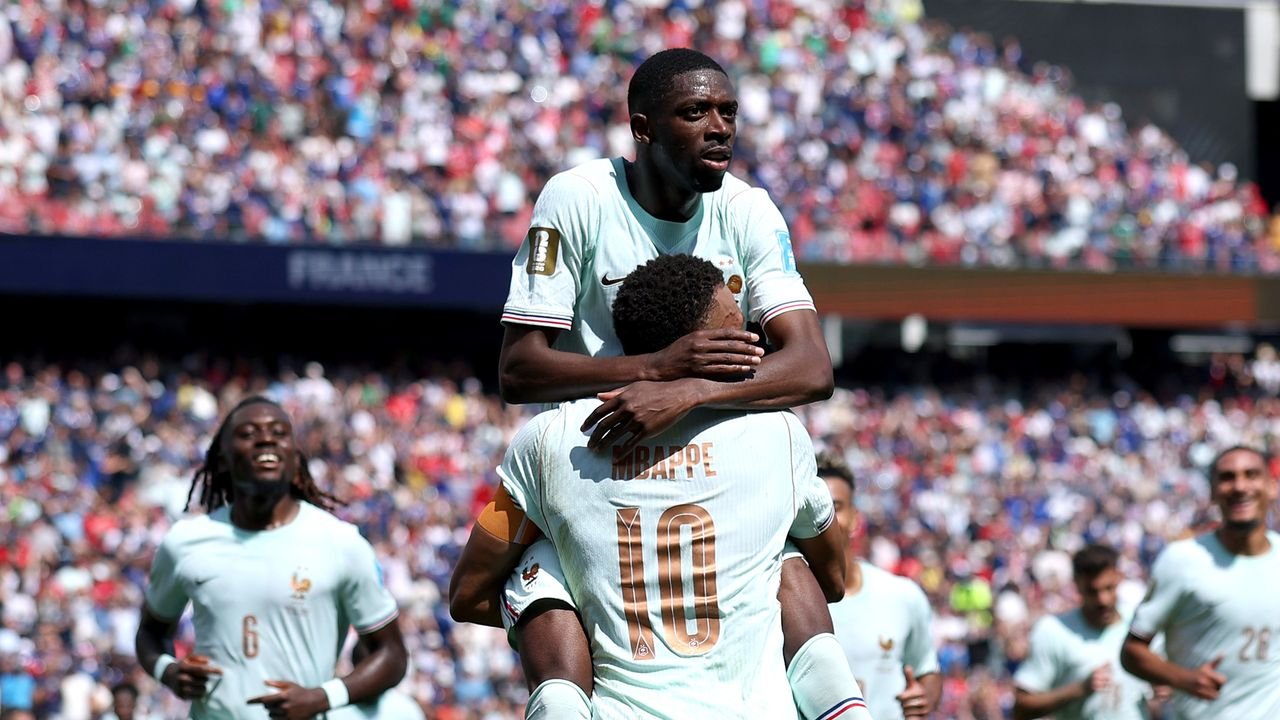
Shortly before the start of the France versus Norway group-stage World Cup match at Boston Stadium, word began to circulate that Erling Haaland, the hulking, long-locked Norwegian striker—a man who codes less as “professional soccer player” than as “bringer of vengeance and destruction”—would be sitting on the bench, along with nine other regular starters. Given the stakes of the match (the winner would take the top spot in Group I, insuring an easier path to the final), the moves made by Norway’s manager, Ståle Solbakken, came as a surprise. They also came as a disappointment to most of the sixty thousand people in the stands, who’d paid ransom sums for tickets to see Haaland clash with France’s Kylian Mbappé, in the early rounds’ most prominent matchup on paper.
But Solbakken defended the decision not to play his best as a “no-brainer.” The team was on a tight turnaround after a tough win over Senegal in hot, humid weather. Norway has a population roughly the size of South Carolina’s; the team needs its few stars to be in peak condition if it hopes to go far. He’d also apparently determined that the path awaiting the winner of Group I was hardly less treacherous than the runner-up’s. Solbakken wasn’t the first manager to look past his team’s third match with an eye on the knockout rounds. (The previous night, after the U.S. men’s team had already won its group, the U.S.M.N.T.’s manager, Mauricio Pochettino, changed out nine players for a match against Türkiye, which the U.S. lost.) “We have to be smart rather than greedy,” Solbakken said before the game.
And so, without Haaland in front to bash the ball into the goal, or Martin Ødegaard, fresh from captaining his club team, Arsenal, to a Premier League title, taking on France would have to be a full-team effort. During warmups, while the French players lazily passed the ball between one another or popped it off the ground to gently juggle with their feet, the Norwegians, their red shirts bright against the grass, formed a tight circle and did vigorous plyometrics. In the stands, Norwegian fans in Viking caps pulled in synchrony as if rowing on an invisible longship.
Twenty seconds into the match, though—around the time that Mbappé, sprung loose on the right side by a nifty pass, hammered the ball into the inside of the crossbar, as near a miss as a miss can be—I had a hard time believing that any squad at full strength would have been able to stand up to a French team in full flight. Norway promised to be stiffer competition than France had faced so far, but they weren’t—well, they weren’t France: champions in 2018, runners-up in 2022, one of the deepest and most astonishing collections of offensive talent the world has yet seen. This was Norway’s first World Cup since 1998. “They’re probably going to win against us,” Haaland told Fox after the Senegal game, when asked about the prospect of playing France. “They’re probably going to win the whole tournament.” That might have been tongue-in-cheek. For at least the first half on Friday afternoon, though, it looked true.
About four minutes into the match, Manu Koné—curiously alone at the top of Norway’s box—trapped a clearance attempt and rifled a shot on goal, which Norway’s keeper, Egil Selvik, diving, punched away. Then, all of seven minutes into the game, Mbappé sent a pass to Ousmane Dembélé, who dribbled, feinted, put the ball on his right foot, and scored. That was just the start for Dembélé. A few minutes later, Mbappé stoically held the ball under pressure and then found Dembélé on a fast break, who fired another hard shot—this time with his left foot—into the goal’s corner.
Rowing together? Never mind. Norway, up to that point, was, for better and worse, Selvik’s one-man show. But I was still admiring the replay of Dembélé’s second goal on the jumbotron when a burst of cheers from the undaunted Norwegian fans shook me out of my admiration: Norway had just scored. Perhaps France had been too busy watching the replay, too, to notice Norway furiously flying up the field on the break. Hardly ten more minutes had passed before Dembélé scored again—this time, cutting inside and stuttering his dribble and then, having befuddled the defense, rolling the ball right past it into an open corner of the goal. It was one of the quickest hat tricks you’ll ever see.



