
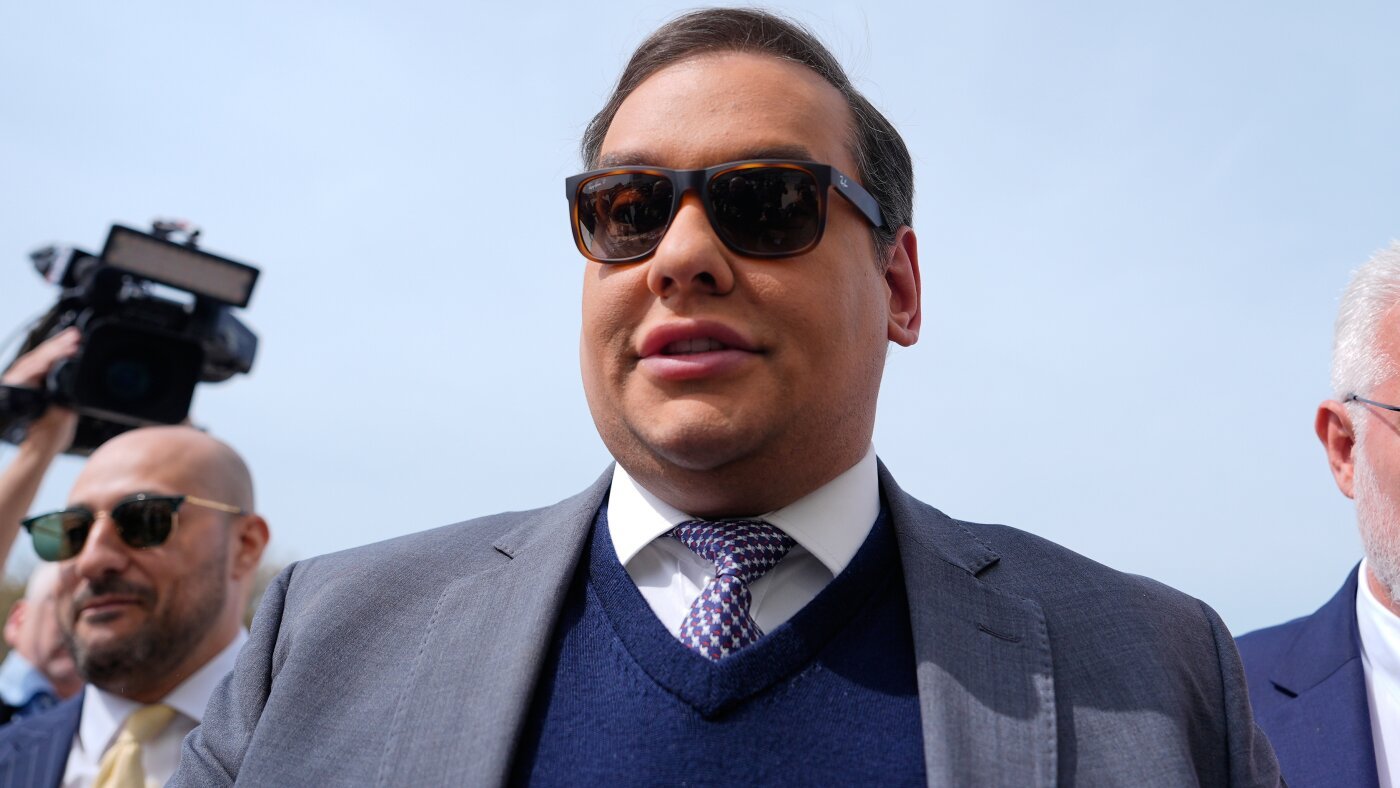
Former U.S. Rep. George Santos is being investigated for trades on the prediction market Kalshi where he appears to have profited by deceiving the public about attending Trump’s State of the Union address in February.
Julia Demaree Nikhinson/AP/AP
hide caption
toggle caption
Julia Demaree Nikhinson/AP/AP
I was winding down my work day here in Los Angeles when my phone rang at 5:37 p.m. from a blocked number. It was former Congressman George Santos. He was boiling with rage.
The day before, I published a story revealing that the Justice Department and the Commodity Futures Trading Commission had opened investigations into his trading activity on the prediction market site Kalshi.
Officials at the company detected that he was betting against his appearance at Trump’s State of the Union address in February, just as he posted a video on X gushing to his followers about how excited he was to attend. With the help of three sources, I was able to confirm that Kalshi referred the matter to federal authorities in the Southern District of New York and Washington.
Before the story, I emailed him, and he called me from a blocked number. So when my phone buzzed again from a blocked number, I had a pretty good sense of who it might be.
Santos, whose political rise and fall was characterized by a notorious trail of lies and falsehoods, claimed my story was riddled with errors. He said “my lawyers have been calling the Department of Justice all day, and they can’t find any investigation.”
As we were talking, I asked if I could record the call. He said no. I was in front of a keyboard, though, furiously jotting down every word.
I asked him who his lawyers are, and he refused to answer. I questioned whether he really does have attorneys. He replied: “I’m George f*cking Santos, of course I have a legal team.”

He then proceeded to name-call and attack the reputation of NPR, the kind of invective that’s common when reporting on people who try to discredit reporters and news organizations for stories they don’t like.
What Santos said next took me aback, even by his outlandish and brazen standards.
“This story is going to get you a gun in your face,” Santos said.
I asked him what he meant by that.
“You know what I mean.”
It did not exactly feel like an imminent threat to my life that a convicted fraudster expelled from Congress who lives thousands of miles away from me in Pennsylvania’s Pocono Mountains was lodging violent words at me.
It felt more bizarre than threatening, but then it grew even stranger and more confusing.
While he had been calling me from a blocked number, I tracked down his cell phone from a public records search, and I sent him a text message confirming it was him. He greeted it by launching into full-throated denial. “I NEVER SAID ‘this story would get a gun in your face, I said ‘it’d blow up in your face,” he wrote in a text.
He then called me “an insane person,” “a clown,” among other broadsides.
Santos was front-running his denial of his violent threat before I ever publicly confronted him for doing it.
Not long after, he took to his favorite megaphone, X, to tell the world this never happened, claiming I “was now making things up,” even though I had yet to publicly reveal what he had said.
“I’ve interacted with hundreds of reporters in my life… not once was I ever threatening or aggressive… sassy? Sure but aggressive and threatening? NEVER!” he wrote.
In the post, he added: “He’s now demanding I disclose the names of my lawyers ‘or else’ (only God knows what that means.)”

Which is a fiction. I did ask him who his lawyers are, but the “or else” is Santos fantasy, perhaps his way of turning me into the menacing actor in all of this.
Threats against journalists are unnervingly common. Most are flung by online trolls or aggressive attorneys and PR handlers trying to protect their clients.
At times, it can be hard to know when it’s frivolous or hyperbole, or when you should take it seriously.
I grappled with whether I should call this out at all. After all, drama and attention are oxygen to someone like Santos, who has become something of an internet troll since President Trump commuted his prison sentence, giving him his freedom back and his access to X.
But given his mischaracterizations of how it at all went down, and his quick handiwork trying to cover his tracks, I thought it was worth setting the record straight.
Since I published the story on the federal investigations into Santos, the Associated Press reported that Polymarket has cut ties with Santos, who had been paid by the company, a rival to Kalshi, to boost social media posts featuring some of its prediction markets.
He also appears to be hoping to drum up some new business on Cameo, the site where celebrities are paid to record personalized videos.
Santos is now offering 55% off his Cameo videos, meaning for $150, he will record himself saying just about anything. Although there’s no guarantee he won’t later deny it on X.



