
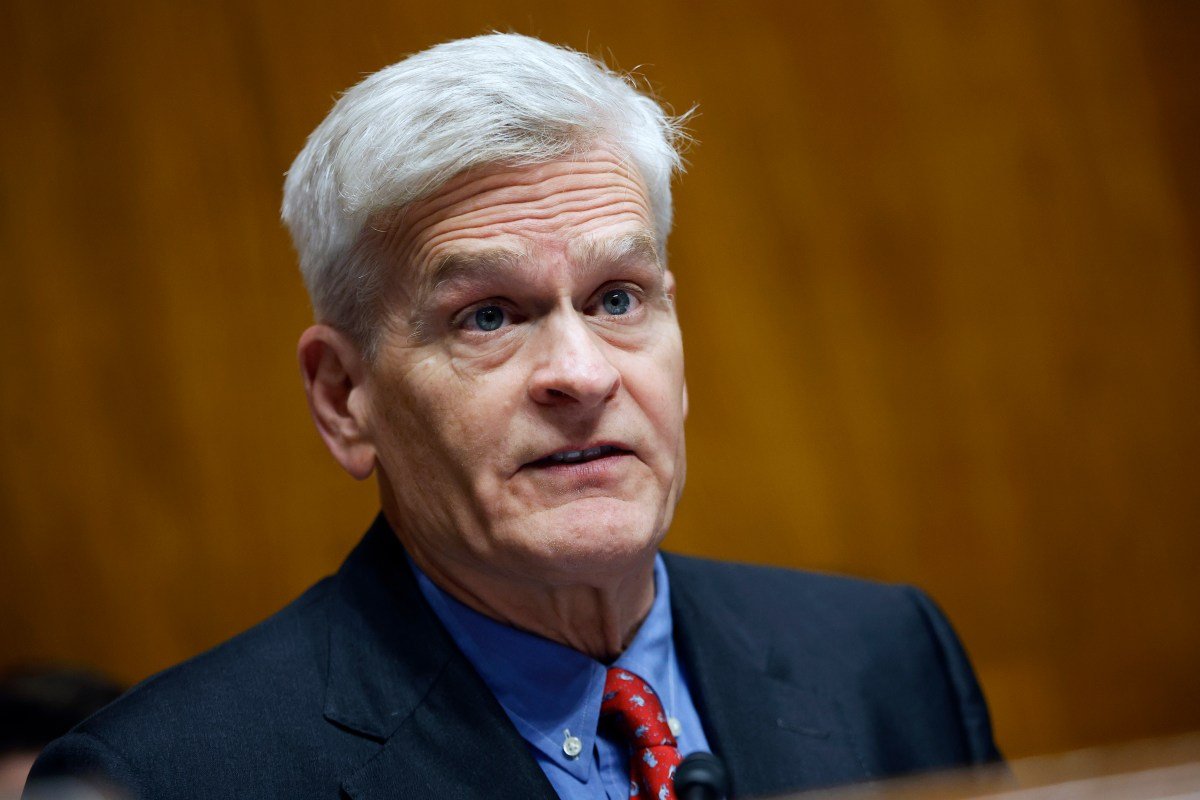
Senator Bill Cassidy is trailing in polls and prediction odds in the Louisiana Republican Senate primary against his Trump-backed challenger Representative Julia Letlow and state Treasurer John Fleming.
Cassidy, one of the seven Republican senators who voted to impeach Trump following the January 6, 2021, U.S. Capitol riot, is facing two conservative rivals in the May 16 primary. The primary tests whether Trump’s once iron grip on GOP primary voters has softened amid his waning nationwide approval rating and if Republicans are willing to support a Trump critic in a solidly conservative state.
Trump backed Letlow, who represents the state’s 5th congressional district, over Cassidy. Polling suggests Fleming is also a potentially viable candidate with notable conservative support. Cassidy, a doctor, has been critical of Health and Human Services Secretary Robert F. Kennedy Jr. over vaccinations but has also sought to downplay differences between himself and Trump on the campaign trail in a bid to hold support among conservatives who still support the president.
Newsweek reached out to the Cassidy, Fleming and Letlow campaigns for comment via email.
Bill Cassidy vs. Julia Letlow and John Fleming: What Polls Show
Louisiana Republicans are set to cast their votes in the contentious primary on Saturday, May 16, as the campaign enters its final stretch where each candidate will work to motivate their supporters to head to the polls. If no candidate receives an outright majority during the primary, the two candidates with the most support will head to a June 27 runoff.
The latest poll of the race, conducted by national polling firm Quantus Insights, gave Letlow a lead in the primary with 42 percent support. Fleming followed with 30 percent, while only 20 percent said they would vote for Cassidy.
Cassidy would face difficult headwinds in a runoff against either candidate, according to the poll. Letlow would have a nearly 40-point lead, winning 63 percent to Cassidy’s 23 percent, while Fleming would hold a 30-point lead (55 percent to 25 percent), the poll found.
Letlow would also lead Fleming in a runoff, according to the poll, which gave her 45 percent and Fleming a 40 percent in that scenario.
It polled 1,015 likely voters from May 6-7 and had a margin of error of plus or minus 3 percentage points.
“With the primary now close at hand, the burden has shifted. Letlow no longer needs to prove she is viable. The data say she is leading. Fleming must show that his earlier coalition can be reassembled quickly or during the runoff against Letlow,” the polling memo reads.
Meanwhile, Cassidy’s support “has failed to expand beyond a static minority share,” the memo adds.
A Fabrizio, Lee & Associates survey found Letlow holding 32 percent, Cassidy holding 26 percent and Fleming holding 21 percent in the GOP primary. It polled 600 likely voters from May 4-5 and had a margin of error of plus or minus 4 percentage points. It was sponsored by the Accountability Project, which supports Letlow.
A recent poll from Emerson College, sponsored by KLFY and Nexstar Media, showed Fleming holding 28 percent, Letlow holding 27 percent and Cassidy holding 21 percent in the primary. It surveyed 500 likely voters from April 24-26 and had a margin of error of plus or minus 4.3 percentage points.
“Fleming’s strength is among male voters, who support him over Letlow 36% to 27%; 20% of men support Cassidy. Women are more split: 27% support Letlow, 23% Cassidy, and 21% Fleming,” Spencer Kimball, executive director of Emerson College Polling, said in the polling release.
What Do Prediction Markets Show?
Letlow is favored in prediction markets to eventually win the Republican nomination. Kalshi gives her a 67 percent chance of winning, compared to Fleming’s 32 percent chance and Cassidy’s 4 percent chance.
Polymarket gives Letlow a 66 percent chance, Fleming a 29 percent chance and Cassidy a 4 percent chance of victory in the primary.
Prediction markets allow participants to buy and sell contracts tied to political outcomes and current events, aggregating real‑money wagers into probability estimates. Prices fluctuate as traders react to polling, fundraising, candidate developments and broader political trends. They measure trader sentiment at a given moment and do not always add up to 100.
How a New Election System Is Sinking Bill Cassidy in Louisiana
The vote to convict Trump is “the big issue” for Cassidy in the primary, Robert Hogan, department chair of political science at Louisiana State University, told Newsweek.
But the shift to a semi-closed primary from a “jungle primary” system has also weakened the incumbent, he said.
Cassidy, who is viewed as more of a moderate, has built a political coalition based around Republicans, independents and some Democrats. That worked in the state’s previous primary system where all candidates appeared on a single ballot regardless of their political party. But in a race with only Republicans and independents, Cassidy faces tougher odds due to a lack of support from MAGA, Hogan said.
“One of the reasons they adopted it, a lot of the Republicans had in mind was what can we do to keep people like Bill Cassidy from being our representative,” he said. “This is the mechanism that they chose, and indeed his trailing in the polls is in large measure due to that.”
The senator’s path to reelection is based around whether independents will have greater turnout and gravitate toward Cassidy, Hogan explained.
Louisiana is unlikely to become competitive in the general election. It’s a solidly Republican state, having backed Trump by more than 20 points in 2024.
Bill Cassidy and Donald Trump Feud Explained
Cassidy emerged as a Trump foe within the GOP following his vote to convict Trump over the January 6 riot, when a group of the president’s supporters violently protested the 2020 election results during Congress’ certification of former President Joe Biden’s victory.
“Our Constitution and our country is more important than any one person. I voted to convict President Trump because he is guilty,” Cassidy wrote in a statement at the time.
The decision to convict was Cassidy’s way of saying what Trump did was “distasteful,” and he likely believed Trump would “be in the rearview mirror,” Hogan said.
“But he miscalculated in that way,” he added, noting that Republicans have not been able to “dislodge that from their brains.”
Cassidy faced swift backlash from Louisiana conservatives over the vote. He was never seen as a particularly staunch Trump ally in the Senate but generally votes along party lines, having been supportive of Trump in the past.
Trump announced in January he would be supporting Letlow over Cassidy.
“Should she decide to enter this Race, Julia Letlow has my Complete and Total Endorsement,” he wrote on Truth Social.

The president attacked Cassidy on Truth Social on April 30, describing him as a “very disloyal person” because he played a role in stalling his nomination of Dr. Casey Means to become the surgeon general.
“Hopefully all of the Great Republican People of Louisiana, which I won, BIG, three times, will be voting Bill Cassidy OUT OF OFFICE in the upcoming Republican Primary!” he wrote.
Cassidy, for his part, has sought to downplay any tensions with the president, telling NOTUS that attempts to say he is not loyal to Trump are “ridiculous,” highlighting his support for other Cabinet secretaries. He has also attacked Letlow over her previous support for Diversity, Equity and Inclusion (DEI) programs during her education career.



