
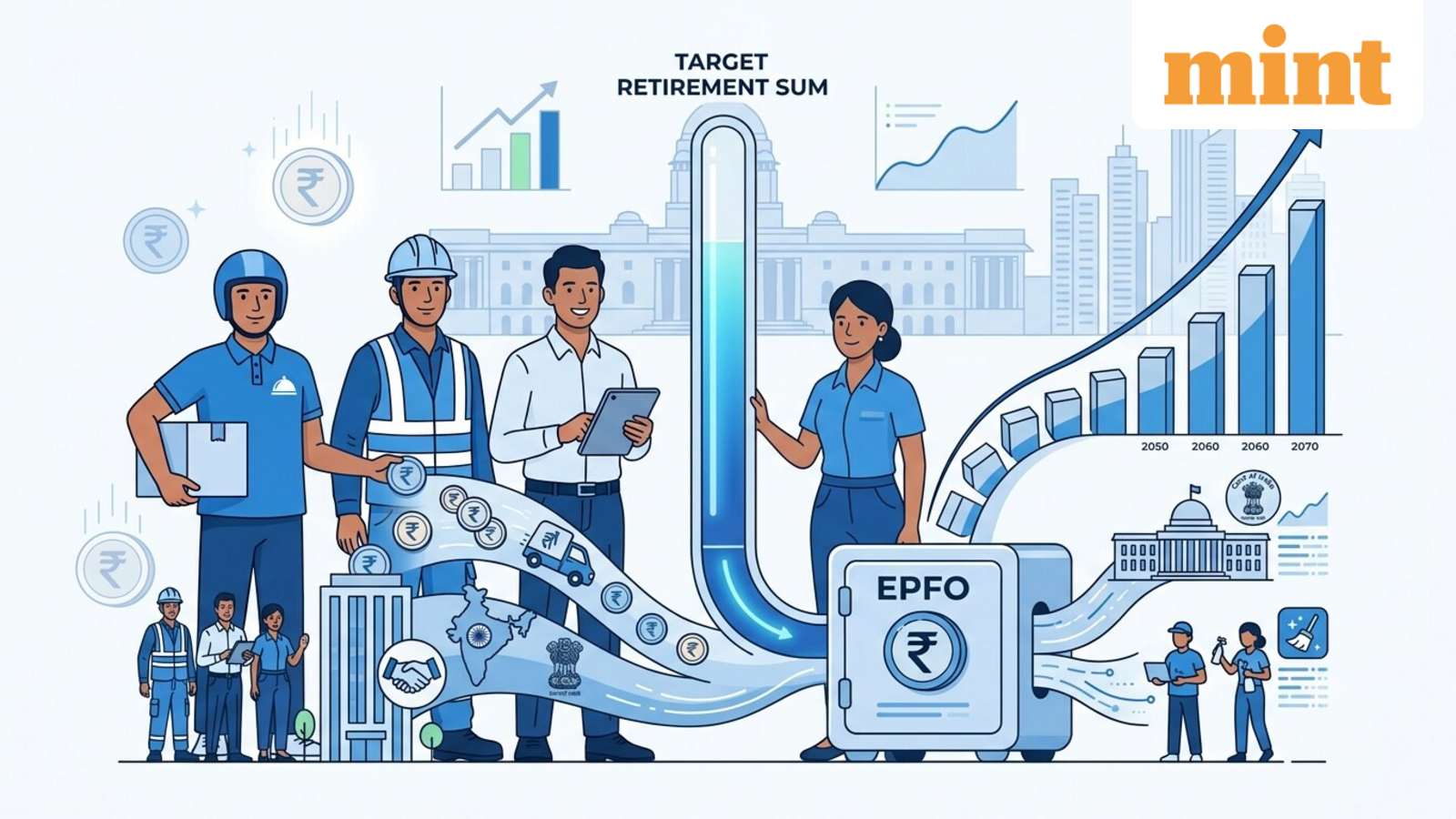
The government is working on a new contributory pension scheme that could significantly expand retirement coverage beyond the existing Employees’ Pension Scheme (EPS), according to a report by The Indian Express.
The proposed scheme, which is part of the government’s EPFO 3.0 reform agenda, aims to cover workers in both the organised and unorganised sectors, including gig and platform workers as well as higher-wage employees who are currently outside the EPS framework.
Unlike the existing pension system, the proposed model is expected to follow a defined contribution approach, where retirement savings accumulate in an individual account over time and are invested in long-term government-backed securities.
Interest would be credited annually, and at the age of 60, the accumulated corpus could be converted into a pension based on prevailing annuity and interest rates.
Proposal to introduce a target retirement sum approach
A key feature of the proposed scheme is the concept of a Target Retirement Sum (TRS). According to The Indian Express, every member would have an individual pension account, with the system calculating the retirement corpus required to achieve the pension goal selected by the member.
As quoted by the publication, an official said, “The system will compute the proposed Target Retirement Sum (TRS) dynamically based on the member’s chosen pension goal and expected retirement age. Members will have personalised dashboards showing total contributions, real-time corpus status, and progress towards the TRS for applicable schemes.”
The system would also estimate the contribution amount and frequency needed to reach the target and allow members to revise their retirement goals whenever required.
Contributions may come from multiple sources
According to the report, contributions under the new pension scheme may not be limited to employees and employers alone.
The proposal allows contributions from government co-contributions for lower-income workers, aggregators for gig and platform workers, and even third parties such as CSR funds, NGOs and donor organisations.
The report also states that the EPFO is planning a “one-to-many” mapping system under which a single Universal Account Number (UAN) can be linked with multiple employers or digital platforms.
This would allow gig workers with multiple income sources to track all provident fund and pension contributions through a single account.
More flexibility than existing pension systems
One of the major differences between the proposed scheme and the National Pension System (NPS) is the flexibility it may offer after retirement.
According to The Indian Express, EPFO is considering allowing members, from the age of 55, to decide how they want to use their accumulated retirement corpus.
Explaining the proposal, an official told the publication, “Till that time, it will operate like PF, you keep on accumulating. At that stage when you are retiring, it converts into an annuity or a systematic withdrawal plan.”
The official further said the NPS is “purely annuity based, while the proposed pension scheme will be more flexible, risk-free and based on real and not notional returns,” as per the report.
Members may be able to choose their monthly pension payout after retirement. If the payout is limited to the interest earned on the corpus, the principal would remain intact.
Opting for a higher payout would involve drawing down part of the principal, with the flexibility to adjust withdrawals over time. The system is also expected to offer retirement simulations based on age, corpus size, contribution frequency, retirement age, and inflation assumptions.
Family benefits and wider social security coverage
The proposal also includes family and survivor pension benefits for spouses, children and orphans through a pooled “Family Benefit Fund” managed on actuarial principles, the report said.
“Members of EPF, GPF, and other provident funds could also be allowed to transfer balances into the new pension initiative to enhance retirement savings,” the publication mentioned, citing an official.
According to The Indian Express, an official told them EPFO is studying retirement models from countries such as Singapore while designing the framework. The reforms are also intended to support the implementation of the Code on Social Security, which seeks to extend social security benefits to gig and platform workers for the first time.
The report added that the Ministry of Labour and Employment is yet to finalise the nodal agency for implementing the proposed social security scheme. The proposal remains under consideration, and the government has not yet announced a timeline for its rollout.
Disclaimer: This is for informational purposes only. Please visit the official website for the latest laws and regulations, or consult a qualified expert.



