
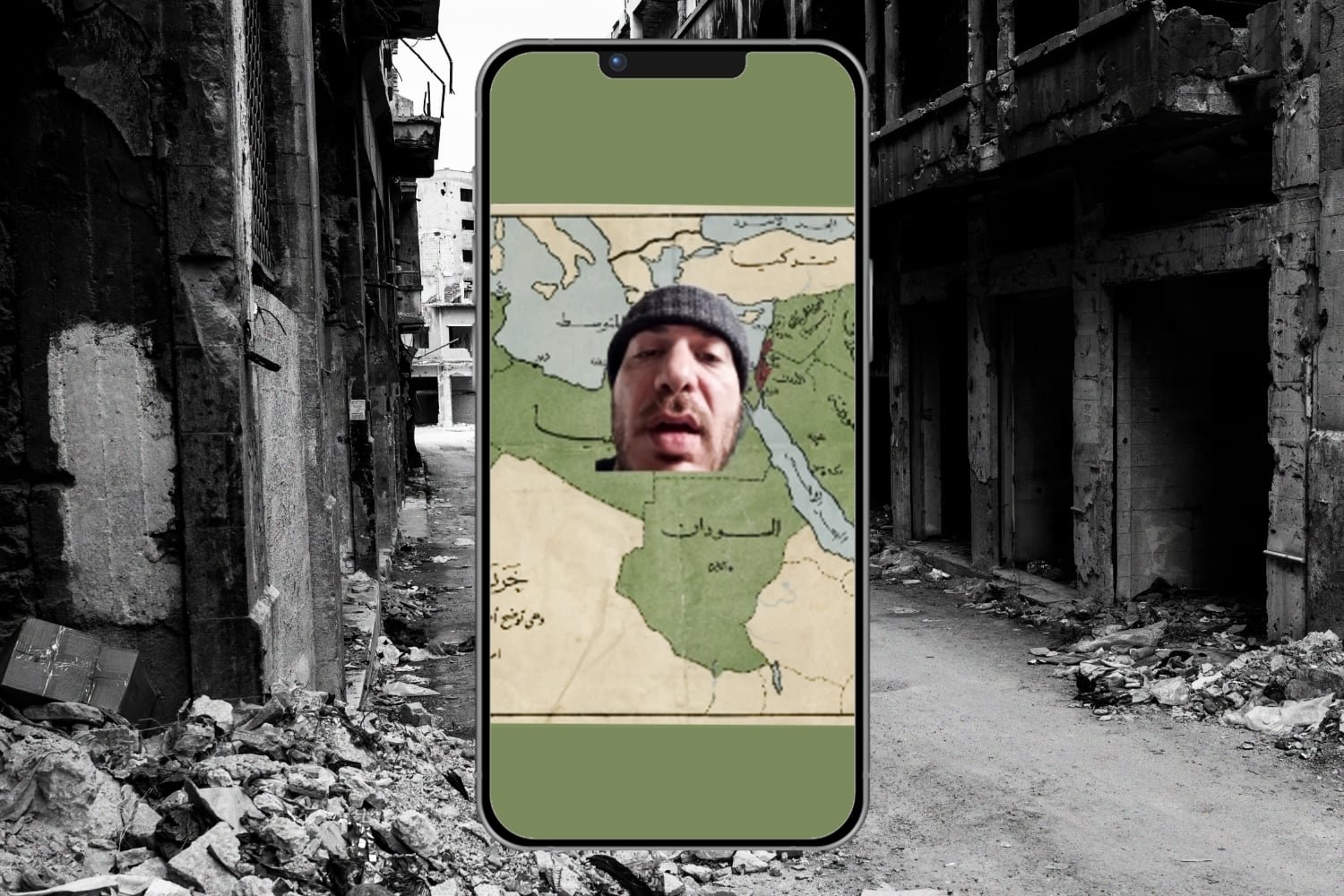
Hassan Akkad’s floating, shaved head against absurd green-screen backgrounds has become an unlikely icon in the last few months on Syrian social media.
In a series of recent Instagram videos, Akkad called out Mousa al-Omar, a famous media personality who is in Syrian President Ahmad al-Sharaa’s inner circle. Like many wealthy and prominent public figures, Omar had pledged commitments in several reconstruction campaigns that launched across the country after the fall of the Assad regime. And, like many wealthy and prominent public figures, he hadn’t fully paid them. Akkad was particularly insistent in pointing to the $10,000 that Omar promised the city of Homs and had yet to deliver.
Omar grew tired of Akkad’s trolling and blocked him. Akkad responded by traveling to Homs and calling on Omar directly through a megaphone from his car window as he drove around the city’s destroyed neighborhoods. Bystanders on the streets and balconies held up their phones, recording the performance. Shortly after, Omar posted a video announcing development projects totaling $40,000 that he will support in Homs. He insisted that it was not in response to the “pressure of the online blackmailing campaign.”
But the next day, the money came through.
Hassan Akkad’s first forays into Instagram commentary included a satirical travel show and series of English classes.Instagram
Akkad stumbled into his current role as a good government troll and anti-corruption celebrity. When he returned to his home in Damascus last year after 14 years in exile, the activist and filmmaker began sharing his observations on the country after the war. Starting with a proud photo in a brand-new “safari suit,” Akkad began posting deadpan dispatches about Syria’s new reality.
In his first Instagram series, “Reasons to visit Syria,” Akkad took on the persona of a confident travel influencer, recommending the capital’s best shawarma sandwich, best camel meat restaurant, and best circumcision shop. Then came the social and environmental critiques of reckless driving, excessive pesticide spraying, and vandalism of public spaces. His message? “You watched us die on the news for years. Now come watch us live.” Visit Syria, even with all its faults.
Akkad’s second series drew upon his prewar teaching experience. “English with Hassan” underscored real struggles in the country by teaching terms like “nepotism,” “cronyism,” “victim blaming,” “exploitation,” and “de facto power.” His floating head took on more ridiculous positions in front of the green screen, as his witty jokes mixed with a growing sense of deflation. Focusing on what’s not working in the country and speaking primarily in English, Akkad acknowledged that he was engaging with a “niche subculture.” Still, the commentary resonated. Followers commented, often mirroring his pessimism, and asked the question that many Syrians have been wondering since the fall of the Assad regime, “What has changed?”
Akkad’s posts shifted again when he introduced the terms “transactional justice” and “performative activism.” He began to criticize the Syrian government for giving wealthy businesspeople, who got rich as war profiteers supporting former President Bashar al-Assad, the right to buy their way back into the country and the government’s good graces. Particularly egregious, in Akkad’s eyes, was the fact that many of these businesspeople were publicly pledging millions of dollars to help rebuild parts of the country and then were not delivering on their promises. This is how the “Give us the money that you owe!” campaign started.
Last year saw a string of high-profile national events intended to raise funds for reconstruction from local sources, bypassing the international sanctions that were still crippling the economy at the time. These fundraisers, in Damascus, Homs, Daraa, and Idlib, culminated in a multiday festival in Aleppo with elaborate stages, screens, music, dancing, celebrities, and influencers. Livestreamed online and on national TV, these events featured wealthy men taking the microphone, shouting pledges, and gaining instant praise and accolades.
The “Loyalty to Idlib” event famously raised $208 million from Syrians locally and from the diaspora—Syrian billionaire Ghassan Aboud proudly offered $55 million. Yet, a couple of months later, when winter storms flooded the region’s internally displaced camps and left thousands to freeze in their muddy tents, these funds were nowhere to be found.
It has been 18 months since the fall of the Assad regime. But while the transitional government has made strides in repairing international relations, advocating for the removal of sanctions, and reconnecting Syria to the global banking system, the regional investments have not come fast enough. More than 90 percent of the population lives below the poverty line. Prices for gas and electricity have skyrocketed. Much of the country is largely in ruins after 13 years of airstrikes and shelling.
The World Bank Group has estimated Syria’s reconstruction costs to be $216 billion. Struggling Syrians hear flashy promises of Saudi and Gulf investments enthusiastically announced at international conferences. They watch Syrian President Ahmed al-Sharaa being welcomed (and perfumed) by U.S. President Donald Trump in the Oval Office. And they see more than $14 billion pledged to build new airports, energy investments, and luxury towers in their country. But they still feel little relief in their daily lives.

Wealthy businessmen pledging support for reconstruction can now expect to be publicly held to account if they don’t follow through. Instragram
The Syrian Development Fund’s website has a record of the donors from the Damascus fundraiser, marking those who didn’t fulfill their pledges. This includes a $20 million pledge from the auctioning of Assad’s confiscated fleet of luxury cars. So, Akkad did what any concerned citizen would do. He posted a video on Instagram, with his head popping out of a laptop perched on a living room table, and composed a polite email asking Sharaa to fulfill the pledge.
Akkad scrolled through the list, uncovering dozens of names and millions of dollars in uncollected funds. And this was just one of the national fundraisers—the Aleppo campaign alone raised more than $426 million. Governors’ offices reported that only a small percentage of the commitments have been collected.
Akkad’s first “Give us the money that you owe!” post was dedicated to Ahmad and Amro Hamsho, who had pledged $1 million. The brothers are sons of Mohammad Hamsho, a tycoon who worked for the Assad family and was famous for systematically stripping bombed residential buildings in Damascus suburbs and eventually across Syria. His crews stole the steel from the ruins of people’s homes and processed the scrap metal, making millions.
Syrians from Jobar, one flattened Damascus suburb, were livid at the Hamsho sons’ pledge, arguing that the money had been literally extracted from the ruins of their homes. And on top of that, they didn’t pay.
In post after post, Akkad exposed the pledges, asking businesspeople, tribes, and organizations to pay up. He threatened them with jokes and funny reels, all set to music ranging from traditional Syrian numbers to the theme song of the HBO television show Succession. Since starting in April, Akkad’s new series has targeted a few dozen people. Two weeks in, Hind Kabawat, Syria’s minister of social affairs and labor who had pledged $500, was the first person to respond and pay.
In a conversation with Foreign Policy, Akkad called this a turning point. “People were like, shit, if ministers are responding to him, then why aren’t civilians responding?” he said. His posts started going viral.
Akkad’s campaign was featured on the news. When he received threats and was told to stay out of politics—he posted them on his social media. But when he posted asking for help, hundreds of people wanting to volunteer stepped up. The campaign now includes a team of Syrian journalists, researchers, and designers who have formed a new creative agency called Stunning Studio.
Akkad’s efforts are working. When the Syrian Development Fund calls to follow up on pledges now, people respond out of fear of Akkad’s public-shaming tactics. The campaign has also affected accountability measures inside government offices. Records are being updated and corrected online because citizens are checking these sites.
Akkad has been overwhelmed with messages of support from Syrians across the country. People send him gifts like skincare products, tissue paper, and even a new stove for his mother. “We watched our country come apart,” he said. “We had a civil war, then we had a liberation, and after that we had sectarian killings in Syria. The public support of the campaign represents how we can get together on a matter, whether we agree with each other or not.”
And it’s clear from the reposts, shares, and thousands of comments that many Syrians agree. A local therapist, Tasneem, posted a video analyzing the campaign as a method of collective healing and reclaiming agency. In it, she said, “By watching him boldly address politicians and celebrities as ordinary people, he’s breaking our inherited fear and restoring our shattered identity. We are no longer victims.”
This is a full-circle journey for Akkad, who joined the 2011 revolution protests in Damascus and was detained and tortured by the Assad regime. He fled Syria like millions of other refugees, traveling by boat and land to reach Europe. After living through the horrors of the notorious refugee camp in Calais, France, he finally ended up in London, where he built his life back as a writer and award-winning filmmaker.
Akkad got emotional when talking about why he returned to Syria. “It took me three months to get to England, but it took me only five hours to return back to Syria,” he said. He considers his work today a public duty.
Akkad’s campaign could not have existed before the fall of the Assad regime. Calling out public officials, ministers, powerful civilians, and even the president for their unpaid pledges? A person would have lost their life for far less. More importantly, thousands of people commenting, sharing, and making their own content around the campaign would not have dared to before.
It turns out that when people are no longer afraid of being killed for speaking, they have a lot to say. Whatever other criticism the Sharaa government deserves, this change should be celebrated.
Many people who could not or chose not to speak up against Assad during the revolution have found a meaningful way to participate through Akkad’s campaign—to call for justice and accountability, to joyfully shame war profiteers, to take part in collective action, and to stop being victims and become citizens for the first time.
“This campaign is one of the answers to the Syrian question: What has changed?” Akkad said. He’s aware that what he’s doing cannot be done in most Arab countries. He also doesn’t want to sugarcoat the new reality, citing the corruption, cronyism, and nepotism that still exists in the government and society. But he insisted that there are many in the government who want to fix things.
Recently, Akkad visited the Syrian Ministry of Information, and a top employee hugged him, saying, “I love you, man, and we love your content.” He was stunned that he felt not only unafraid but at home at a government office.
For decades under the Assads, Syria was ruled by the politics of tanfees—the act of releasing air pressure slowly, like from a balloon without popping it. The regime was an expert at slightly opening the pressure valves of the oppressed masses to manufacture a sense of release through state-sanctioned humor. Wildly popular television shows that made comedic and critical social commentary like Yasser al-Azmeh’s Maraya and films of satirist Duraid Lahham, gave Syrians the illusion of agency to express frustration with inflation or corruption—so long as the release never truly threatened power. Humor became the language through which Syrians said dangerous things indirectly.
Today, the opposite of tanfees is happening, as real pressure is emerging from the bottom up. On social media and in public protests, people are directly criticizing government officials, businesspeople, and organizations—and sometimes seeing real change happen.
For Akkad, the fight continues. Next, he and his team want to see where all these newly fulfilled pledges are actually being spent. He promised that his new campaign will “annoyingly” document every reconstruction project across the country, reel by reel.



