
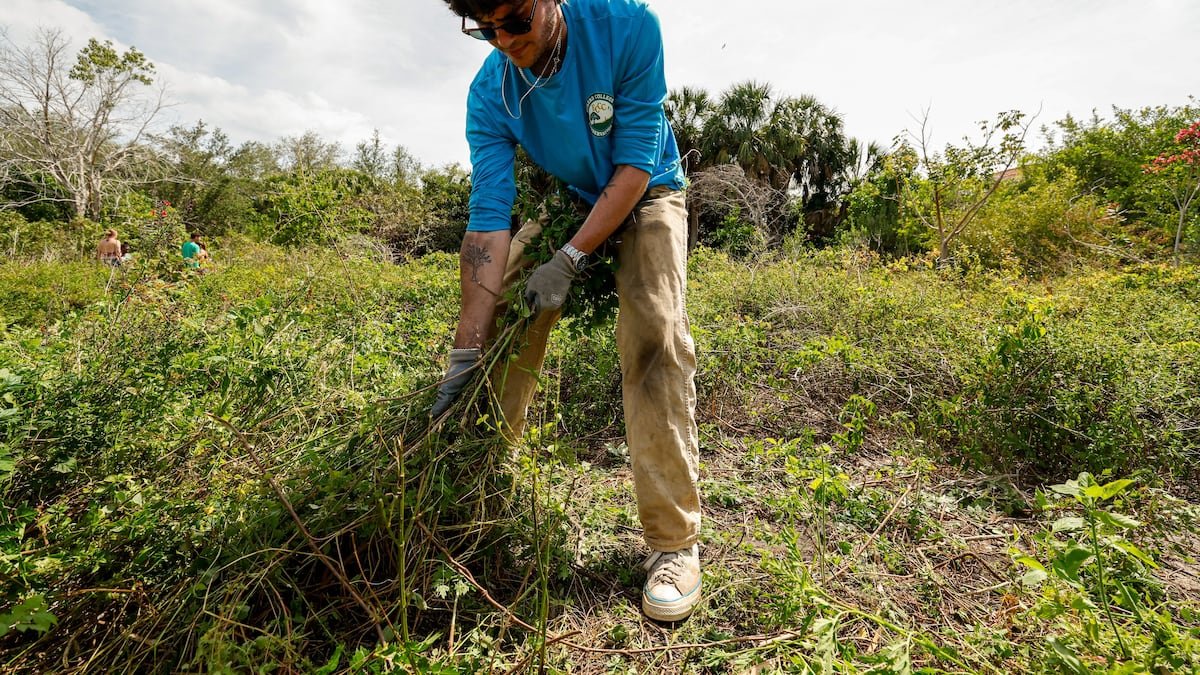
Students wearing grubby Converse shoes and well-worn hiking boots gathered at the edge of the Eckerd College butterfly garden.
Green weeds with tiny white flowers sprawled over sprinkler heads, and tall bamboo-like stalks hid benches and old bird feeders. The garden, which blends into a palm tree hammock, was damaged during hurricanes Helene and Milton and never completely restored.
“This is what we call a hack and whack,” said Tyler Cribbs, pointing to the overgrowth. “If you’re not sure, please ask somebody in the blue if it’s a good, bad or ugly weed.”
Cribbs is the faculty director of the college’s Conservation Corps, which officially formed this spring with a $25,000 grant from Duke Energy Florida. Around 50 students are part of the group, which addresses environmental issues in the community and on campus.
University leadership is pushing to “rewild” the campus, Cribbs said. Among other things, they want to restore the tree canopy and convert unnecessary turf grass fields into tiny forests.
Last week, students grabbed shovels and gloves to get into the dirt for their third butterfly garden restoration. The college’s radio station soundtracked the event and set up a station to paint old CDs and vinyl. The group was small, about 15 students.
“At the end of the day, you’re asking students to give up their free time to sweat it out and get dirty and hack plants up,” said junior Tate Mullineaux. “That’s definitely not everyone’s M.O.”
But a group of committed students always shows up, he said.
The Conservation Corps began without funding last year to help with hurricane recovery, Cribbs said.
Students have historically tended to wildlife habitats on campus, but the efforts went by the wayside in light of the hurricane damage, he said.
He wants students to become connected to their campus as a natural space, not just as the place they go to school. It’s important for students to get their hands dirty and get out of the classroom, he said.
“That’s really been the mindset, thinking of campus as a park, as a public space, and how best to engage students with some areas that they may walk by a million times to and from class but (have) never really looked at before,” he said.
Mullineaux has had Cribbs as a professor and said he wanted to get involved as soon as grant funding came through.
He said he loves hearing from friends or faculty that areas of campus look better because of the group’s work. It’s the same sense of pride you get when you clean your house, he said.
“I drive past all of these (natural spaces) on the way to class, or walk past them, every day,” he said.
Behind Mullineaux’s pile of dug-up scorpion tail — the weed with white flowers — Grace Albrecht pulled up stalks of castor bean.

She graduated in December and works part-time for the corps. The butterfly garden is her favorite on campus, Albrecht said, but it’s in need of some plant diversity. She said she’ll be back to water whatever the group plants next.
“We want to turn this space into a Florida prairie environment,” she said.
The corps’ funding pays for four student positions, as well as a golf cart, mulch, plants, gloves, shovels and an electric chain saw the group used to pull up invasive Brazilian peppertrees.
Cribbs said the Conservation Corps isn’t meant to replace the campus’ landscaping crew, but rather work with them. If students have a question, the landscaping crew stops everything to drive over to help, he said.
Cydney Harkness, the president of the college’s national honor society Omicron Delta Kappa, said she doesn’t get outside to garden as much as she should.
“Earth is our home,” she said. “If we won’t take care of it, we’re gonna get ourselves closer to ruin. The earth takes so much care of us, whether it’s from water or natural resources.”
As the students added to the pile of dug-up overgrown weeds, roots and stalks, the garden’s benches started to emerge.
“I found one!” one student yelled, pointing to a sprinkler hidden under weeds near the palm tree forest.
A chorus of student “woohoos!” bounced across the garden. Then, they wiped sweat off their foreheads and bent down back to the dirt.
The Tampa Bay Times Education Hub reports on Florida’s schools and universities and the students they serve. You can contribute to the hub through our journalism fund by clicking here.



