
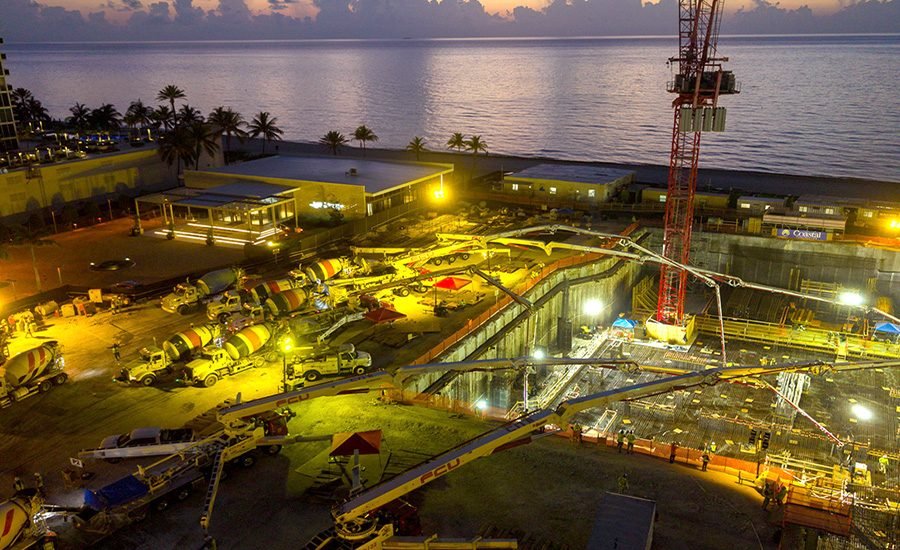
Beginning early evening July 24 and running into the next day, Miami-based Coastal Construction Co. completed a continuous 8,400-cu.-yd. mat foundation placement beneath the future St. Regis Residences near 108th Street in Sunny Isles Beach, Fla., clearing the way for vertical construction of a 62-story luxury oceanfront tower.
While the milestone marked the most visible phase of the project’s foundation work, project officials said the overnight operation represented only the latest chapter of an engineering effort that began years earlier and required weeks of planning before the first ready-mix truck reached the site.
“We poured 8,400 yards in less than 16 hours,” says John DiPaula, general superintendent for the St. Regis project. “But in order to do that, we have to set up a lot of things. There are a lot of moving parts in order to make this a success.”
Long before concrete placement became the focus, crews were confronting the realities of building a 62-story tower on a narrow barrier island where groundwater sits just feet below the surface.
Coastal Construction says the beachfront site required excavation about 40 ft below grade through groundwater-laden coastal soils.
Even before work could begin, specialty geotechnical contractor Keller North America used 6-ft augers to mix native soils with cement 60 ft to 70 ft below grade, creating a low-permeability plug that allowed excavation to proceed while controlling groundwater. Crews then installed approximately 470 auger-cast piles beneath the future tower.
According to the project team, the owner also elected to install more than 100 additional piles, reducing predicted settlement from roughly 18 in. to about 2 in. before the mat foundation was placed.
“The fact that we’re 40 feet in the ground on the beach—that’s what makes this unique,” DiPaula said.
Concrete placement continued through the night beneath the future St. Regis Residences as six boom pumps distributed material across the 8,400-cu.-yd. mat foundation. Every tenth truck was diverted for quality-control testing while the remaining deliveries continued in sequence to maintain uninterrupted placement.
Photo/Coastal Construction Co.
Planning for the placement began roughly six weeks beforehand, crew members told ENR. Coastal Construction, concrete subcontractor Baker Construction, ready-mix supplier CEMEX, the owner and municipal agencies coordinated every aspect of the operation—from maintenance-of-traffic plans, police details and lane closures to inspections, truck routing, contingency planning and the logistics required to support hundreds of workers during the continuous placement.
Weekly coordination meetings eventually became almost daily as the scheduled date approached.
“You order shirts and food and extra outhouses and everything for the logistics of the huge influx of people we have for that weekend,” DiPaula says. “As the time gets closer, we meet weekly, and then just a few days before the pour we make sure everything is done.”
The project team said city officials requested that the placement take place after the FIFA soccer World Cup tournament concluded due to the anticipated influx of visitors to the Sunny Isles Beach area. Once the date was established, crews worked backward from it, completing the final reinforcing steel work only hours before the first concrete trucks arrived.
Keeping the Concrete Moving
Miami International Airport’s control tower sequences more than 500,000 aircraft movements each year. Every takeoff and landing is timed, routed and monitored to keep traffic flowing through one of the nation’s busiest airports.
The St. Regis foundation placement demanded no less precision.

Crews prepare reinforcing steel and embedded utilities before the continuous mat foundation placement at Coastal Construction’s Shorecrest condominium project in West Palm Beach, Fla. The placement was completed during the same period as the contractor’s larger St. Regis foundation operation in Sunny Isles Beach, each requiring dedicated concrete supply, municipal coordination and carefully sequenced construction activities.
Photo/Coastal Construction Co.
Roughly 1,000 ready-mix truck deliveries supplied the mat through four dedicated CEMEX batch plants feeding six boom pumps positioned around the excavation. Each batch plant and delivery route was assigned before placement began, allowing trucks to feed the operation continuously once concrete flowed.
The project fronts Collins Avenue (A1A), the north-south spine running through the barrier-island communities of Miami Beach, requiring overnight lane closures, police traffic control and carefully choreographed delivery routes to keep both traffic and concrete moving continuously.
“There are a lot of partnerships that have to be in place, that have to be strong to make these things successful,” says Nekita Whyte, a senior project manager for Coastal Construction. “You have the structural side, the MEP side, your superintendents, your office team, but also the trade partners … CEMEX … and all the suppliers of the material.”
Once the first truck discharged concrete, the operation shifted from planning to execution. Every movement followed a predetermined sequence.
“The biggest hurdle we have with any mat foundation placement is the rotation of the trucks coming in, which one stops to get tested, and the rest of the trucks pulling in and backing up to the pump,” DiPaula says.
Baker Construction personnel directed truck movements to individual boom pumps, while every tenth truck peeled out of the delivery queue for quality control testing. Behind it, another mixer was already entering the line, maintaining the continuous rhythm needed to keep concrete flowing without bottlenecks or backing truck traffic onto Collins.
“The proper planning makes it a lot easier,” DiPaula says.
Backup pumps, on-site mechanics, towing capability and contingency plans for equipment failures had all been established before placement began. Traffic permits remained in flux until only days before the operation, while inspections continued virtually until concrete placement commenced.
“Passing those and being cleared to place concrete is always one where you hold your breath,” Whyte says.
Even after months of planning, one variable remained beyond anyone’s control: the weather.
Crews tracked lightning activity within an 8-mile radius throughout the placement using mobile weather alerts. Despite the nearly 16-hour operation, only one warning interrupted the team’s attention, arriving with approximately 40 cu. yd. of concrete remaining before the mat was complete.
DiPaula said wryly that anything short of a hurricane would not have delayed the placement once it was underway.
After the Last Truck
Throughout the placement, crews monitored truck arrival times, concrete temperature, slump and working time while performing scheduled quality-control testing. Once the last truck departed, crews immediately shifted from placement to curing. The newly placed mat entered a wet-curing regimen designed to control the heat generated as thousands of cubic yards of concrete cured.
An aerial view shows reinforcing steel and formwork taking shape at Coastal Construction’s Shorecrest condominium project in West Palm Beach, Fla., before crews began the 1,800-cu.-yd. continuous mat foundation placement. Unlike the St. Regis project, Shorecrest relied on sheet piling and a wellpoint dewatering system rather than deep soil mixing to prepare the below-grade excavation.
Photo/Coastal Construction Co.
“It doesn’t end there,” DiPaula says. “On our pour, in particular, they want us to keep it insulated and wet for 14 days. We have blankets on it now, and we’re hosing it down, trying to keep it cool, because it does get hot.”
The St. Regis operation was not the only major foundation placement underway. During the same period, Coastal also completed a separate 1,800-cu.-yd. mat foundation placement at the Shorecrest condominium project in West Palm Beach.
That operation likewise relied on dedicated CEMEX batch plants, municipal coordination and detailed traffic management, underscoring the planning required to execute continuous mat foundation placements regardless of scale.
Looking back, DiPaula credited the operation’s success less to any single engineering innovation than to the planning that assigned every participant a specific role long before the first concrete truck reached the site.
“Right people in the right roles and proper planning,” DiPaula said. “We’ve done this dozens of times. We didn’t miss anything on this one.”
Source: www.enr.com



