
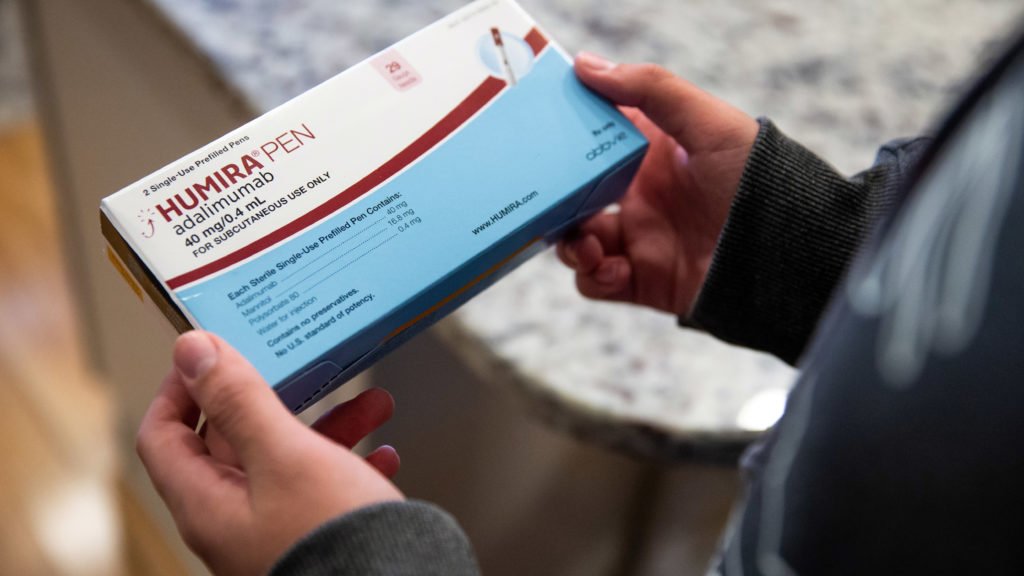
Sen. John Cornyn: How many patents do you [have?]
AbbVie CEO Richard Gonzalez: … A hundred and thirty-six patents.
Cornyn: A hundred and thirty-six patents on one drug?
Gonzalez: But, well, remember, Humira is like nine different drugs, or 10 different drugs. So —
Cornyn: I thought you said to Sen. [Debbie] Stabenow it was the same
molecule.
Gonzalez: It is the same molecule, but it treats different conditions. And if you look at that patent portfolio —
Cornyn: So you use the same molecule to treat different conditions and you can get a patent on that treatment?
Gonzalez: Certainly.
The above exchange comes from a 2019 congressional hearing. Sen. John Cornyn, a Republican from Texas, was asking AbbVie’s CEO, Richard Gonzalez, to explain to the Senate Committee on Finance how his company had amassed so many patents on this single drug called Humira. Gonzalez, who was no stranger to controversy, chose to respond by likening it to multiple drugs. After AbbVie had received the first regulatory approval for Humira to treat rheumatoid arthritis, a condition that causes inflammation of the joints, it thought the drug might also work on inflammatory bowel disease. In fact, AbbVie would eventually test, obtain patents for, and get FDA approval of the drug for several inflammation-related conditions. For Gonzalez, the 136 patents AbbVie had accumulated up until that point were justified. They were “innovations they had created,” he said. This would mean another 18 years of patent protection beyond the expiry of Humira’s original patent in 2016.
AbbVie had asserted over 70 patents in litigation against some of its competitors. This wall of patents, or patent thickets, as they are colloquially known, would delay them from entering the market with more affordable versions for an additional seven years beyond the expiry of its original patent for the drug.
That meant AbbVie could continue to charge monopoly prices until 2023 before the first competitor would enter under the agreed settlement terms. These settlement terms, as Gonzalez would explain, would allow the competitors to license AbbVie’s patents for a royalty when they entered.
He was keen to point out that despite having patent protections on the drug until 2034, even though unpopular to some, his company had struck a reasonable balance by settling to allow competition to enter approximately 10 years earlier. With the litigation settled, AbbVie had extracted an extra seven years of market monopoly between 2016 and 2023 thanks to its thicket of patents for its so-called innovations.
AbbVie would earn more in revenue — $114 billion — in these extra seven years for its drug Humira than it had in its previous 13 years when the drug was first approved by the FDA in 2002. Since the launch of Humira, it had also raised the price by 470% to approximately $77,000 for a year’s supply. Many of those increases were made during the added seven years of market monopoly after its main patent expired.
What Gonzales did not reveal at the Senate hearing that day was how AbbVie had created the innovations and 136 patents that had helped extend its market monopoly and block competitors. Two years after the Senate hearing, the Committee on Oversight and Reform in the House of Representatives issued a report on AbbVie as part of a larger drug-pricing investigation it was conducting into several companies. During the investigation, it had obtained documentation and a series of PowerPoint slides of the consultancy firm McKinsey advising AbbVie on how to block competition against Humira. The Committee on Oversight had also opened a separate investigation into McKinsey for its role in advising companies on how to drive sales for addictive opioid painkillers.
Based on the documentation retrieved, the investigation would reveal the numerous schemes AbbVie had come up with to fend off the threat of competition. At the heart of the plan was finding ways to build product extensions, called “differentiating the product.” This included finding different conditions the drug could be used to treat; formulation or dosage changes; new processes for making the drug; and then obtaining patents on these “new products,” or innovations.
Through this approach, AbbVie identified that it could block the development pathways of competitors while also allowing the patents to be used through aggressive litigation to tie up its rivals in court for at least five years. Six years before its main patent was set to expire, Abbott Laboratories, AbbVie’s former parent company, would activate McKinsey’s masterplan for blocking the competition. Brainstorming sessions were held to generate new ideas for patents and expanding its IP space. One slide proudly bulleted that in a kick-off effort, Abbott had generated over 200 ideas for new types of patents and IP. To encourage these new ideas for patents and IP, Abbott was offering three levels of awards. Participants would receive an iPhone or iTouch for generating a new patent idea, an iPad for a patent submission, and an Apple computer for a patent being awarded.
The irony of all this is that neither Abbott nor AbbVie ever invented the underlying technology that allows for the generation of fully human antibody proteins by fusion phages. It was the British scientist and 2018 Nobel Prize winner Gregory Winter, along with biochemists George Smith and Frances Arnold, who made the breakthrough relating to the development of therapeutic antibodies. Winter was more directly responsible for refining the technology along with the German company BASF, which would facilitate the eventual development of numerous biologic drugs using the technology, including Herceptin (trastuzumab) for breast cancer and Avastin (bevacizumab) for certain cancers and age-related macular degeneration. Abbott would buy Knoll Pharmaceutical, a division of BASF, in 2002, together with the technology that would result in Humira. What Abbott did after was to make the investment to bring the drug to market, including running clinical trials and testing, and then patent every conceivable variation it could think of under the guise of innovation. When Democrat Rep. Rohit Khanna of California asked Gonzalez during a 2021 Committee on Oversight and Reform hearing on drug prices who invented the drug that became Humira, Gonzalez professed he didn’t know. He said they were more focused on creating new innovations that help patients, to which Khanna would respond, “what you are really doing is business.”
Although Humira has become the poster child for patent abuse, this process is not exclusive to AbbVie. The business model of using patents and the language of innovation to justify prolonged patent monopolies that keep knowledge privatized for longer than necessary is endemic across the pharmaceutical industry.
This is especially the case with many of the best-selling medicines on the market. My (Tahir’s) organization I-MAK has spent the last eight years investigating the scale of patenting around some of the top-selling drugs in the United States. On average, there were 74 patents granted on each of the 10 top-selling drugs in the United States in 2021. Companies had filed more than 140 patent applications on average per drug, with 66% of the filings coming after the FDA had already approved the product to be on the market.
Many of these follow-on patents are applied for over a period of time after the initial patent for the original invention that already provides companies with 20 years of protection as an incentive to make the investment to carry out the R&D.
The pharmaceutical industry’s argument is that the follow-on patents are for innovations to improve an existing drug. While that may be the case, these innovations that claim to improve an existing drug do not enhance the therapeutic efficacy and are often based on commonly practiced science techniques that technically are not inventions.
Yet current patent policies allow them to be granted to incentivize investment and, in the process, enable companies to extend patent protection for as long as possible to maximize revenues and profits. This is in addition to the separate marketing exclusivities that agencies like the FDA give. In the case of biologic drugs, companies are given 12 years of marketing exclusivity in the United States alongside any patent protection. That means they are already guaranteed 12 years of unfettered monopoly control of the market to get a return on their investments and maximize profits before any of the patent shenanigans play out.
What the Humira story and the patent data on many of the best-selling drugs capture is what is commonly known in business circles as lifecycle management. Lifecycle management has evolved alongside the policies of innovation that have come to the fore with the rise of neoliberalism and corporate entrepreneurship. Nowhere is the practice used more vigorously than the pharmaceutical sector. So much so that entire books have been written on the subject and law firms or legal departments in companies have staff dedicated to the mission. In their book “Pharmaceutical Lifecycle Management: Making the Most of Each and Every Brand,” Tony Ellery and Neal Hansen describe this as the practice of utilizing all available measures to maintain brand exclusivity for as long as legally possible. In their words, “Every loophole in the pertinent legislation will be taken advantage of as the financial benefits of blocking generic entry are so gigantic.” Very few legal systems offer more loopholes than today’s patent system because of the innovation policies that have come to define it and the standards applied.
In the last three decades, these practices have given birth to new terms such as “incremental innovation” within the pharmaceutical industry — as if innovation alone was not a low enough bar to further privatize the knowledge commons through the patent system. The pharmaceutical companies justify the need for patents on innovation and incremental innovations on the grounds that reducing the industry’s ability to generate revenue from such practices would mean they have less to reinvest in R&D.
In other words, patents for innovations and incremental innovations provide the revenue that will help support the development of actual groundbreaking inventions, assuming that is where the profits are directed. This industry logic means the public must continue to pay more for the patented innovations described by AbbVie as “differentiated products” instead of having earlier access to affordable generic or biosimilar versions.
Such justifications and policy choices serve as a root cause for why drug prices are reaching unsustainable heights and many Americans and people around the world must decide whether to put food on the kitchen table or fill a prescription. While there is no denying that investment is important to develop technologies into commercial products, using the patent system as the driver has become a zero-sum game, a race to the bottom. Although innovation may mean newer products, it does not mean new knowledge or progress. Just because a company invests does not mean it has invented anything novel. In this sense, today’s patent system has become more of an exclusivity system for financial investment and not invention as originally intended.
But these are no longer the concerns of the industrial policy of innovation and the patent system. Innovation policies allow the same knowledge to be re-patented repeatedly yet still maintain a perpetual novelty and non-obviousness for the purpose of the patent system. It has distorted any integrity the patent system may have had, turning it into an ATM machine for drug companies.
For policy-makers and anyone else affected by the pharmaceutical medicines system, a 50-year fealty to the god of innovation should force some serious questioning of the system.

Are the products that receive dozens and even hundreds of overlapping 20-year patent monopolies all based on novel and non-obvious science, as claimed by the industry in their legal, marketing, and policy statements? Are we content with handing out patents that are based on routine techniques and which are a renewal and re-monopolization of existing scientific knowledge? Is it acceptable that the incremental and trivial improvements for which 20-year patent terms are granted provide no therapeutic benefits but only modify how we use drugs that already exist on the market? Does it matter so long as the industry keeps investing a fraction of its outsized revenues and profits in R&D, even if the science behind the newly marketed or existing version of a drug is repurposed knowledge packaged as progress? Is innovation the perfect cover for the financialized pharmaceutical business model where shareholder value, share prices, and lifecycle management strategies of existing products to maximize short-term profits have become the primary goal?
Until and unless these questions are pursued with more critical thinking and answers, we will continue to be caught in an innovation trap that fuels high drug prices and longer pharmaceutical monopolies.
Tahir Amin is a founder and CEO of the Initiative for Medicines, Access & Knowledge (I-MAK). Rohit Malpani is an independent consultant and former Director of Policy for the Médecins Sans Frontières Access Campaign. This essay is adapted from their new book “Pharma Monopoly: The Battle for the Future of Medicines,” out now from Polity.
Source: www.statnews.com



