
Welcome back to World Brief, where we’re looking at Iran’s warning for the Strait of Hormuz, U.S. accusations of European market overcapacity, and a new “ethnic unity” law in China.
Khamenei’s First Warning
Iranian Supreme Leader Mojtaba Khamenei delivered a defiant message on Thursday in his first public statement since succeeding his father, who was killed during U.S.-Israeli strikes on Feb. 28. “Iran will not refrain from avenging the blood of its martyrs,” Khamenei said, adding that Tehran will seek compensation from its adversaries “or destroy their assets accordingly.”
Welcome back to World Brief, where we’re looking at Iran’s warning for the Strait of Hormuz, U.S. accusations of European market overcapacity, and a new “ethnic unity” law in China.
Khamenei’s First Warning
Iranian Supreme Leader Mojtaba Khamenei delivered a defiant message on Thursday in his first public statement since succeeding his father, who was killed during U.S.-Israeli strikes on Feb. 28. “Iran will not refrain from avenging the blood of its martyrs,” Khamenei said, adding that Tehran will seek compensation from its adversaries “or destroy their assets accordingly.”
Khamenei vowed to continue blocking the Strait of Hormuz as a “tool to pressure the enemy.” Passage through the strategic waterway, where normally one-fifth of the world’s oil transits, has ground to a virtual standstill as Iranian forces target commercial shipping vessels.
Tehran also warned all U.S. bases in the Middle East on Thursday to close immediately, saying “those bases will be attacked.”
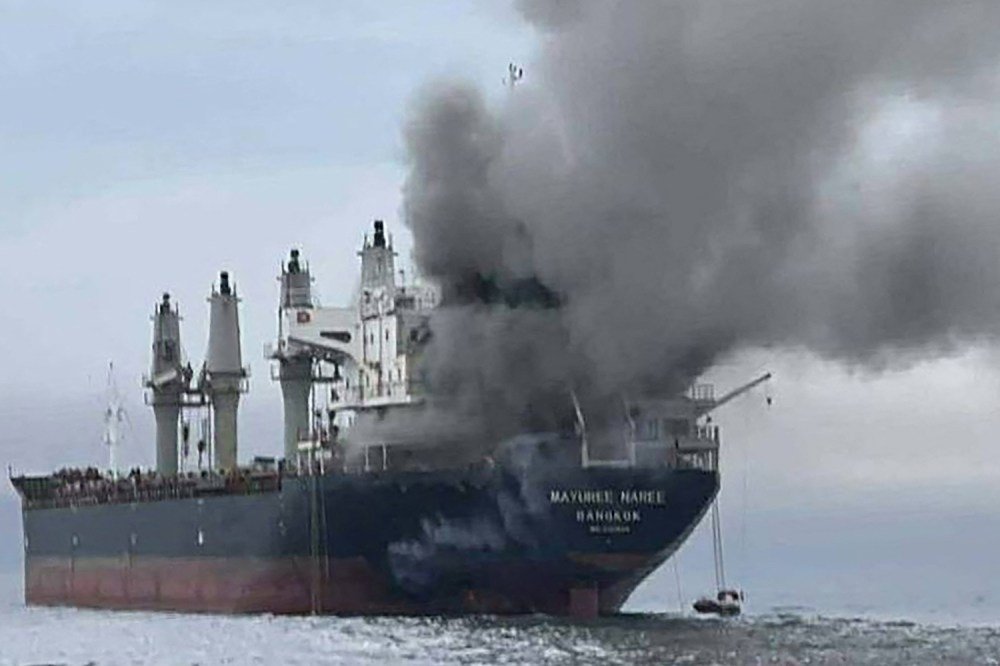
Iranian forces have escalated their strikes on oil and civilian infrastructure in recent days. On Thursday, a suspected Iranian attack targeted two tankers in an Iraqi port, just hours after three commercial ships were struck in the Persian Gulf. Iran’s Islamic Revolutionary Guard Corps claimed responsibility for at least one of Wednesday’s attacks: an assault on the Mayuree Naree, a Thai-flagged bulk carrier. Bangkok denounced that strike on Thursday and demanded that Tehran issue an apology.
Also on Thursday, Qatar’s Defense Ministry said it had thwarted several missile and drone attacks targeting its country. And Saudi Arabia’s Defense Ministry said it had intercepted two drones heading toward its Shaybah oil field.
These attacks have not stopped the United States and Israel from continuing their own military operations. According to U.S. Central Command, U.S. forces have struck around 6,000 Iranian targets, including more than 60 ships and 30 minelayers, since the war began. And on Thursday, Israel unleashed a fresh onslaught of attacks on alleged Hezbollah sites in Beirut, prompting the British government to issue a new travel advisory for its citizens in Lebanon. “If your presence in Lebanon is not essential, you should consider departing now,” the alert states. “If you decide to stay, we cannot guarantee we will be able to help you.”
Iranian strikes have injected uncertainty into global energy supply flows. On Wednesday, members of the International Energy Agency (IEA) unanimously agreed to release 400 million barrels of oil from their strategic reserves to help bring down rising crude costs. That same day, an Iranian military official warned that the price of oil per barrel could reach $200.
But Western powers appear less concerned about oil markets following the IEA’s decision. On Thursday, the European Commission said it does not have any immediate concerns regarding the security of oil supplies. And U.S. President Donald Trump said preventing Tehran from acquiring a nuclear weapon was more important to him than the price of crude. Trump also said the United States would profit from high oil prices. “The United States is the largest Oil Producer in the World, by far, so when oil prices go up, we make a lot of money,” he wrote on Truth Social.
But rising oil prices aren’t the only financial concern. Pentagon officials told U.S. lawmakers on Tuesday that the war’s estimated cost exceeded $11.3 billion within its first six days—not including other operational costs, such as hardware and personnel buildups.
Today’s Most Read
What We’re Following
The threat of more tariffs. The European Union on Thursday rejected U.S. allegations that the bloc was responsible for global market overcapacity, vowing to respond “firmly and proportionately” to any breach in the EU-U.S. trade deal, which was reached last year. “The sources of such overcapacity are well identified, and they do not lie in Europe,” European Commission spokesperson Olof Gill said.
Last month, the U.S. Supreme Court ruled that Trump had overstepped his executive authority when he used the 1977 International Emergency Economic Powers Act to impose sweeping tariffs on virtually all of Washington’s trading partners. Trump immediately condemned the 6-3 decision and vowed to circumvent the ruling with the 1974 Trade Act.
On Wednesday, the White House used Section 301 of that act to accuse more than a dozen major economies, including the EU, of unfairly overproducing goods. Opening an investigation into foreign manufacturing practices marks an effort by Trump to replace the hundreds of billions of dollars in revenue that the United States lost following the Supreme Court’s ruling.
Gill on Thursday said the EU had not received any indication that Washington planned to deviate from its previous trade deal commitments, which stipulates that U.S. tariffs on European goods cannot surpass 15 percent. But with the agreement not formally ratified yet, EU lawmakers are worried that the new investigation will complicate the deal’s approval process.
“Forced assimilation.” China’s National People’s Congress approved an expansive new law on Thursday that makes “ethnic unity” the responsibility of all levels of society. Beijing maintains that the legislation will protect China’s 56 recognized ethnic groups. However, experts warn that the law’s primary focus is to forge a single national identity—shaped by the Han majority—to enable sweeping assimilation and prevent foreign influence.
Under the new law, all citizens must abandon “outdated customs” and embrace “correct views” on history, religion, and culture. Parents will be required to “educate and guide children to love the Chinese Communist Party,” and minority residents will be forced to live in mixed communities. This is a “blatant move by Beijing to legalise forced assimilation and political control,” said Yalkun Uluyol, a China researcher at Human Rights Watch.
Notably, the law mandates that Mandarin Chinese be the language used in schools and official communications, which rights activists warn could dilute minority cultures and languages, such as Mongolian, Tibetan, and Uyghur.
Storm Shadow missiles. Russia’s foreign ministry accused the United Kingdom on Wednesday of supplying Ukrainian forces with Storm Shadow missiles that were used to carry out a lethal strike in the Russian city of Bryansk the day before. “It is obvious that the launch of these missiles was impossible without British specialists,” Kremlin spokesperson Dmitry Peskov said.
Storm Shadow missiles are long-range weapons jointly produced by Britain and France. Moscow accused London of trying to derail peace talks—even when Russia-Ukraine negotiations have already all but stalled due to the Iran war. Britain had no immediate response to Russia’s allegations.
The Kremlin alleges that Kyiv deliberately targeted civilians in Bryansk, killing seven people in what it characterized as a “terrorist attack.” Ukraine, however, maintains that it struck the vital Kremniy El factory, which Kyiv’s general staff called a “critically important link in the chain of production of Russian ‘high precision’ weapons.”
Meanwhile, Russia has repeatedly been accused of deliberately targeting civilians and critical infrastructure, such as Ukraine’s power grid.
Odds and Ends
Kenyan authorities arrested a Chinese national at Jomo Kenyatta International Airport on Tuesday for allegedly attempting to smuggle more than 2,200 live garden ants out of the country. According to court filings seen by Reuters on Thursday, immigration officials had flagged a “stop order” on the 27-year-old suspect’s passport for evading arrest last year. An investigation by the Kenya Wildlife Service is still ongoing, though investigators said the man mentioned working with three accomplices in Kenya to acquire the insects.



