
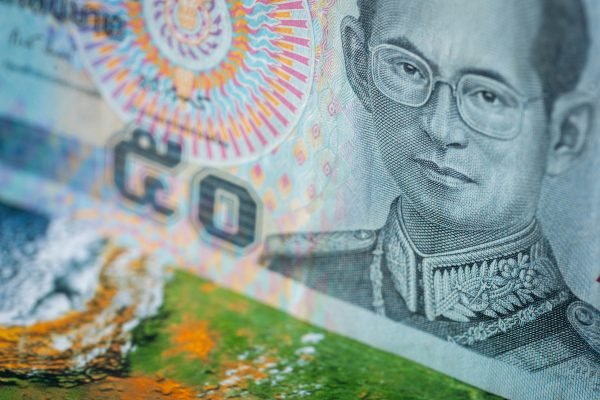
Thailand enters 2026 on a puzzling note: the economy is facing stiff headwinds and low growth, but the currency has strengthened substantially against the dollar. Isn’t a strong baht a sign of a strong economy? Not according to the country’s Minister of Finance, who cautioned last month that the baht was too strong. Why then is a strong baht bad for Thailand, and why is the currency gaining value even when the economy is struggling?
Regarding the first question of whether a strong baht is beneficial or detrimental to the Thai economy, the answer is that it depends. Emerging markets must carefully manage their currencies in order to make exports attractive, without inducing capital flight. If a currency like the baht loses a lot of value very quickly, it could cause investors to start pulling out of Thailand in large numbers.
When that happens, it usually kicks off a balance of payment crisis, as the market loses confidence in your currency and it becomes harder to service external debt. This is what happened in Laos recently. Thailand keeps hundreds of billions of dollars in foreign exchange parked at its central bank to back-stop its currency against precisely this kind of rapid and uncontrolled depreciation. Emerging markets will almost always want to avoid having their currencies rapidly weaken.
That does not mean, however, that a strong currency is inherently desirable. Export-dependent countries, such as Thailand, generally prefer a somewhat under-valued currency in order to make their exports more competitive. International transactions are still primarily settled in U.S. dollars, so when a local currency like the baht is strong, it makes exports less competitive for the simple reason that the same amount of dollars buys less Thai goods and services.
The goal is to find a sweet spot where the exchange rate makes exports attractive, while avoiding big swings in either direction. Right now Thailand’s economy, which depends on exports of goods and services, is struggling. The current account is back to surplus, but it’s not the massive surplus Thailand was accustomed to running before the COVID-19 pandemic. In particular, service exports (mostly tourism) are still below their pre-pandemic levels.
Meanwhile, stiff competition from Vietnam is biting into Thailand’s once dominant position as the region’s export powerhouse. This is why the Minister of Finance says the baht is too strong. Thailand hopes to export its way out of its current economic malaise, but that becomes more challenging with a strong currency. A weaker currency, while not always desirable in every situation, should boost exports and that is what the government wants at the moment.
The next question is why is the currency strengthening now? The baht gained nearly 9 percent against the dollar over the course of 2025, continuing a steady years-long appreciation. The Indonesian rupiah, Vietnamese dong, and Philippine peso all lost value against the dollar during the same time period. What’s different about Thailand that is making its currency appreciate when regional peers are depreciating?
Exchange rates and currency valuations are often tied to capital flows. When capital flows into a country, the currency appreciates. When capital flows out, the currency depreciates. So, if the baht is gaining in value we would expect to see increased investment flowing into Thailand.
And indeed, we do see that, with the largest source of recent capital inflows to Thailand being direct equity investments, mainly in the non-bank sector such as corporations and other non-bank financial institutions. In 2024, direct investment grew by 10 percent. In the first nine months of 2025, it rose another 9 percent. The Thai government has identified high gold prices and a surge in gold trading as one of the main causes of currency appreciation. That might be part of it.
But it seems that a significant uptick in direct investment has also been a long-term driver of baht appreciation. This leads to an interesting question which is that if the baht is appreciating because Thailand has been the recipient of large and sustained direct investment inflows in recent years, where is the investment going and why has it not generated more economic growth and spurred a quicker economic recovery?



