
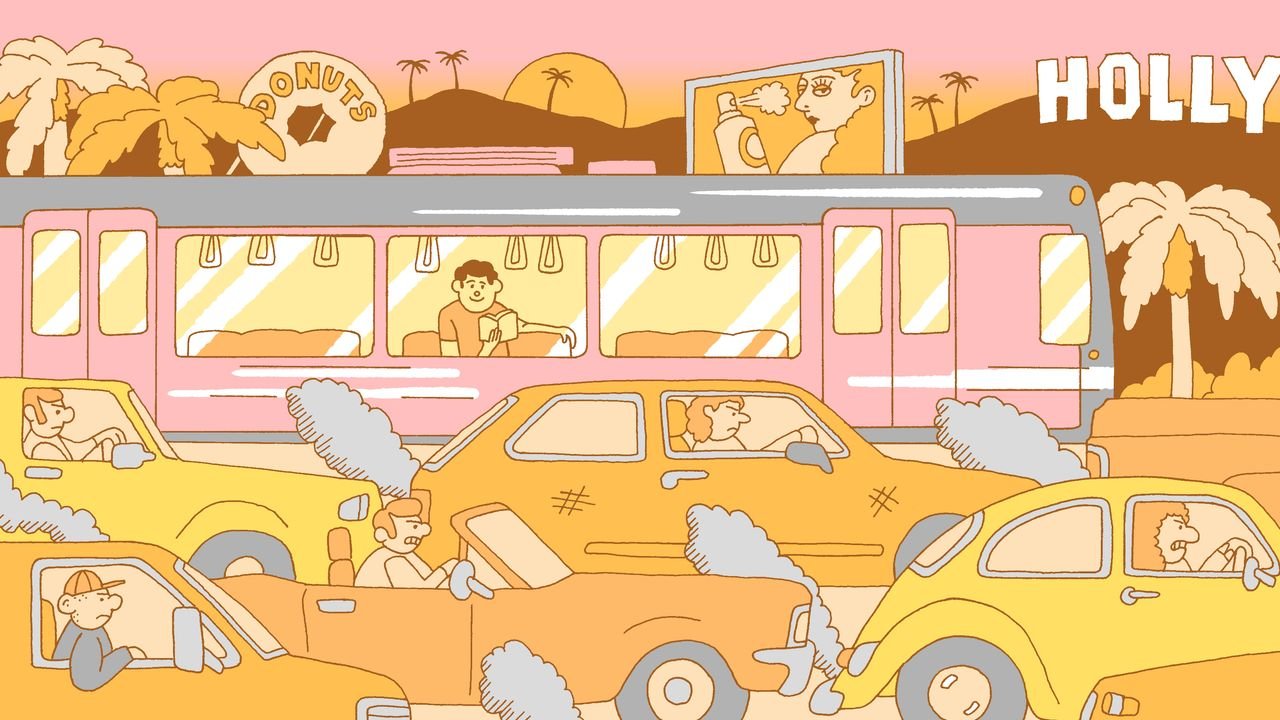
Eventually, the government built a network of freeways in Southern California, and drivers began facing the same traffic jams that had made them turn away from the Red Cars decades before. In response to the mounting issues of car culture, a movement formed to bring rail transit back. Tom Bradley, who was elected mayor of Los Angeles in the nineteen-seventies and went on to serve five terms, made reviving the streetcar (and a subway to the sea) a cornerstone of his platform. But many Angelenos remained wary of mass transit. In the seventies and eighties, a wave of East Coast transplants, fleeing the economic decline of cities like New York, brought with them an aversion to public transportation. “At that point, the New York City subway had a pretty bad reputation as being crime-ridden,” Elkind told me. For wealthier Angelenos on the West Side and in the San Fernando Valley, a Manhattan-like city of subways was antithetical to the suburban fantasy that they were building.
Still, over the next twenty years, Bradley and other civic leaders managed to push rail transit along in parts of L.A., with one major exception: a section running the length of Wilshire Boulevard. In 1985, an explosion in the basement of a Ross department store—caused by an unventilated buildup of methane gas underneath the store—razed several city blocks and injured twenty-three people. Henry Waxman, a congressman who represented the city’s West Side, used the incident as a pretext to propose a bill in Congress that banned the use of federal funds for tunnelling under a large swath of Wilshire. In reality, the incident had no bearing on subway construction—much of Los Angeles sits on or near petroleum and natural-gas deposits, and Metro engineers had already demonstrated that they were equipped to deal with the hazards—but the bill passed anyway. The B Line was rerouted to avoid Waxman’s methane zone by turning north from Wilshire Boulevard and heading up to Hollywood. In a moment of foresight, though, Metro built a small spur off the B Line down Wilshire Boulevard that ended right at Waxman’s boundary.
The spur opened in 1996. Eleven years later, with the urging of the then mayor, Antonio Villaraigosa, Waxman reconsidered his opposition to the project, and Congress lifted the tunnelling ban, paving the way for a renewed effort to complete the Wilshire subway. Still, many residents on the West Side and in Beverly Hills rallied against the project. The school board of Beverly Hills once claimed that the subway would make the local public high school a target for ISIS terrorists, and the school’s parent-teacher council released a video showing the school’s campus being hypothetically destroyed by a methane-related explosion that, the argument went, might occur should the subway pass underneath it. (Curiously, parents and administrators were unconcerned with the health or safety issues posed by the active oil wells on campus.) But the fearmongering failed. Digging for the new D Line project began in 2018; six years later, boring machines finished their dig after reaching the line’s new terminus at the Veterans Affairs campus in Brentwood.
A few weeks ago, I talked to Uri Niv, an attorney who lives in L.A.’s Highland Park neighborhood. The opening of the full D Line extension next year will take him from his house to a stop that is half a mile from his office, in Beverly Hills. “I can’t wait to ride it,” he told me. But he has concerns, too. “I used to ride the B Line daily from North Hollywood to downtown. It was so convenient and cheap, but it felt sketchy before the pandemic, and then after it was unbearably scary and dirty.”



