
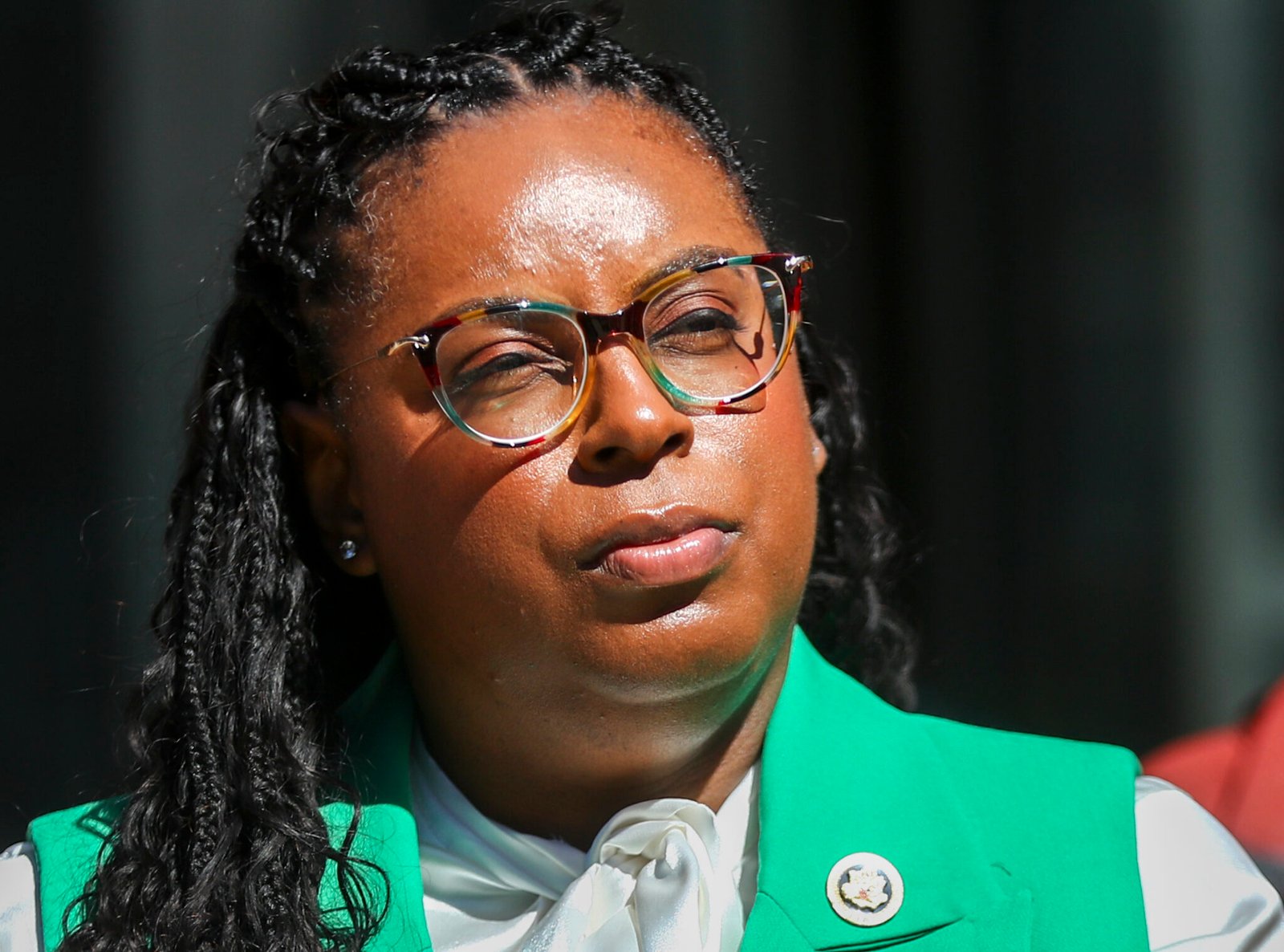
WILMINGTON, DELAWARE — A panel of federal appeals judges heard arguments in the federal assault case against Rep. LaMonica McIver on Wednesday, with both sides agreeing that McIver was involved in a confrontation with federal agents outside the Delaney Hall migrant jail in May 2025, but arguing over whether she is shielded from prosecution for her conduct during that scuffle.
At the center of the dispute are McIver’s actions during the 68-second scuffle that occurred outside the Newark detention center last year, during which prosecutors allege she assaulted federal agents. McIver’s attorney, Paul Fishman, argued that because McIver was at Delaney Hall to conduct legislative oversight, she cannot be charged with a crime for her actions while she was on the jail’s property. Prosecutors say her actions during the melee were separate from her oversight duties.
Fishman disagreed.
“There was not a 68-second pause,” he said. “She was there for one lawful oversight visit.”
Mark Coyne, chief of the appeals division of the U.S. Attorney’s Office for the District of New Jersey, noted that the other members of Congress who accompanied McIver to Delaney Hall that day did not get physical with federal agents like McIver did, and he brushed off suggestions that this is selective or vindictive prosecution.
“Charging a sitting member of Congress is a consequential act. It’s not something my office took lightly,” he said.
The case stems from a May 9, 2025, visit McIver made to Delaney Hall in Newark alongside Reps. Rob Menendez and Bonnie Watson Coleman. While the three members of Congress were waiting to tour the jail, federal agents moved to arrest Newark Mayor Ras Baraka, who was also at the detention center that day, for trespassing. A chaotic scene resulted, and prosecutors allege McIver assaulted federal agents during the melee.
While Baraka’s trespassing charge was quickly dropped, McIver was indicted on two felony counts and one misdemeanor in June 2025. She faces up to 17 years in prison if convicted. She has pleaded not guilty.
McIver’s attorneys failed to convince the federal judge overseeing her case to toss the charges, so they appealed to the 3rd Circuit.
Wednesday’s hearing was the latest in the yearlong legal battle that moved McIver into the national spotlight and pitted her against the Trump administration and its mass deportation effort. Numerous Democrats from across the country issued public statements in support of McIver Wednesday, including Texas Rep. Jasmine Crockett and Washington Rep. Pramila Jayapal.
Outside of the Delaware courthouse, McIver told reporters that this case is about “weaponizing the Department of Justice to do their personal bidding against people that they don’t like, and I’m one of those people on that list.”
McIver, a first-term Democrat who is pregnant with her second child, said she’s exhausted and stressed, and she criticized the federal government for spending taxpayer dollars to prosecute a sitting member of Congress.
“I have, literally, the president of the United States and the Department of Justice trying to send me to jail for 17 years. That’s very frightening,” she said.
McIver sat near her attorneys during Wednesday’s hearing, with some members of her family watching. She did not address the court.
Her lawyers noted that no one was injured during the fracas outside Delaney Hall last year. McIver’s action during the confrontation “wouldn’t have drawn a flagrant foul in the Knicks-Spurs game last week,” Fishman joked.
The Constitution’s speech or debate clause, which shields federal lawmakers from prosecution over legislative acts, was a key topic during the first hour of the hearing. Judge Stephanos Bibas, a Trump appointee, proposed a hypothetical to Fishman: Would a member of Congress, while performing legislative duties, be protected if he groped a teenage girl?
Fishman said no, he wouldn’t be protected, but that McIver’s case shouldn’t be looked at “in a vacuum,” adding that “there’s context” to different situations and stressing that sexual assault and contact with a federal officer are distinctly different.
Bibas said multiple times that McIver’s conduct inside of Delaney Hall is certainly protected, but Baraka’s arrest and the chaotic scene that ensued occurred outside the perimeter of the facility.
Fishman argued that the speech or debate clause gives members of Congress the latitude to protect their constituents, citing “qualified immunity for police officers who have to react in a split second.” Coyne said the “use of physical force is never, never covered by the speech of debate clause.”
Judge Thomas Ambro, a Clinton appointee, pushed Coyne multiple times to find a similar case where a member of Congress faced assault charges. Coyne cited one where an umbrella was thrown at a federal agent, and Ambro and Bibas mentioned a separate case where a man who threw a sandwich at a U.S. Customs and Border Protection agent was charged with assault (a jury acquitted him).
McIver’s argument that she is the victim of selective and vindictive punishment by the Trump administration was also front and center. Fishman noted that the decision to arrest Baraka the day of the Delaney Hall scuffle was made by the then-deputy attorney general of the United States, not by people on the ground in Newark. Prosecutors did not announce they were charging McIver until 10 days after the Delaney Hall incident, after they said they were dropping Baraka’s trespassing charge.
Coyne maintained that McIver’s conduct, not her politics, drove the charges.
Fishman rebutted: “They are picking on someone who is a member of Congress who does not agree with their views, so that is the problem.”
It’s not clear when the judges will issue a decision.



