
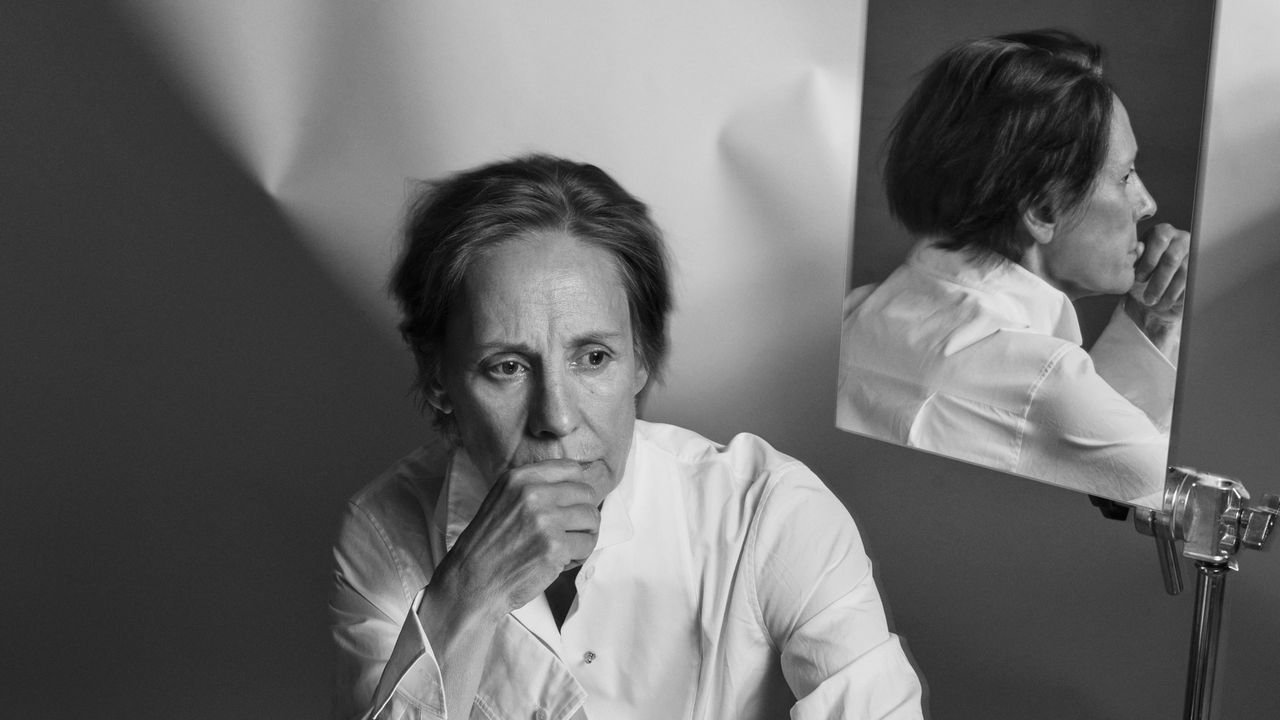
Somewhere in the bowels of Lincoln Center, Laurie Metcalf was in a rehearsal room, quietly conferring with the director Joe Mantello. It was February, days before the new Broadway revival of Arthur Miller’s “Death of a Salesman” would move into the Winter Garden Theatre. Four weeks into rehearsals, the cast—led by Nathan Lane, as the delusional, doomed salesman Willy Loman—was still refining the Loman family’s implosion. Metcalf, playing Willy’s enabling wife, Linda, had read the play in high school but had purposefully avoided ever seeing a production. “I thought maybe down the line I’d be able to play the part, so I didn’t want somebody’s performance in my head,” she explained. The same went for Martha in “Who’s Afraid of Virginia Woolf?” and Mary Tyrone in “Long Day’s Journey Into Night”—characters that Metcalf had tackled in the past decade and a half. “I stayed away from bucket-list-type roles, just in case,” she said, then let out a hearty laugh. “And now, in my dotage—here they come!”
Metcalf’s turn as a Broadway eminence was far from assured. Since the nineteen-eighties, TV audiences have known her as the rootless, rubbery Aunt Jackie, from the sitcom “Roseanne.” The more stage-savvy know her as a charter member of Steppenwolf Theatre Company, the red-blooded Chicago troupe that emerged in the seventies and launched such talents as John Malkovich, Gary Sinise, and Joan Allen. In 2017 and 2018, Metcalf won back-to-back Tony Awards, for Lucas Hnath’s “A Doll’s House, Part 2” and Edward Albee’s “Three Tall Women”; she was simultaneously nominated for an Oscar, for her role in Greta Gerwig’s film “Lady Bird.” She was hailed as the new First Lady of American Theatre, a moniker once given to Helen Hayes. In the Times, Ben Brantley wrote that Metcalf had attained the stage career “that Meryl Streep might have had, had she not abandoned Broadway for Hollywood.”
None of this acclamation has imbued Metcalf with grandeur. At seventy, she remains a workhorse. She excels at playing women with hardened exteriors, rough edges, and working-class muscle—salt-of-the-earth people, with extra salt. That is certainly true of her Linda Loman. At Lincoln Center, Metcalf was dressed simply, in jeans and a worn “Three Tall Women” hoodie. (“Her wardrobe is made up of merch from shows she’s done,” Mantello observed.) The cast, which that morning had sat through mandatory harassment training—“So, there’s that,” Metcalf said, flatly—included Christopher Abbott and Ben Ahlers, as Willy and Linda’s deadbeat sons, Biff and Happy. They took their places for a climactic scene in Act II in which Linda berates her sons for their shoddy treatment of their father, who is crawling in the dirt outside, his mind unravelling, planting a garden in the middle of the night. Mantello has done away with the naturalistic kitchen-sink set; in the rehearsal room, a plywood box stood in for a red 1964 Chevy that would dominate the stage. In the scene, Linda tosses aside a bouquet of flowers which her sons have bought to appease her and yells, “Get out of my sight.” Metcalf gave the line a venomous hiss, before raising her voice to a shriek. “I got too hot too fast,” she told Mantello afterward, rescoring Linda’s emotional melody.
Nathan Lane, who plays Willy Loman in “Salesman,” was eager to have Metcalf in the role of his wife, Linda: “I knew that she would find this strength and fierce protectiveness toward Willy, and that it wouldn’t be sentimental in any way.”Photograph by Emilio Madrid
The scene was interrupted when one of Lane’s prop seed bags burst, spilling everywhere, and the cast devolved into hysterics. Lane, turning hammy, bellowed, “I’m hoping to have an entire salad come the spring!” Clowning around, Metcalf and Ahlers went into a little bowlegged hop. Then it was back to work. I sat behind a table, next to a man in a brown sweater who watched intently through wire-rimmed glasses. It was the producer Scott Rudin, who, more than anyone, is responsible for Metcalf’s prolific third act. In 2021, amid allegations that he had bullied his staff (abusive tirades, thrown office supplies), Rudin stepped back from his career as a pugnacious Broadway titan with exquisite taste. After a four-year exile, he returned, last fall, with Samuel D. Hunter’s play “Little Bear Ridge Road,” starring Metcalf as a hard-bitten Idaho nurse. By doing “Salesman,” she was doubling down on their partnership, even though Rudin remains a controversial figure in the business.



