
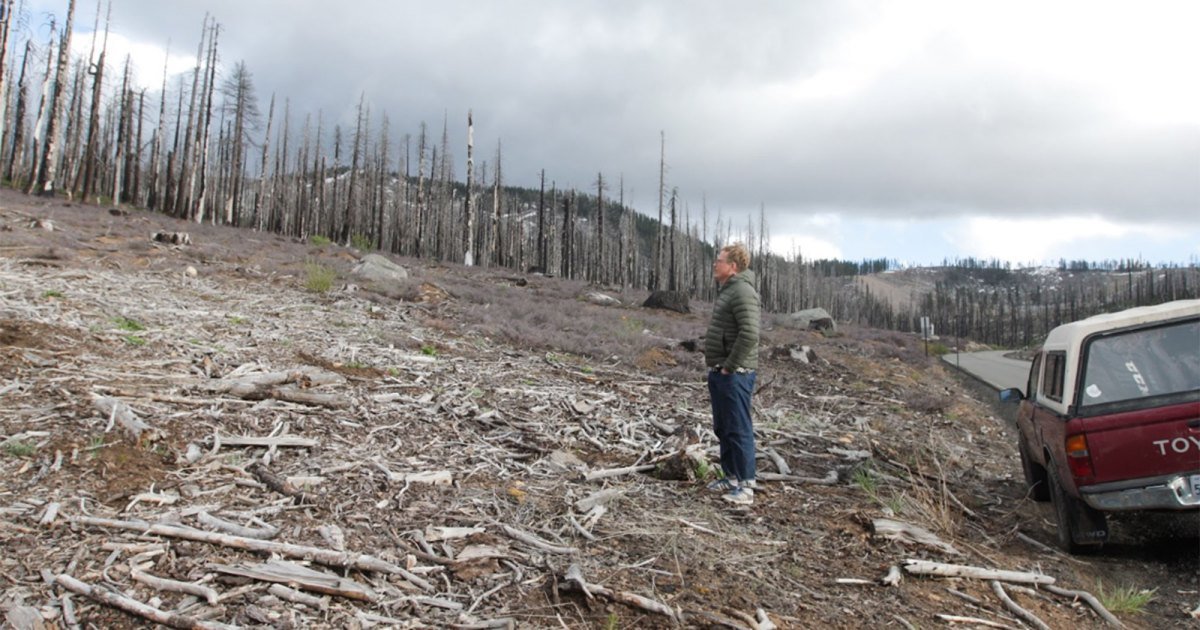
Reporter Nate Halverson surveys a patch alongside Sierra-at-Tahoe Road near the ski resort that has been sprayed with glyphosate.Peter Berger/Mother Jones
This past Sunday, I found myself walking across the snowless ski runs of Sierra-at-Tahoe in California, which sits on public land in the El Dorado National Forest. I had come to chase down a rumor.
Numerous Tahoe-area residents had told me the Forest Service’s plan to spray the controversial herbicide glyphosate—part of the agency’s forest restoration plan for about 75,000 acres scorched by the devastating 2021 Caldor Fire—had been delayed until 2028. A local news site, along with a major local environmental group—Keep Tahoe Blue—were telling people some version of that.
But I had my suspicions. I dug up maps from the Forest Service’s website, and headed to a spot where one of them indicated spraying might already be happening. It was strange to be standing in the middle of a ski run, with neither snow nor skiers around. But I knew if spraying were happening, it would be obvious.
Public uproar has echoed across the Tahoe area since April, when our yearlong Mother Jones investigation revealed that, in California, the fastest-growing use of glyphosate—the main ingredient in Roundup—is to spray forested areas, including this massive new project around Lake Tahoe. Everyone from environmentalists to an Olympic snowboarder and a prominent voice in the Make America Healthy Again (MAHA) movement have since condemned the Forest Service’s plan.

A petition on Change.org gathered about 10,000 signatures in less than two weeks. And people have taken to social media to call for action, generating hundreds of thousands of views, with companies and organizations like Patagonia and Greenpeace sharing information about the spraying. “Pesticides have no place in our forests!” Greenpeace wrote on its Instagram.
Snowboarder Hannah Teter, who won gold in the half pipe at the 2006 Winter Olympics in Torino, Italy, and Silver at the 2010 games in Vancouver, has voiced her opposition on Instagram, where she has 275,000 followers, as well as on her Facebook page.
“It’s so stupid. Everyone in Tahoe is so bummed,” she told me. “How the heck did they get this approved?”
The Forest Service did allow for public comment back in 2023 on its initially smaller proposal for herbicide use in the Caldor Fire scar, which most people in the area seemingly never heard about. Then a 2025 executive order by President Trump to expand timber harvesting on national forestland allowed the Forest Service to more than double its proposed herbicide use within the Caldor Fire scar without soliciting public feedback.
As the outcry grew over the past few weeks, news begin circulating on social media that the Forest Service was backing off. “They cancelled the plan!” one person wrote. “People showed up to meetings, called our representatives and it’s finally cancelled. OUR VOICES MATTERED ON THIS ONE.”
The Forest Service began spraying glyphosate in the Tahoe area last year, including directly on the slopes of Sierra-at-Tahoe.
But that wasn’t true. At Sierra-at-Tahoe, I stood on a mountainside that clearly had been doused in glyphosate. The plants around me were nearly all dead—killed with the controversial herbicide, which the World Health Organization’s International Agency for Research on Cancer has deemed a probable human carcinogen—and that a 2020 report from the US Environmental Protection Agency said likely harms 93 percent of endangered species.
Roundup’s manufacturer, Bayer, is currently on the hook for more than $12 billion in legal payouts to more than 180,000 people who say glyphosate made them sick—the company is now seeking immunity from some of its liability in a case recently heard by the Supreme Court. (In a statement, the company said glyphosate products are safe when used as directed and that regulators around the world have approved its use.)
Standing on the slopes of Sierra-at-Tahoe, it was clear to me that the Forest Service is moving ahead. It began spraying glyphosate in the Tahoe area last year, including here at the ski resort, and has been spraying elsewhere this spring.
Down the ski slope from me, I could see hillsides teaming with life, painted in the lush greens and brightly colored petals of spring. But where I stood, next to a ski run called “Marmot,” the land was devoid of spring flowers; the bushes leafless, brittle, and dead by all appearances. Practically the only thing growing was what the Forest Service intended—pine trees: Its workers had hand-planted baby conifers all across the slope.
This scene of devastation is part of the Forest Service’s pivot towards embracing glyphosate in its efforts to reforest in the wake of massive wildfires. The agency’s herbicide use in the Tahoe area is mirrored by another fire-restoration plan in Northern California’s Lassen National Forest, where the Forest Service plans to spray about 10,000 acres with Roundup or a similar product.
As our investigation revealed, the deployment of glyphosate in California’s forestlands has been growing for decades, driven in part by the worsening fires, as companies and government officials scramble to harvest burned wood and replant trees for future timber sales. Glyphosate is among the effective methods—and the Forest Service says the cheapest—to get pine trees to grow back faster, as it kills any other plant that might compete for sunlight, soil nutrients, and water.
These new projects are expanding the agency’s historic use of the herbicide. In 2023, it sprayed 14,900 pounds of pure glyphosate across California, according to an analysis of more than 5 million state records that my colleague Melissa Lewis and I compiled as part of our investigation.
The Forest Service has authorized the spraying of glyphosate over about 75,000 acres within the Caldor Fire scar at up to the legal limit of eight pounds per acre. This means the Tahoe project could deploy more than 584,000 pounds of glyphosate over the next few years. In a document outlining how to transform the fire-scarred land into an ideal timber producing forest, the agency noted that “multiple herbicide applications may be required,” which could further increase the total.
This approach treats portions of the National Forest similarly to farmland, where managers aim to maximize yields and minimize costs. After all, the Forest Service exists within the US Department of Agriculture (USDA).
“It has a well-established toxicity to the environment. And, for endangered species, Roundup is a significant risk.”
The agency has not said exactly how much of the designated area around Tahoe it actually plans to spray, although its documents note that spraying herbicides is “the most effective method available for achieving reforestation objectives in the majority of situations.” Officials did not respond to my questions about how much glyphosate the agency will use, nor whether it still considers the chemical safe for people and the environment—especially now that we know that key research papers vouching for glyphosate’s safety were secretly orchestrated by its manufacturer.
This month, the nonprofit Keep Tahoe Blue sent a message to a concerned local, who then posted it online, saying “no glyphosate has been applied as part of the Caldor Fire Restoration Project, and the USFS has stated the earliest any potential herbicide application could occur is now 2028.” But this was inaccurate.
The Forest Service, as part of the Caldor Fire Restoration Project, has indeed been spraying outside the Tahoe basin, where officials plans to reforest 73,000 acres, including the work already done at Sierra-at-Tahoe.
A big source of confusion is that the Caldor Fire Restoration Project actually consists of two separate plans. One involves the Lake Tahoe watershed (a.k.a. the Tahoe basin), meaning the forest creeks that drain into the lake. This smaller portion of the project includes reforestation and potential herbicide use on about 3,000 acres. It was in relation to this area that the local news site SouthTahoeNow.com reported the Forest Service had held off on spraying until 2028.
But a Forest Service spokesperson told me there has been no delay or change of plans: The agency had never intended to spray in that section—which includes areas near Meyers and Heavenly ski resort—this year or next. But its public documents are unclear on this, and they don’t reveal when or under what circumstances that spraying might commence.
On May 7, the Forest Service posted maps online showing it had sprayed glyphosate around and within Sierra-at-Tahoe in spring 2025. When I called and emailed the local officials to confirm, I got a reply saying they’d need to consult with colleagues on the “East Coast” before answering my question. That’s when I decided to drive out and see for myself.
The Forest Service later confirmed that the area I visited indeed had been sprayed, and that the maps I found online were posted this month—a year after the spraying at Sierra-at-Tahoe—“to facilitate awareness.”
It also released maps showing where the agency is spraying in 2026. Those areas were either already treated with glyphosate in April, a government spokesperson told me this week, or the spraying is “ongoing” and expected to wrap up “within the next couple of weeks, weather conditions permitting.”
“Spraying glyphosate in such an environmentally sensitive and pristine place,” says Kelly Ryerson, a.k.a. Glyphosate Girl, “is “ludicrous.”
All of the spraying, they said, has been accomplished by crews using backpack sprayers. These tend to be contract workers, often Spanish speaking immigrants who may not be aware of the potential safety risks. Mother Jones obtained a photo of one work crew that was cited by a county inspector for failure to wear the mandated protective gear—their exposed skin was purple, covered with the chemical.
The spokesperson said the agency posts signs at locations where it sprays herbicides—and typically removes them within 48 hours. Several research papers indicate that glyphosate can persist in the environment and even plant tissue for months, even years, raising risks to the ecology and human health.
One Forest Service map shows areas outside the Tahoe basin that the agency plans to reforest as part of its restoration project—and which it says will likely require glyphosate and other herbicides. The USDA has defended the Forest Service’s use of glyphosate, noting that it relies on the EPA’s “use of gold-standard science to assess pesticide safety.”
Attorney George Kimbrell, co-executive director of the Center for Food Safety, scoffs at that assertion. “It has a well-established toxicity to the environment. And, for endangered species, Roundup is a significant risk,” he told me.
In 2020, the EPA concluded glyphosate was safe for humans when used according to the label, and any environmental concerns were outweighed by the benefits. But that decision was quickly challenged in court by Kimbrell, who represented a coalition of environmental and farm labor groups arguing that the agency did not adequately assess health and ecological risks.
The 9th Circuit Court of Appeals agreed, overturning the EPA’s decision, noting that most of the studies the EPA examined had “indicated that human exposure to glyphosate is associated with an at least somewhat increased risk of developing non-Hodgkin lymphoma” and that the agency had shirked its duty in properly assessing the ecological risks. The EPA is expected to announce an update on its glyphosate safety assessment this year.
People in Tahoe, worried about glyphosate’s potential health and environmental harms, have begun organizing to slow or stop the Forest Service’s plan. That effort includes Kelly Ryerson—Glyphosate Girl on Instagram—an influential voice who visited the White House earlier this year with other members of the MAHA coalition.
The group met with President Trump and his staff and discussed the risks of glyphosate, among other issues. Trump has angered his MAHA base this year by taking action to protect Bayer from lawsuits, both via the Supreme Court case and in an executive order issued in February that sought to boost domestic protection of the chemical and shield it from legal liability.
Ryerson told me she is now committed to reversing the Forest Service’s plan in Tahoe. “It’s ludicrous,” she said. “To be spraying glyphosate in such an environmentally sensitive and pristine place, where it can get into the water that so many people drink, or swim in, I mean, who thought this was a good idea?”



