
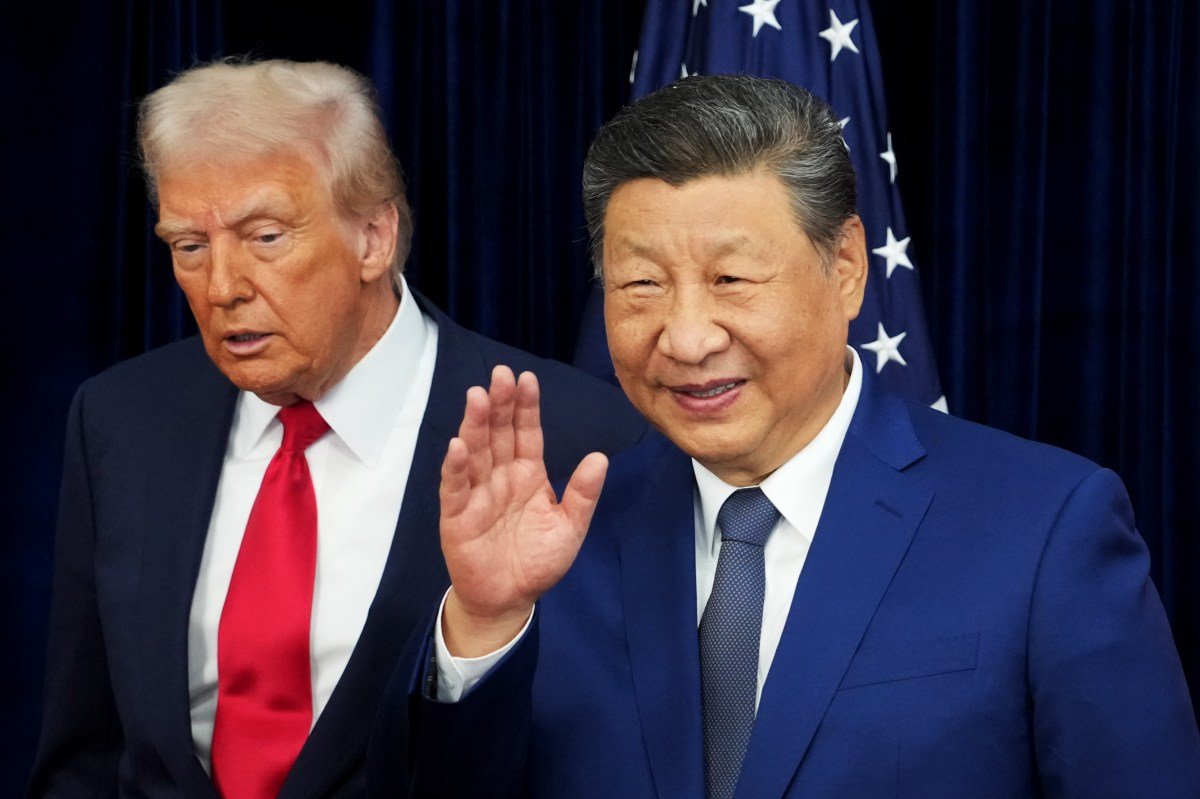
The upcoming meeting between President Donald Trump and Chinese President Xi Jinping will be a high-profile moment in the U.S.–China relationship. It’s also an opportunity to de-escalate both tariffs and tensions between the world’s two largest economies.
It’s been a year since President Trump issued major tariff hikes on China and other U.S. trading partners as part of what he called a large-scale effort to bring manufacturing back to the United States. That patriotic goal makes sense in critical sectors, but it’s not realistic, possible or even desirable for all manufacturing. We should make more cutting-edge semiconductor chips in the United States, but it’s not clear that anyone benefits from U.S. factories making more pencils or purses at many times the cost.
On the other hand, President Trump’s tariffs, dating back to his first administration and accelerating over the past year, pushed many companies to diversify beyond China. One example is Mexico, which has emerged as a strategic manufacturing hub. According to a recent Brookings report, Mexico more than doubled its exports of technology products like data servers, motherboards and data center components–many to the United States. Meanwhile, consumer technology imports from China fell from 45 percent in 2024 to 22 percent in 2025.
We should welcome this trend. Tariffs may re-route supply chains in the short term, but a complete reshoring of consumer technology manufacturing isn’t possible. We don’t have the facilities, supplier ecosystems or workforce to manufacture at the capacity that would be required.
Resilience does not mean pulling everything back within U.S. borders. Real resilience comes from diversifying. That means reshoring where it makes sense, near shoring where it’s efficient, ‘friend shoring’ with trusted allies and trading partners and recognizing that trade with countries like China will continue to be part of the economic mix. This is especially true in critical minerals, where Chinese firms dominate between 60 percent and 90 percent of processing capacity for many materials, when they are mined elsewhere, including the United States.
Manufacturing today is deeply global by design. Components are sourced from dozens of countries, assembled with extreme precision and scaled to meet worldwide demand. Recreating that entire ecosystem inside U.S. borders—quickly and at competitive cost—is not realistic. CTA research found moving all consumer technology manufacturing back to the U.S. would require roughly $500 billion in direct investment over 10 years and a more than tenfold increase in the manufacturing workforce.
Strong global trade can work in tandem with efforts to build American manufacturing. A modern, rules-based global trade system that rewards innovation and protects intellectual property helps American companies compete abroad. Efforts to ratchet down tariff rates and bring down nontariff barriers can also support a ‘Make in America’ manufacturing revival. Tariffs on parts or machine tools that typically cannot be bought in the United States make it harder for companies manufacturing in America to compete. That’s especially true for small businesses and startups that operate on low margins. Tariffs used broadly to enable a sweeping industrial policy without complimentary policy to strengthen our workforce make the U.S. less secure, less competitive and less innovative over time.
That would be a tragedy, especially given great work by the White House to support American-led innovation in AI and other emerging technologies. In a time of growing global competition, the Administration’s focus on AI innovation is welcome and necessary. But innovation does not exist in a vacuum. It depends on access to markets, clear and enforceable trade rules and predictability for businesses of all sizes.
We also need an honest national conversation about talent.
Immigrants are part of the secret sauce of American innovation. Many are the engineers, entrepreneurs and scientists who choose to build their futures here. Others will help support the factory build out and operations this administration envisions. We need a future-focused approach to immigration policy that helps the U.S. attract and retain the world’s best talent.
We should expand high-skill visas and create clear pathways for graduates in STEM fields to stay and work in the United States, ensuring employers can fill critical roles. The Stanford Institute for Human-Centered AI’s latest AI snapshot suggests that our country is finding it harder to attract AI talent, with the number of AI scholars moving to the United States down 80 percent in the last year alone. That’s not good news for American innovation!
The Trump–Xi meeting can reset and help build a more stable road forward–paving the way for more sustained U.S.-China engagement. The ultimate goal should be to reduce tensions and build some level of trust and understanding. This helps to avoid future crises that upend global supply chains and hurt American businesses reliant on goods made only in China. It could also set the stage for more durable wins for American business, including enforceable agreements to curb China’s unfair economic practices. President Trump’s “Phase One” deal with China in 2020 took the first step toward a practical economic relationship between two competitors. The upcoming summit could help us take a few more.
Gary Shapiro, Executive Chair, Consumer Technology Association (CTA),



