
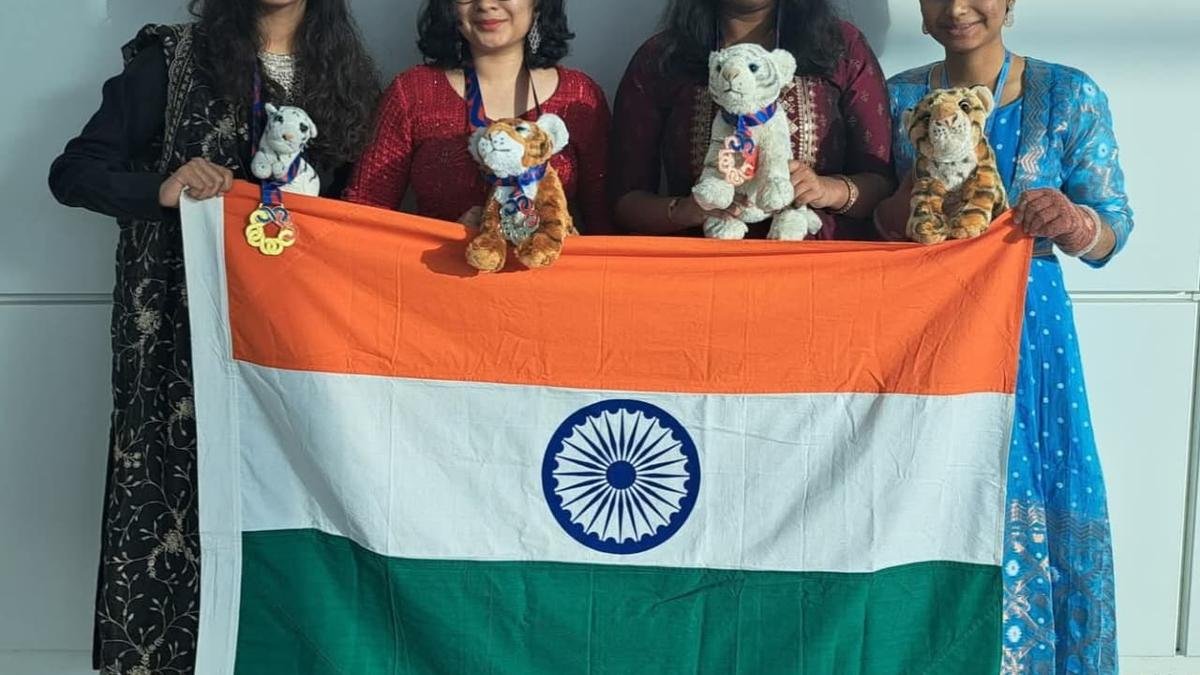
Sixteen-year-old Shreya Mundhada can spend hours working on a mathematics problem without knowing whether she will solve it.
(Sign up for THEdge, The Hindu’s weekly education newsletter.)
Sometimes the answer comes. Sometimes it does not. Yet that uncertainty is precisely what keeps her interested. “If you are not able to solve a problem, it doesn’t necessarily mean you don’t understand mathematics,” she said. “It might simply be a difficult problem.”
Later this year, Ms. Mundhada a student from Pune, will represent India at the International Mathematical Olympiad (IMO) in Shanghai, one of the world’s most prestigious competitions for school students. But her journey into mathematics began long before Olympiads and international contests entered the picture.
Non-routine mathematics
Homeschooled since childhood, she grew up studying at her own pace. Mathematics was always among her favourite subjects, but it was only when she attended a camp organised by the Raising a Mathematician Foundation, while in Class 8 that she encountered what she describes as “non-routine mathematics” — problems that did not resemble the exercises found in textbooks.
“That was amazing,” she recalled. “I got to know a lot more people who knew as much about maths and that gave me some sort of community.”
Her experience points to a growing effort among educators, mathematicians and Olympiad mentors to expose students to mathematics beyond school examinations and prescribed curricula. At a time when mathematics continues to be among the most feared subjects in Indian classrooms, these initiatives are trying to present the subject through puzzles, exploration, discussion and collaborative problem-solving.
For many students in India, mathematics is often associated with marks, coaching classes and board examinations. Anxiety around the subject is so widespread that it has become part of the larger conversation around academic stress in India.
Those working with mathematically gifted students acknowledge that challenge, even though their primary focus lies elsewhere. “We focus on identifying and nurturing mathematical talent across the country,” said Vinay Nair, secretary of the Raising a Mathematician Foundation, a non-profit organisation working with school students interested in mathematics.
Founded in 2014, the organisation conducts residential camps, online programmes and a growing network of Math Circles in different cities.
In these programmes, Mr. Nair said, students are introduced to areas of mathematics that are rarely encountered in school. “They get exposed to mathematics outside of the school curriculum so that they can make a more informed decision about what kind of courses they want to pursue in college and what kind of careers they want to pursue later,” he said.
The organisation currently reaches around 2,500 students annually through its various initiatives. Among them are Math Circles, weekly sessions where students learn directly from mathematicians rather than through conventional classroom instruction.
The concept originated in Russia nearly a century ago but remains relatively new in India. “We run six Math Circles across India,” Mr. Nair said. “In Math Circles, students learn mathematics outside of the school curriculum. It is more like exploration, solving a puzzle or sometimes even like a game where they have to think and come up with a strategy.”
That distinction, he believes, is important.
Many students, he said, develop a fear of mathematics because they encounter it primarily through procedures, memorisation and abstraction. “Children usually get scared of mathematics because of its abstraction sometimes, or because they feel there is a lot of memorisation that they need to do,” he said. “But in reality, mathematics is a beautiful subject where you can explore, you can play around, like art, and still get excited about the subject.”
The foundation also conducts teacher training programmes that encourage educators to present mathematics through reasoning and logic rather than purely procedural methods.
A sense of community
At the same time, Mr. Nair is careful not to claim that such programmes eliminate mathematics anxiety.
In fact, he says the foundation’s work is primarily aimed at students who already possess an interest in the subject.
“I wouldn’t say students who come for these programmes will have their fear of mathematics go away,” he said. “We are going to present them something more challenging.”
Its focus, he explained, is on identifying students with aptitude and providing them with opportunities that regular school curricula may not offer. “There are students who have potential, but they may not be identified,” he said. “Our role is to nurture that potential.”
For Ms. Mundhada, one of the most significant aspects of this ecosystem has been the sense of community that accompanies it. Contrary to the popular image of mathematics as a solitary pursuit, much of her Olympiad preparation has involved learning alongside other students.
After qualifying for national-level camps, she became involved with student-run initiatives such as the Sophie Fellowship and the Online Math Club, where senior Olympiad students mentor younger participants through classes, discussions and problem-solving sessions.
“Most of my training after that point has been through that,” she said.
The programmes are run almost entirely by students. Participants conduct weekly classes, prepare problem sets and offer personalised guidance to juniors struggling with specific topics. “It is generally a very close-knit community,” Ms. Mundhada said.
One of the most valuable parts of the experience, she added, is group solving. “There is a lot of group solving that goes on, which is really great,” she said. “Ideas are shared. It feels really fun and collaborative.”
Collaborative, not competitive
The collaborative aspect is notable because mathematics competitions are often perceived as intensely individual pursuits. The IMO itself is an individual contest, even though students travel and prepare as national teams. Yet many participants say collaboration forms a large part of their learning process.
“There isn’t really any pressure about how much a single person is contributing,” Ms. Mundhada said. “The community is really helpful and people are very nice.” She believes that exposure to this culture can help students develop a healthier relationship with mathematics.
At school level, she said, there is often excessive emphasis on prescribed methods. “I think there is a little bit too much focus on the specific methods and the method that is told in the book,” she said.
Olympiad mathematics works differently. The problems are deliberately designed to be unfamiliar and difficult. Students are expected to spend long periods experimenting with ideas that may not immediately work. “Especially in Olympiads, the problems are meant to be that way,” she said. “They are completely original ideas.”
The challenge, according to Ms. Mundhada, is learning to remain comfortable with difficulty. “You spend one and a half hours on a problem, but still continue to try it and enjoy the process,” she said. That process is not always easy. She acknowledged that the pressure associated with competitions increases over time, particularly when students begin performing well and expectations rise.
“It does happen,” she said. “The pressure does increase over the years.” Her solution is surprisingly simple. Take a break. “Sometimes just group solving with other people works because that takes out the pressure and the competitive part of it,” she said.
She also emphasises something often overlooked in discussions around academic excellence. “The importance of maintaining a sleep schedule is underrated,” she said. “Sleep enough, go out, touch grass.” The idea that learning can be collaborative rather than purely competitive also appears in other Olympiad ecosystems.
Prof. Achutha B.S., coordinator of the Indian Junior Science Olympiad and Head of the Department of Physics at V.V.S. Sardar Patel PU College in Bengaluru, said collaboration has become an important component of science training as well.
The Indian Junior Science Olympiad, conducted for students of Classes 8 to 10, includes group practical examinations where participants work together to solve problems. “One different thing from other Olympiads is that here students perform practical examinations in groups,” he said. “Right from this age students develop a collaborative approach to solve problems.”
Students work together for several hours, dividing responsibilities across physics, chemistry and biology before presenting solutions collectively. “The idea is that they learn a collaborative approach,” he said.
Prof. Achutha believes such experiences reflect the realities of modern scientific research. “Most major research today is a collaborative effort,” he said. “A student getting this exposure at this point of time is very important.”
Every year, nearly 60,000 students appear for the first stage of the Junior Science Olympiad selection process. After multiple rounds of examinations, camps and training sessions, six students are selected to represent India internationally. The process is rigorous, involving lectures, problem-solving sessions, practical training and multiple rounds of assessment. Yet even within such competitive environments, educators increasingly emphasise collaboration and peer learning alongside individual achievement.
For Ms. Mundhada, that may be one of the most important lessons she has learned through mathematics. The subject remains difficult. Olympiad problems remain frustrating. Not every question has an immediate answer. But difficulty, she says, should not automatically become a source of fear.
At every stage, she believes, learning requires patience. “It will be hard work,” she said. “Just start from the things that you understand and work through it slowly. You will start enjoying the process.”
(Danish Pandit is a journalist and a documentary filmmaker based in Delhi.)



