
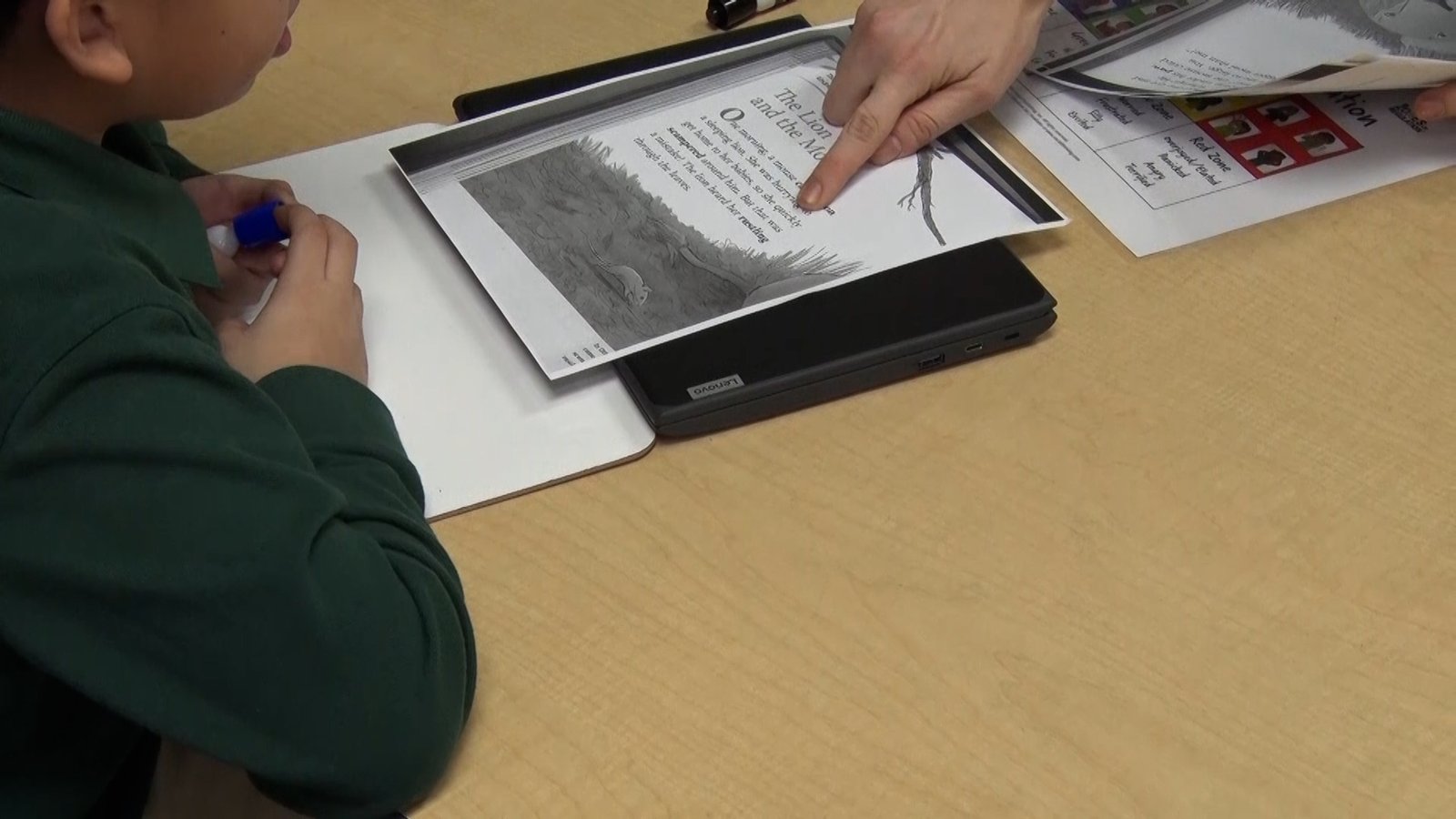
Pulling apart and smushing sounds to form words— what experts refer to as “phonemic awareness” — proved troublesome to most K-3 students at the school year’s start, according to early data from New Jersey’s first mandatory universal literacy screening.
What’s more, historic reading proficiency gaps statewide could be narrowed by teachers who can use that information to shape classroom instruction, education leaders say.

Under a 2024 law, this academic year marked the first time New Jersey teachers were mandated to evaluate K-3 students on the foundational skills needed for reading, better known as universal literacy screening.
“For the first time, we have clear statewide visibility into literacy screener usage,” said Jorden Schiff, assistant commissioner at the state Department of Education. State education leaders presented early screener data from the fall at a state school board meeting this month.
“This level of transparency allows us to better support districts and communicate more clearly with families about how students are being assessed and supported,” Schiff said.
Screeners, or tools to evaluate reading skills, must be administered at least twice a year, the law states. School districts must provide parents with their students’ results within 30 days.
Reading proficiency slumped statewide and nationally after the COVID-19 pandemic shifted classroom learning to online, and uneven access to reliable internet and digital devices further widened achievement gaps.
Reading proficiency dropped further below statewide averages for Black and Latino students, as well as English language learners and economically disadvantaged students. Scores from the 2024 National Assessment of Educational Progress showed more than half of fourth graders in all states struggling with reading proficiency.
In New Jersey, 38% of fourth graders showed reading proficiency on the 2024 national test, compared with 49% in 2017.
Students who lack reading foundation skills may face greater dropout risk and limited career opportunities, research shows, making the stakes high in New Jersey where many third graders are not reading on grade level.
Requiring schools to administer literacy screeners to all K-3 students “has significant implications for closing long-standing achievement gaps,” Lisa Haberl, executive director of teaching and learning at the state Education Department said at a state school board meeting earlier this month.
Predicting challenges
Screeners evaluate five reading foundational skills: naming letters; phonemic awareness, or identifying sounds and words; phonics, or decoding words; oral reading; and reading comprehension.
Roughly 75% of school districts use state-approved screeners, department officials said, including Dynamic Indicators of Basic Early Literacy Skills and i-Ready.
About one in four school districts didn’t share screener data with the state Education Department, and a smaller proportion are using non-approved screeners, according to the department.
Overall, 43% of students were reading below grade level, while 57% were at or above grade level, according to the data presented at the state school board meeting.
About 54% of students were below grade level in phonemic awareness, 52% were below grade level in phonics and 52% were below grade level in reading comprehension.
Phonemic awareness involves word sounds, and phonics “connects what a student is seeing to what a student is hearing,” Paula White, executive director at JerseyCAN, a literacy advocacy group, told NJ Spotlight News.
Phonics bridges visual print with speech, an essential reading fluency skill.
Paula White shared a list of questions parents can ask school leaders:
- Has your district submitted universal screener data to the state Department of Education?
- Has the Department of Education identified your district’s screener as a high-quality one?
- What is the name of your district’s literacy curriculum and how does it address the five literacy areas of New Jersey’s law: letter-naming, phonemic awareness, phonics, oral reading and comprehension?
- What are the top three interventions your district is using to support students who are not on grade level?
- What is your district doing to engage and educate parents about raising a great reader?
“It does give us pause when we have more students that are coming into school challenged around phonics and phonemic awareness because those are really predictive of challenges later on,” White said. “This is letting us know where our students need to be supported in order for them to get to where they need to go with reading.”
Students did better naming letters, with about 60% meeting or exceeding grade-level expectations, and reading aloud, with about 61% hitting that mark.
Where’s the trouble?
Education leaders emphasized screeners are an instruction tool, and not the same as state assessments.
“The goal is simple: Screen early so we can support students sooner,” Haberl said. “Universal screening shifts our approach from reaction into prevention.”
Early intervention with reading difficulties helps prevent minor challenges from becoming significant barriers to learning, research has shown.
White compared the literacy screeners with other tools that help to identify children’s support needs, such as hearing and eye exams.
“A literacy screener is the same idea — it’s simply a way to find out how best to support a child in their learning,” White said.
Screeners that show a child is aware of grade-level phonetic awareness but struggles with phonics can let a teacher and parent know that “connecting the auditory to the visual is where their kid is having trouble,” White said.
Screener results allow teachers, tutors and the school team to focus instruction
“It’s OK if children start the school year and they don’t have this knowledge,” said White, adding that results from later months are more telling.
$50 million grant
New Jersey’s literacy law requires two screeners annually, at the start and end of the school year.
“We really need to have a sense of urgency in regards to putting out this fire of our students not being able to read on grade level,” said Nedd James Johnson, state school board vice president.
Education Commissioner Lily Laux said the state department plans to give updates on literacy efforts more regularly.
Through a $50 million grant to be used over five years, the state awarded $6 million in the fall to 41 school districts to hire literacy coaches, who train educators in teaching literacy skills.
White said she’s a proponent of more literacy coaches.
“Even LeBron James has a coach,” White said. “Great teachers need to have a coach, too.”



