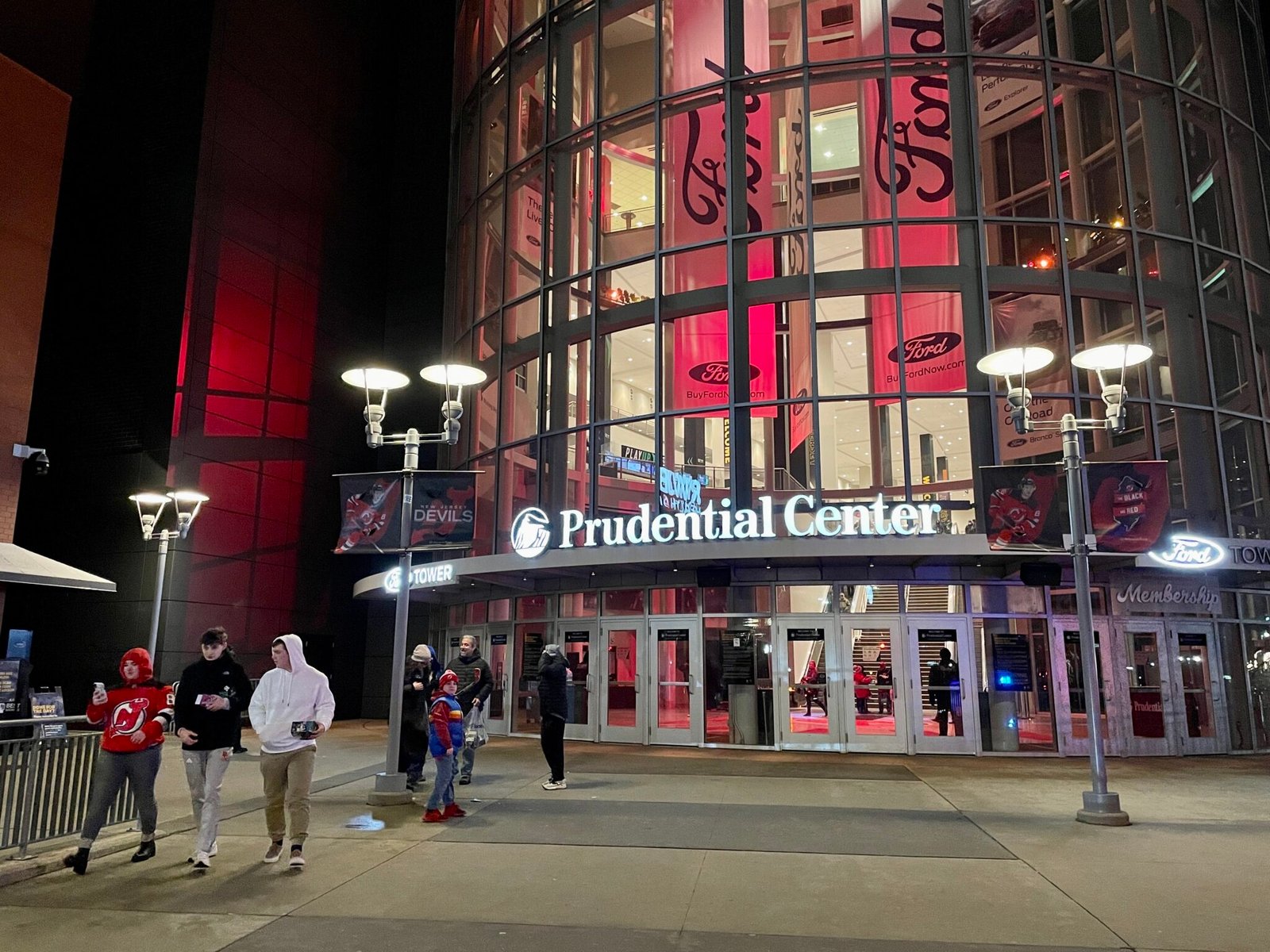
A bill that would expand the state’s corporate tax incentive programs by billions and extend new tax subsidies to Newark’s Prudential Center was advanced by Assembly lawmakers Monday over the objections of critics.
The measure, which won 10-2 approval from the Assembly’s economic development committee, would pour an additional $2.5 billion into the state’s marquee tax incentive programs and extend up to $300 million in state subsidies for renovations at the Newark arena. Assembly members Dawn Fantasia (R-Sussex) and Alex Sauickie (R-Ocean) voted no.
“It’s at the point where it needs to have major renovations in order to not only make sure the only professional sports team that New Jersey has, which is the New Jersey Devils, can continue to play, but also so that they’re able to compete and bring in different spectators and bring in different shows,” bill sponsor Assemblywoman Eliana Pintor Marin (D-Essex) said.
Tax incentives for the publicly owned Prudential Center’s redevelopment faced resistance.
Though some witnesses praised safeguards in the bill that would allow the state Economic Development Authority to rescind awards under certain circumstances and require firms receiving incentives to make some public disclosures, they questioned whether the project would actually bring benefits to New Jersey.
“Almost every independent and neutral assessment of sports arena subsidies is that they are a bad deal for public investment broadly speaking,” said Peter Chen, a senior policy analyst at progressive think tank New Jersey Policy Perspective. “They almost never pay back the promised revenues, and when looking at municipality or countywide revenues, they tend not to make any effect at all.”
The bill would require the Prudential Center’s renovation to generate economic activity equal to at least 150% of the tax incentives it receives. Because awards are capped at 80% of a project’s costs or $300 million, whichever is less, the requirement could mandate the Prudential Center generate $450 million in economic activity.
Jake Reynolds, president of the New Jersey Devils and the Prudential Center, told the panel the arena had more than $680 million in annual sales and generated $30 million in state tax revenue and $4.5 million in Newark taxes annually.
Reynolds argued that investment is needed to keep the arena in good repair and competitive with other stadiums in the region and country.
“With the age of the building and the 23 million visitors that have continued to come through the doors since the opening, along with the more than 3,000 events we have hosted there, it has taken a toll on the facility’s infrastructure,” Reynolds said. “The time has come for a full-scale renovation.”
Though New Jersey’s constitution bars the Legislature from passing special tax legislation — bills that single out localities for special treatment, positive or negative — language in the bill advanced Monday would guarantee that only the Prudential Center is eligible for the award.
To be eligible for incentives, a venue must seat at least 15,000 and have operated for at least 15 years in a city with an international airport in a non-coastal county with at least 550,000 residents and a density of not less than 3,000 people per square mile.
New Jersey has only two international airports, Newark Liberty International Airport and Atlantic City International Airport, and Atlantic County does not meet the population or geography requirements.
Separate provisions expanding funding for the Aspire program, which provides gap financing, and the Emerge Program, which provides per-job tax credits to boost job creation, drew some opposition from witnesses, both over their breadth and the timing of the bill’s movement.
Dena Mottola Jaborska, executive director of New Jersey Citizen Action, cautioned lawmakers against advancing the bill outside of budget negotiations, noting the state already plans to spend about $1.5 billion more than it brings in through taxes during the current July-to-June fiscal year.
Outlays could expand that deficit in the budget lawmakers are set to approve in June, and the loss of federal funding and programs could further strain New Jersey’s finances, Jaborska said.
“We are in for a very brutal budget. Our communities that we serve … are already dealing with the loss of so many supports and benefits and programs, so you are talking about taxpayer dollars going towards these wealthy corporations, 3 billion dollars’ worth, at a time when we’re going to have a hard time balancing our budget heading into next year,” she said.
Other witnesses hailed the $11.5 billion tax incentive programs as boons for the state’s economy and said they need more money because existing funding had been drawn down since lawmakers created them in late 2020.
“[Aspire] is really chugging along, and has quite a robust pipeline of projects. At the end of 2025, as a result of that, we have run out of tax credits,” said Tony Pizzutillo, a lobbyist for the New Jersey chapter of the National Association for Industrial and Office Parks, a commercial real estate advocacy group.
Another bill advanced Monday would require film production companies receiving tax credits from the state to only use domestically produced original music and scores in their work.
Industry representatives cautioned that the bill could make New Jersey film production less affordable. The American Federation of Musicians of the United States and Canada argued the requirement would ensure taxpayers see the benefits of their tax dollars, a view that found some support among lawmakers.
“Tax credits are supposed to create in-state and in-country jobs, strengthen regional economies, and generate returns for taxpayers. When productions outsource music recording abroad, that purpose is undermined,” Fantasia said.
Assemblyman Brian Bergen (R-Morris) voted no.
Because tax incentives affect state revenue, the bills would need to advance through the Assembly Appropriations Committee before reaching the chamber’s floor. Senate companions for both bills have yet to reach the floor in the upper chamber. The new legislative session begins on Jan. 13.
GET THE MORNING HEADLINES.