
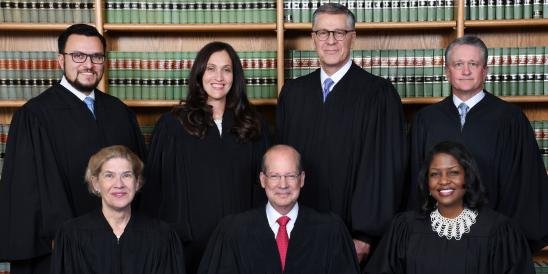
New Jerseyans have the right to examine communications by government officials who use private email accounts to discuss public business, the New Jersey Supreme Court ruled.
In a unanimous decision issued Thursday, the state’s highest court ruled that email logs of government-related correspondence must be disclosed under the Open Public Records Act, or OPRA, even when public officials use personal email.

“Because the government-related emails themselves are government records, so too are the logs of the personal email accounts where those emails are housed,” Justice Fabiana Pierre-Louis wrote for the court.
The ruling stems from a January 2023 case filed by Alex Rosetti, whose request for email logs was denied by the Ramapo-Indian Hills Regional High School Board of Education. Rosetti sought logs for all email accounts used by current and former trustees to discuss board business.
The school board provided a redacted log from the members’ official board accounts and said it had no obligation to provide private email logs. It also argued that creating logs from individual email accounts would be difficult.
Rosetti argued that it would be impossible to request specific emails without a list of exchanges that involved school board matters. A log typically includes senders, recipients, dates and subjects of emails. Rosetti said board members could use their email programs’ search function to generate such a list.
‘Within OPRA’s reach’
A trial court denied Rosetti’s request, though the appellate division reversed that.
The high court found that if board business is being discussed via private emails, logs of such emails must be provided in response to an OPRA request. A log should list only those emails involving public matters.
“We reiterate that emails related to government business, whether stored on government or private servers, are within OPRA’s reach, so using a private email account will not shield those government records from production under OPRA,” the decision states.
The court went further, admonishing board members for discussing public business using private emails, and urged an end to the practice statewide.
“The issues in this case could have been avoided altogether if Board members did not use their private email accounts to conduct Board business and instead used only their government-issued email accounts, as intended,” Pierre-Louis wrote. “Government agencies should strongly advise their employees, elected officials, and others engaged in government-related business to refrain from using their personal email accounts when conducting government-related business.”
The court ordered board members to search their email accounts and produce a log of government-related emails only, then submit a certification of their work so that a lower court can determine if the searches were proper and captured all relevant emails.
Hailing decision
Attorney Donald Doherty Jr., who represented Rosetti, called the decision “significant.”
“Obviously, it is a very good day when the Supreme Court so clearly reaffirms the commitment open government,” Doherty said said. “On the other hand, it leaves me deeply troubled that the case had to go this far. Government candor and honesty have all too often been cast aside for either corruption or expediency on every level.”
The case drew a number of friend-of-the-court briefs. The New Jersey League of Municipalities and then-Attorney General Matt Platkin had argued, alongside the school board, that OPRA does not require the release of private email logs. The American Civil Liberties Union took the opposite position.
“Today’s decision was a great vindication of the public’s right to monitor the actions of its government,” said CJ Griffin, a lawyer who specializes in public records and First Amendment cases. “My hope is that the public agencies will follow the Supreme Court’s unanimous instruction that government employees and officials should not use personal email accounts to conduct government business.”



