
Welcome to Foreign Policy’s Southeast Asia Brief.
The highlights this week: Indonesia’s president visits Moscow even as he signs a U.S. defense agreement, Vietnam’s To Lam consolidates power, and a survey shows Southeast Asian leaders would pick China over the United States, if forced to choose.
Prabowo Is Rowing Between Two Reefs
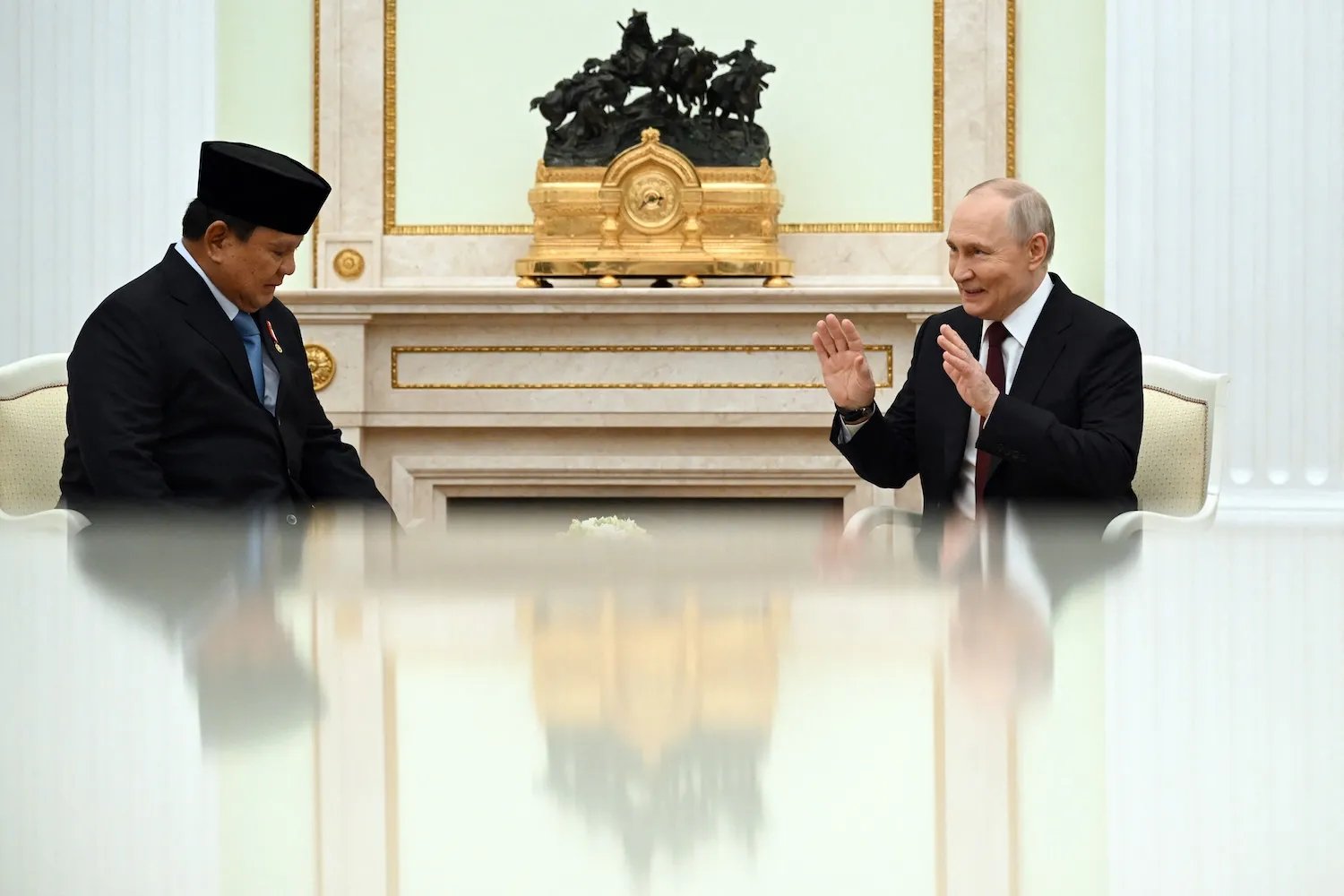
Indonesian President Prabowo Subianto met with Russian President Vladimir Putin in Moscow on Monday. According to readouts, the two presidents agreed to increase cooperation on energy and economic issues.
Few details beyond this have been forthcoming. However, Indonesian Cabinet Secretary Teddy Indra Wijaya said discussions included “long-term cooperation” in the oil and gas industries.
Indonesia is also looking at purchasing Russian oil to make up for disrupted supplies from the Middle East, according to a statement from Russia’s energy minister.
In a short speech, Prabowo said that he “came to consult because the global geopolitical situation is experiencing very rapid development and changes. We view Russia as having played a very positive role in navigating this uncertain geopolitical climate.”
The very same day, Indonesia and the United States announced a new defense cooperation agreement.
The agreement focuses on military modernization and capacity-building, military training and education, and exercises.
The two countries are discussing an agreement that would let U.S. military aircraft freely access Indonesian airspace.
In some ways this is classic Indonesia. Since independence, its foreign-policy philosophy has been “rowing between two reefs,” or avoiding aligning with any one power.
However, this mix of summitry and security diplomacy is also distinctly Prabowo. Since his election in 2024, the Indonesian president has been on a mission to increase Indonesia’s international profile.
To this end he has made frequent trips abroad to meet with other national leaders, often calling for diplomacy and peace.
Prabowo has also overseen Indonesia joining both BRICS and U.S. President Donald Trump’s Board of Peace, as well as volunteering Indonesian peacekeepers for Gaza. These are the sorts of decisions that other presidents might have steered clear of.
Security issues have been the other major feature of his diplomatic push. In February, Prabowo oversaw the striking of a new security pact with Australia. This followed the establishment of a new Joint Foreign and Defense Ministerial Dialogue with China in 2025.
Concrete results so far are unclear. In particular, the decisions to get close with the United States and involve Indonesia in the Middle East have proved controversial domestically.
Some see Prabowo as weak-kneed on the issue of Palestine. The recent deaths of three Indonesian peacekeepers stationed as part of a preexisting deployment—one killed by Israel and two likely by Hezbollah, according to U.N. investigations—has amped up the controversy.
Talk of overflight rights, a privilege usually granted to allies, has also raised eyebrows. The foreign ministry has privately warned the defense ministry that it risks entangling Indonesia in potential South China Sea conflicts.
In this context, a visit to Russia with a clear domestic benefit of securing fuel may go down better.
Vietnam’s To Lam becomes president. To Lam was unanimously elected president of Vietnam by the country’s National Assembly last Tuesday. Earlier this year, he was also reappointed to the more powerful position of general secretary of the Communist Party of Vietnam.
Lam has succeeded in his push to centralize power in his own hands, moving away from the more collective leadership system Vietnam previously practiced.
Chosen as prime minister was Le Minh Hung, formerly the governor of Vietnam’s central bank. Le’s technocratic credentials fit with Lam’s aggressive push to raise growth. He is also seen as close to Lam personally. Le’s father used to be Lam’s boss.
Lam has followed his election with a visit to China this week.
Vietnam has been strengthening relations with China in areas including trade, tech, and security. But Lam has also moved to cultivate close ties with the U.S., joining Trump’s Board of Peace.
Singapore holds firm on Hormuz. Singapore has no plans to negotiate with Iran to let its ships pass through the Strait of Hormuz, Minister for Foreign Affairs Vivian Balakrishnan said in response to a question in Parliament.
Balakrishnan went on to say the right to transit is established in international law. “The Strait of Hormuz, just like the Straits of Malacca and Singapore, are examples of Straits Used for International Navigation. No ifs, no buts, no questions, as far as we are concerned,” Balakrishnan said. “There is a right of transit passage. It is not a privilege to be granted by the bordering state, it is not a license to be supplicated for, it is not a toll be paid. It is a right of ships to traverse. This right is enshrined in the United Nations Convention on the Law of the Sea.”
Why is Singapore so hung up on this?
“You may be wondering why I am taking such a legal and strict definition. It is not because I am particularly obsessed with law, but because the Straits of Malacca and Singapore is in fact another critical choke point,” Balakrishnan explained. He noted the Strait of Malacca was not only narrower than Hormuz, but it also saw greater flows of maritime oil and far more container trade pass through it.
The analogy is not perfect. As the Economist noted, if the Strait of Malacca closed, a lot of the trade could be redirected to other passages. But Singapore’s economy is built on its status as a trade hub. Other Southeast Asian countries—including Malaysia, the Philippines, Thailand, and Vietnam—have struck deals with Iran for safe passage.
Police are sprayed by revelers taking part in mass water fights on the first day of Songkran, or Thai New Year, in Bangkok on April 13.Anthony Wallace/AFP via Getty Images
FP’s Most Read This Week
A news investigation by the Organized Crime and Corruption Reporting Project and the Guardian Australia unravels the links between a proposed Timorese blockchain resort, Cambodian conglomerate the Prince Group, and crypto company World Liberty Financial, co-founded by members of Trump’s family.
Jack Board digs into the tragic story of Bua Noi, an elderly female gorilla kept alone in a cage on the seventh story of a Bangkok mall, in Channel News Asia.
“I didn’t understand why I was being deported to Africa because I’m Cambodian.” After serving a 15-year prison sentence for attempted murder, Pheap Rom—whose became a permanent resident of the U.S. in 1985—was deported to the tiny African country of Eswatini. Now repatriated to Cambodia, he talks about his experience to AFP, republished in the Straits Times.
Upward of half of Thailand’s fishing fleet is sitting in port due to high diesel costs—and the catch is plummeting. By yours truly in Nikkei Asia.
Numbers of the week: ASEAN prefers China
If they were forced to choose, a slim majority of key Association of Southeast Asian Nations (ASEAN) decision-makers would side with China over the United States, 52 percent to 48 percent.
That’s according to the State of Southeast Asia report by the ISEAS-Yusof Ishak Institute, which polled government officials, civil society representatives, and senior private-sector decision-makers in the region. In 2025, the U.S. had enjoyed a similarly slim majority.
Two things to note here. First, this poll came before U.S. strikes on Iran unleashed brutal economic turmoil in the region. Current U.S. standing may well be even worse. Second, there are big variations between countries on this issue. Indonesia (80.1 percent) and Singapore (66.3 percent) stand out as notably pro-China, the latter seeing a huge jump in pro-China sentiment since 2025. Meanwhile, the Philippines still strongly prefers the United States.
The shift reflects various factors. The most striking is fear of the United States. Asked to rank geopolitical concern, poll respondents listed U.S. leadership under Trump as their biggest worry. The second-biggest worry was actually scam-center operations, testament to just how massive and disruptive these criminal enterprises have become.
China’s aggressive behavior in the South China Sea only came third—whereas in 2025 this was the top concern. Meanwhile, China continues to be seen as by far the most influential country in the region.
Just over half of respondents ranked Beijing as the most influential economic power, and 40 percent ranked it as having the most political and strategic influence.
While the above figures have generated a lot of buzz in the news, they don’t necessarily reflect the region’s priorities. Firstly, when given the option, 55.2 percent said ASEAN should not side with either power and instead try strengthening itself so it can steer its own course. Secondly, neither’s power was very welcome, with more than half of all respondents worried about the growing economic and strategic influence of both China and the U.S. over the region. Thirdly, when asked about the biggest challenges facing Southeast Asia, the top three issues were climate change, economic competition between major powers, and domestic political stability.
Great-power geopolitics, in other words, is not top priority.



