
Russian President Vladimir Putin has a lot to worry about these days. What he originally planned as a quick regime-change operation in Ukraine has now gone on longer than the Soviet Union’s fight against Nazi Germany, and Kyiv is increasingly bringing the war to the Russian heartland. (On June 3, guests at Putin’s showcase international forum in St. Petersburg awoke to the sight of blazing fires from Ukrainian drones.) The Russian economy is showing serious signs of strain. And even China, Putin’s most important friend and patron, has shown that it’s not willing to give Moscow unlimited support.
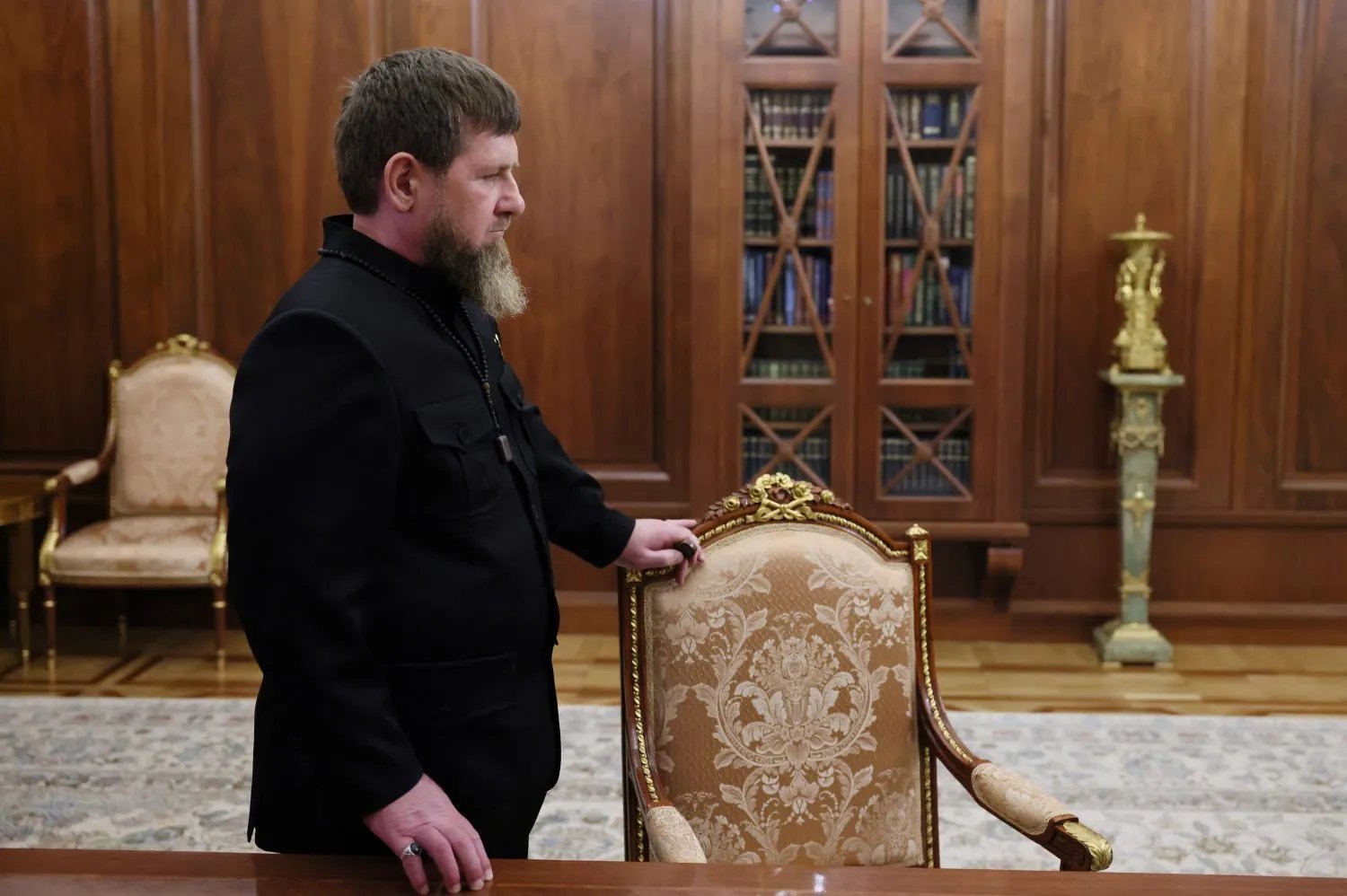
But there’s another problem brewing in the background—one that could produce serious instability at a time when Putin can least afford it. The Kremlin is confronting a potentially explosive succession crisis in Chechnya, the North Caucasus republic that has a long history of generating turmoil entirely out of proportion to its tiny size. The problem: Chechnya’s all-powerful leader, President Ramzan Kadyrov, 49, is suffering from a serious illness, probably terminal, that could remove him from the scene at any moment.
Russian President Vladimir Putin has a lot to worry about these days. What he originally planned as a quick regime-change operation in Ukraine has now gone on longer than the Soviet Union’s fight against Nazi Germany, and Kyiv is increasingly bringing the war to the Russian heartland. (On June 3, guests at Putin’s showcase international forum in St. Petersburg awoke to the sight of blazing fires from Ukrainian drones.) The Russian economy is showing serious signs of strain. And even China, Putin’s most important friend and patron, has shown that it’s not willing to give Moscow unlimited support.
But there’s another problem brewing in the background—one that could produce serious instability at a time when Putin can least afford it. The Kremlin is confronting a potentially explosive succession crisis in Chechnya, the North Caucasus republic that has a long history of generating turmoil entirely out of proportion to its tiny size. The problem: Chechnya’s all-powerful leader, President Ramzan Kadyrov, 49, is suffering from a serious illness, probably terminal, that could remove him from the scene at any moment.
Kadyrov’s favored successor, his 18-year-old son Adam, is too young to assume the throne. Putin could try to keep the Kadyrov family in power by allowing Adam to exercise nominal control under the guidance of a trusted ally or even a regent from Moscow. But such a solution could turn out to be harder than it looks. Ramzan’s harsh rule over the past 22 years—prompting some to dub him the Kim Jong Il of the Caucasus—has left behind countless grievances in a clan-based culture with deeply ingrained blood feud traditions. He has also driven many of his rivals into exile, where they have been patiently waiting to even the score.
And over the past four years, another complicating factor has joined the mix: the war in Ukraine, where Chechens are fighting on both sides. The Ukrainians, who officially recognized Chechen independence from Russia in 2022, have been doing everything in their power to embolden the opposition to Kadyrov—knowing full well that sparking a new war in the republic would cause a massive drain on Russian resources at a time when Putin is already facing a dangerous new phase in his war on Kyiv.
The Ukrainians remember something that many Westerners have forgotten. Putin rose to the presidency on the back of his reputation as a ruthless suppressor of Chechen rebels in the late 1990s. The ex-KGB man boosted his popularity with Russian voters by promising to pursue Chechen separatists without mercy—“if we catch them in the toilet, excuse me, we will wipe them out in the shithouse,” as he once famously put it. In reality, he combined that tough-guy approach with pragmatic outreach to one of the leaders of the resistance movement: Akhmad Kadyrov, who served for six years as the republic’s top Muslim religious official.
Kadyrov had fought on the rebel side during the first Chechen revolt from 1991 to 1994, when Chechen nationalists took advantage of the weakness of the central government under then-President Boris Yeltsin. Chechen insurgents fought the Russian army to a standstill in a brutal conflict and declared de facto independence that lasted until 1999, when the Second Chechen War broke out.
Then-Prime Minister Putin took a hard-line course against the rebels on the battlefield. The Russians’ indiscriminate tactics, which killed countless civilians, previewed their brutality in their war on Ukraine. At the same time, Putin made overtures to Kadyrov, who had come to oppose the radical jihadis who were coming to dominate the independence movement. He and Putin gradually worked out a deal. If Kadyrov and allied clans could suppress the insurgency and recognize the Kremlin’s sovereignty, then Putin would allow the new ruler to run the place as he saw fit—an autonomy no other Russian province enjoys. When Akhmat Kadyrov was blown up by a bomb in 2004, power passed to his son Ramzan—who has kept a tight grip on it ever since.
Ramzan Kadyrov has managed to pacify his notoriously fractious kingdom through unremitting brutality. Human rights groups have accused him of torturing, killing, and abducting his critics (including journalists) and of deploying collective punishment against the families of his opponents. The United States, the European Union, and Britain have sanctioned him for overseeing the abuse and murder of LGBTQ+ people.
Most strikingly, Kadyrov has imposed an ultraconservative regime of sharia law, including the promotion of polygamy, which is outlawed in the rest of the Russian Federation. Putin might well have taken offense at this crass violation of his carefully cultivated image of a Christian traditionalist; instead, he has showered the Chechen dictator with accolades and cash. The Kremlin transfers $3.8 billion to the republic each year, making up around 92 percent of its total budget.
This amounts to a giant slush fund for Kadyrov that he wields according to his personal whim. Aside from financing his lavish personal lifestyle, he’s used it to build up his own security forces—totaling 33,000 in all and loyal solely to him. They could become a major factor in any post-Kadyrov transition. He’s dispatched many of them to bolster the Russian war effort in Ukraine—though by most accounts they have turned out to be more effective at posting videos of themselves than taking part in combat.
Indeed, recent statistics show that Chechnya has suffered the lowest war casualty rate of any province in the Russian Federation—which, said University of Texas professor Michael P. Dennis, shows just how much slack Putin is willing to give his minion. Dennis noted that Putin has demurred from criticizing even the most outrageous of Kadyrov’s moves, such as the appointment last year of his teenage son Adam as the head of the Chechen Security Council. Putin has also refrained from auditioning potential candidates for Kadyrov’s job.
These are striking omissions. Putin is perfectly happy to publicly berate or summarily fire other regional leaders when he sees fit—but he clearly regards the Kadyrov problem as one to be handled with delicacy. Ramzan Kadyrov himself is clearly worried about what comes after. His moves to appoint his children to high positions despite their obvious unpreparedness suggests that he’s in a hurry to shore up power for his heirs while he still can. In recent years, he’s also made a concerted effort to marry his own children to representatives of other leading clans, another move designed to safeguard his legacy for his progeny. (Not to mention their personal safety—Chechen disagreements can have a tendency to get nasty in a hurry).
Nor has Ramzan Kadyrov stopped there. Over the years, he has cultivated close ties to a number of potentates in the Islamic world— his most notable friend being Mohamed Bin Zayed Al Nahyan, the president of the United Arab Emirates. It turns out that this charm offensive goes beyond merely burnishing Kadyrov’s Islamic credentials. He’s also parked vast sums of money in the UAE and encouraged members of his clan to invest heavily in the Emirati real estate market. One of his nephews has already applied to obtain Emirati citizenship—and others appear likely to follow. Were the Kremlin to topple Kadyrov from power, he’s already got a safe haven well-prepared. If he dies before the succession is secured, his family will know where to go.
It is hard to imagine that anyone in the Kremlin harbors the illusion that a post-Kadyrov transition can be smoothly managed. Recall that Ramzan Kadyrov, after so many years of his father’s unchallenged rule, needed at least five years to subdue his enemies after he came to power—even though his father had thoroughly prepared the way. In 2008, four years after Ramzan Kadyrov took the throne, his troops fought a gun battle with guerillas loyal to warlord Sulim Yamadayev, one of the Kadyrovs’ sworn enemies, that left 18 people dead. A year later, Yamadayev was shot dead in a Dubai parking garage.
The Kremlin knows this history well. Its Caucasus experts are undoubtedly working overtime on post-Kadyrov contingency plans. For now, though, one thing is for sure: The potential for serious volatility in Putin’s Russia is growing by the day.



