
Any attempt to write about Iran and an Iranian film seems to take place under the shadow of the news and the latest war to beset that country. “Reading Lolita in Tehran” addresses the war, all these wars, but in an oblique way, focusing instead on the power of literature to speak to oneself and one’s current circumstances. Even Nabokov and Jane Austen, it seems, have something to say about contemporary Iran.
The movie is the adaptation of the eponymous book published in 2003 by Azar Nafisi, and is to a very large extent autobiographical. Nafisi, a university professor of literature, went back to Iran following the 1979 Islamic revolution. This was a time of optimism and hope for many Iranians, coming after decades of dictatorship and oppression. But from the early scenes of Nafisi arriving at Tehran airport just a few months after the revolution, it becomes very clear that the new regime’s promises of liberation are giving way to new forms of ideological control. As the face of ayatollah Khomeini looms in the background or in worrisome reflection shots, the totalitarian nature of the Big Brother-like regime set up by the fundamentalists comes sharply into focus.
The picture is the story of that fundamentalism, but only through the subjective prism of a literature professor who believes, no matter what, that literature, critical thinking, and the freedom to think for oneself should prevail. Over the more than twenty years that the narrative encompasses, Nafisi goes through hope, disillusionment, despair, resilience and hope again, but never does she doubt the sheer usefulness of books. Although he is never mentioned, Ray Bradbury quickly comes to mind, and many scenes do recall “Fahrenheit 451”, where books are also a lifeline of humanist sanity in a world that has fallen prey to totalitarian insanity.
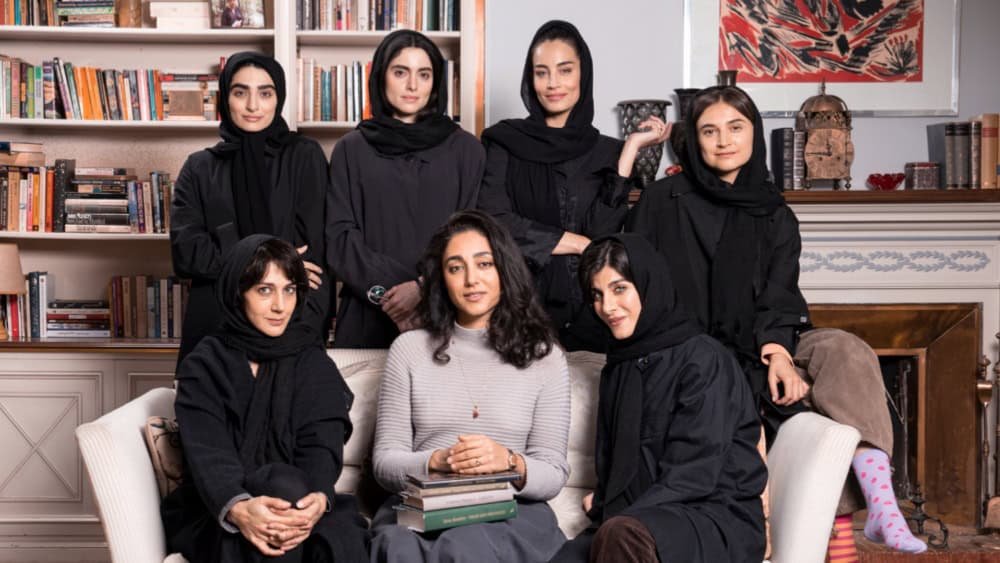
What books and fiction can provide is, among many other things, a sense of solidarity, as Nafisi, after she is forced to resign from her university position, opens a secret literature course and book club at home. There, in an oasis of intellectual ferment where women are free to take off their hijab and even put on makeup and jewellery, she welcomes her former students to discuss books, and through them their lives.
These scenes are the highlight of the feature, focusing as they do not on the horrors these women otherwise experience (some chilling sequences do give an insight into the horror they face) but on the aspirations, dreams, desires (including sexual ones) and longings that drive them. The books and fictional characters under discussion are illustrations of similar feelings and doubts, highlighting their shared human condition. The actresses are all excellent in that regard, from Golshifteh Farahani as the protagonist to Zahra Amir Ebrahimi and Mina Kavani as her diligent students. Like the film itself, they never overplay their roles and never bring the movie into full melodramatic mode, preferring instead an understated approach that gives greater weight to moments of quiet emotion and personal revelation.
Lolita is the subject of some of these debates, including how its depraved protagonist can be compared to the Iranian regime, imposing as they do their own fantasies on their female victims. But other authors are examined by the circle of women, including Jane Austen, whose pages are full of oppressed girls, arranged marriages and patriarchal oppression. These discussions never go very far or deep, which can be frustrating, especially given the richness of the works being discussed. The novels serve primarily as mirrors for the characters’ experiences, highlighting the human condition people – real or fictional – share with one another. These and other authors are also there to express these characters’ dreams of the West and the freedom it represents.
The original book was criticized for that very reason, but it is a fact of life that the West and its many freedoms is an invaluable source of hope for many men and women around the world – like the green light at the end of the dock that so obsesses Gatsby, as the protagonist herself explains. Or like the mythical garden Forugh Farrokhzad’s characters can glimpse through the cracked wall. The movie’s central concern is empathy: through literature, it insists on the possibility of recognizing common aspirations and vulnerabilities across political, national and gender divides, foregrounding empathy as a necessary quality between men and women, among women, or between Iranians, Americans and Israelis.
When Flaubert said that he was Madame Bovary, he meant fiction could allow a man to feel what it meant to be a woman in a patriarchal society. Novels, fiction can bring such enlightenment, and perhaps films like “Reading Lolita in Tehran” can as well.



