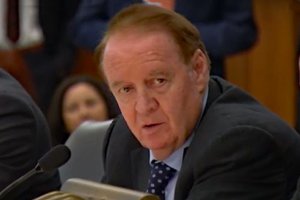
Richard “Dick” Codey, New Jersey’s longest-serving lawmaker and an “accidental” governor, died at age 79.
Kristoffer Shields, the director of the Eagleton Center on the American Governor at Rutgers University, sat down with NJ Spotlight News to reflect on Codey’s legacy.
Codey served as governor from November 2004 to January 2006 after Jim McGreevey stepped down in scandal. It was technically Codey’s second time as chief executive — he served for three days in 2002 after Christine Todd Whitman resigned to lead the U.S. Environmental Protection Agency. Shields said Codey, who had been Senate president, quickly took to his new role, with early actions like appointing the state’s first inspector general showing his intention to be consequential.
“He easily could’ve come in and decided to be a caretaker governor” Shields said. “That was not in Dick Codey’s personality. He was going to come in and actually do stuff. He was going to make changes. He was going to take charge of some things that were more difficult to do as a legislator that he could do now that he was in the governor’s seat.”
Codey worked with lawmakers to pass major legislation, including a statewide smoking ban and a moratorium on capital punishment. Shields highlighted a bipartisan crackdown on local pay-to-play politics, a stand for integrity at a time when the state was grappling with the McGreevey scandal.
“For the Democrats, there was a little bit of brand rebuilding to be done, and this was a great way to do it: to have the new governor, who is also a Democrat, put through these pay-to-play restrictions that did limit government contracts for organizations who donated to local campaigns in New Jersey,” Shields said. “New Jersey has a reputation as a scandal state, right, and new governors often try to attack that. Dick Codey did that in an effective way with pay-to-play fairly quickly.”
Codey prioritized mental health both as lawmaker and governor, inspired by his wife’s struggles with postpartum depression. Shields said that work highlighted Codey’s personal politics.
“He was always unafraid to be himself. He was always unafraid to say what was on his mind, and he was always unafraid to sort of allow that window into what he was thinking and who he was,” Shields said.

We’re in this together.
For a better-informed future.
Support our nonprofit newsroom.