
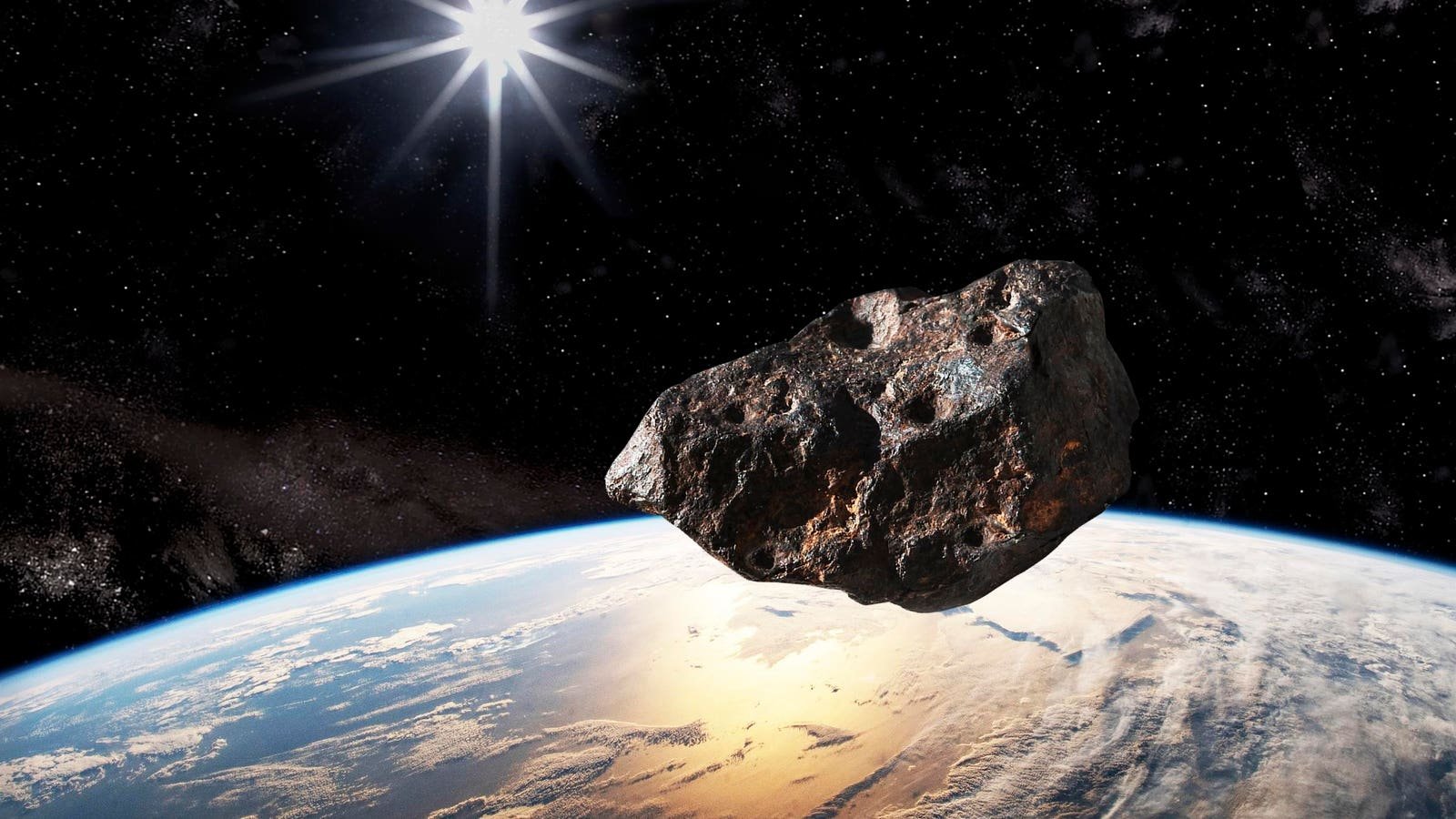
When at its closest at 4:16 p.m. EDT (20:16 UTC) on June 27, 2011 UL21 will be one of the largest asteroids to have recently passed near Earth.
getty
A newly discovered near-Earth asteroid known as 2026 JH2 will make a very close pass by Earth on Monday, May 18, though scientists stress there is no danger of an impact.
The asteroid is expected to pass within approximately 56,907 miles (91,583 kilometers) of Earth — roughly one-quarter of the average distance between Earth and the moon.
Its close pass will be live-streamed here at 3:45 p.m. EDT on May 18:
How Big Is 2026 JH2?
Scientists estimate 2026 JH2 measures somewhere between 52 and 114 feet (15 to 35 meters) across, based on its brightness and reflectivity. Roughly as long as a Boeing 737’s wingspan, it’s comparable in size to the asteroid responsible for the famous Chelyabinsk airburst over Russia in 2013. NASA’s Jet Propulsion Laboratory is classifying the asteroid as house-sized.
If an asteroid of this scale struck Earth, it would most likely explode midair in what scientists call an airburst. Such an explosion could release energy comparable to a small nuclear weapon, creating a powerful shockwave capable of shattering windows and causing localized damage over a wide area.
While not considered an extinction-level threat, objects this size are still regarded as potentially hazardous on a regional scale.
When Was 2026 JH2 Discovered?
2026 JH2 was recently added to the Minor Planet Center database following its discovery on May 10 by astronomers working with the Mount Lemmon Survey in Tucson, Arizona, and Farpoint Observatory in Eskridge, Kansas.
Researchers have classified the object as an Apollo-class near-Earth asteroid, meaning its orbit crosses Earth’s path around the sun. The asteroid follows a stretched, elongated orbit that carries it from Earth’s vicinity out toward Jupiter’s orbit.
Although its trajectory periodically brings it relatively close to Earth, astronomers say current calculations rule out any collision risk. It’s next due to come close to Earth on May 23, 2090.
How To See 2026 JH2
At around magnitude 11.5, 2026 JH2 will be observable in moderate backyard telescopes under decent skies. At its closest approach it will be close to the bright star Spica in the southeast sky, as seen from the Northern Hemisphere during evening hours.
The close flyby will be streamed live online by the Virtual Telescope Project, led by Italian astronomer Gianluca Masi. The broadcast is scheduled to begin at 3:45 p.m. EDT on Monday, allowing viewers worldwide to watch the asteroid — moving at 19,417 mph (31,248 km/h) — just hours before its closest approach at 5:23 p.m. EDT.
Wishing you clear skies and wide eyes.
source: https://www.forbes.com/sites/jamiecartereurope/2026/05/18/see-boeing-737-sized-asteroid-pass-much-closer-than-the-moon-tonight/



