
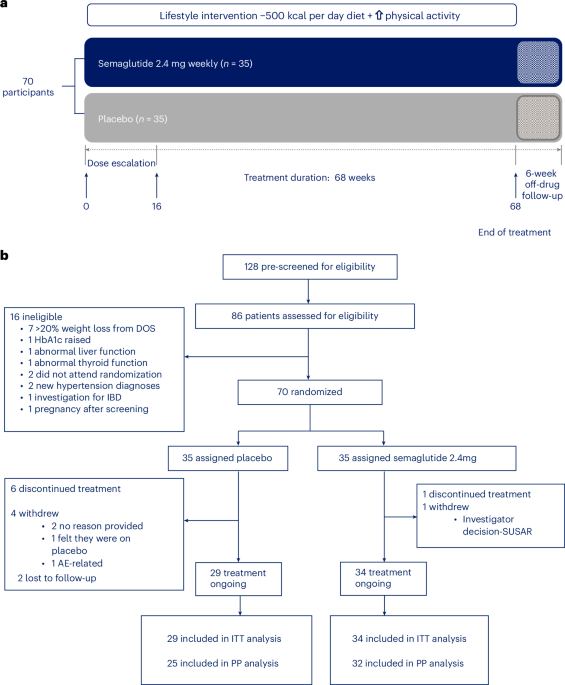
The study was conducted between 1 November 2022 and 9 April 2025. A total of 128 participants were pre-screened for eligibility, 86 screened for eligibility and 70 (mean age 47.3 years, s.d. ± 10.3; 58 (82.9%) female and 12 (17.1%) male) were randomized: 35 to semaglutide 2.4 mg once weekly plus lifestyle intervention and 35 to placebo plus lifestyle intervention. The trial design and Consolidated Standards of Reporting Trials (CONSORT) diagram is illustrated in Fig. 1. The baseline characteristics of the trial population were comparable between groups (Table 1).
a, Trial design. b, CONSORT diagram. IBD, inflammatory bowel disease.
Adherence
Two participants (both in the placebo arm) were lost to follow-up. Five participants withdrew from the trial, including four in the placebo arm (two participants did not provide a reason for withdrawal, one participant did not have a weight loss response, and the remaining participant withdrew due to adverse event (AE) reasons). One participant in the semaglutide group was withdrawn because of an investigator decision due to a suspected unexpected serious adverse reaction (SUSAR).
Twenty-nine participants in the placebo group and 34 in the semaglutide arm completed the trial, meeting the target sample size for the primary outcome analysis. Baseline characteristics for patients included in the primary outcome analysis (intention-to-treat (ITT), n = 63) are reported in Supplementary Table 1.
All participants who completed the trial (ITT population) reached the target dose of semaglutide 2.4 mg (n = 34). However, six participants were maintained on a reduced dose of semaglutide because of AEs (1.7 mg, n = 1; 1.0 mg, n = 2; 0.5 mg, n = 2 and one participant reduced to 1.7 mg before withdrawing).
Definition of the analysis populations
ITT and full analysis set
For the ITT sample, all randomized participants were used for the analyses except those who withdrew or were lost to follow-up. Six participants were included in the ITT but excluded from the per-protocol (PP) analysis because they did not satisfy the definition of full adherence and therefore did not meet the conditions to be included in PP analysis. Reasons included a prolonged time off drug treatment (n = 5) and an apronectomy (n = 1) during the trial.
PP analysis
Participants in the PP analysis followed the study protocol with full adherence, defined as attending all study visits with no substantial interruptions in treatment as monitored from the drug dose diary.
Safety
Safety reporting (that is, AEs and SAEs) and analyses included all randomized participants (n = 70). All participants received at least one dose of the assigned treatment.
Primary outcome: %WL
At 68 weeks, participants in the semaglutide group (n = 34) experienced on average 18.0% weight loss (s.d. = 9.2), compared to the placebo group (n = 29) who experienced a mean weight gain of 0.4% (s.d. = 7.0). In the primary outcome analysis, the adjusted mean %WL of participants in the semaglutide group was −18.2% (s.e. = 2.3), and a mean weight gain of 0.9% (s.e. = 2.2) in the placebo group. The mean adjusted treatment difference for %WL in placebo versus semaglutide at 68 weeks was −19.1% (95% CI −23.4 to −14.8) (P < 0.001) (Fig. 2). A waterfall plot of %WL between groups is illustrated in Supplementary Fig. 1.
Adjusted mean change in body weight (%) over time estimated using a repeated-measures, mixed-effects model adjusting for baseline weight, type of surgery, sex, diabetes status and interaction between treatment and visit (n = 70 all participants using all available data). The error bars indicate the s.e.m. Two-sided t-statistic with 95% CIs. Week 6: n = 70; d.f. = 134; P = 0.008. Week 14: n = 66; d.f. = 141, P < 0.001. Week 32: n = 64; d.f. = 144, P < 0.001. Week 52: n = 61; d.f. = 151, P < 0.001. Week 68: n = 63; d.f. = 147, P < 0.001, not adjusted for multiple comparisons.
Participants in the semaglutide group lost on average −20.7 kg (s.d. = 10.2), compared to a mean weight gain of 0.5 kg (s.d. = 8.0) in the placebo group. The adjusted mean total body weight change in the semaglutide group was −21.1 kg (s.e. = 2.6) compared to 0.7 kg (s.e. = 2.5) in the placebo group. The adjusted difference in mean total body weight change (kg) between groups was −21.7 kg (95% CI −26.6 to −16.8) (P < 0.001).
Categorical weight loss
A total of 93.1% (n = 27) of participants in the placebo group lost less than 10% weight loss, compared to 14.7% (n = 5) in the semaglutide group; 10% or more weight loss was achieved by 6.9% (n = 2) in the placebo group, compared to 85.3% (n = 29) in the semaglutide group. Similarly, 6.9% (n = 2) in the placebo group experienced 15% or more weight loss compared with 61.8% (n = 21) of the semaglutide group. Lastly, 3.4% (n = 1) of the placebo group experienced 20% or more weight loss compared with 47.1% (n = 16) of the semaglutide group (Supplementary Table 2 and Supplementary Fig. 2). Participants in the semaglutide group were significantly more likely to be within a higher weight loss category than the placebo group (P < 0.001).
Secondary outcomes are reported in Table 2. Repeated-measures analyses of secondary outcomes are reported in Supplementary Table 3. Unadjusted values of changes in secondary outcomes are reported in Supplementary Table 4.
BMI
Participants in the semaglutide group experienced an adjusted mean BMI change of −7.9 kg m−2 (s.e. = 1.0) compared to 0.03 kg m−2 (s.e. = 1.0) in the placebo group. The adjusted difference in mean BMI change (kg m−2) between groups was −7.9 kg m−2 (95% CI −9.8 to −6.0) (P < 0.001) (Table 2).
Body composition
In the semaglutide group, the adjusted mean fat mass change was −15.8 kg (s.e. = 2.3) compared to 0.9 kg (s.e. = 2.3) in the placebo group. The adjusted difference in mean fat mass change (kg) between groups was −16.6 kg (95% CI −20.8 to −12.5) (P < 0.001).
The adjusted mean change in lean soft tissue mass in the semaglutide group was −5.5 kg (s.e. = 1.2) compared to −0.2 kg (s.e. = 1.2) in the placebo group. The adjusted difference in mean lean soft tissue mass change (kg) between groups was −5.3 kg (95% CI −7.4 to −3.1) (P < 0.001).
The adjusted mean change in lean soft tissue mass (% of total body weight) in the semaglutide group was 5.5% (s.e. = 1.2) compared to −0.81 % (s.e. = 1.2) in the placebo group. The adjusted difference in mean lean soft tissue mass change (%) relative to total body weight between groups was 6.3 % (95% CI 4.1 to 8.5; P < 0.001).
Cardiovascular outcomes
The adjusted mean change in systolic blood pressure (SBP) in the semaglutide group was −3.9 mm Hg (s.e. = 3.3) compared to 2.0 mm Hg (s.e. = 3.1) in the placebo group. The adjusted difference in mean SBP (mm Hg) change between groups was −5.9 mm Hg (95% CI −12.0 to 0.2, P = 0.059).
The adjusted mean change in diastolic blood pressure (DBP) in the semaglutide group was −1.6 mm Hg (s.e. = 2.3) compared to 5.9 mm Hg (s.e. = 2.3) in the placebo group. The adjusted difference in mean DBP (mm Hg) change between groups was −4.2 mm Hg, (95% CI −8.8 to 0.3, P = 0.068) (Table 2). Mean adjusted changes in SBP and DBP over time are illustrated in Supplementary Fig. 3.
The adjusted mean change in heart rate (HR) in the semaglutide group was −4.9 bpm (s.e. = 2.7) compared to −6.6 bpm (s.e. = 2.4) in the placebo group. The adjusted difference in mean HR (bpm) change between groups was 1.8 bpm (95% CI −3.0 to 6.5, P = 0.460).
SBP and DBP in participants with pre-existing hypertension
The adjusted mean change in SBP in ITT participants with pre-existing hypertension in the semaglutide group (n = 10) was −2.2 mm Hg (s.e. = 3.9) compared to 9.4 mm Hg (s.e. = 3.8) in the placebo group (n = 9). The adjusted difference in mean SBP (mm Hg) change between groups in participants with pre-existing hypertension was −11.6 mm Hg.
The adjusted mean change in DBP in ITT participants with pre-existing hypertension in the semaglutide group was 6.3 mm Hg (s.e. = 3.2) compared to 7.9 mm Hg (s.e. = 2.9) in placebo. The adjusted difference in mean DBP (mm Hg) change between groups was −1.7 mm Hg.
Pharmacological agents required for the management of hypertension
The number of pharmacological agents required for hypertension management was assessed in ITT participants with pre-existing hypertension in the placebo (n = 9, 31.0%) and semaglutide 2.4 mg group (n = 10, 29.4%).
In the semaglutide group at baseline, nine of ten (90%) participants with pre-existing hypertension were on at least one antihypertensive medication, with six (60%) participants on one antihypertensive medication, three (30%) on two antihypertensive medications and one participant on none. At week 68, all participants with pre-existing hypertension had no change in the number of antihypertensive medications from baseline.
In the placebo group, nine (100%) participants with pre-existing hypertension at baseline were on at least one antihypertensive medication. Of nine participants, five (55.6%) were on one antihypertensive medication and the remaining four (44.4%) were on two antihypertensive medications. At week 68, six participants (66.7%) had no change, two participants (22.2%) increased and one participant (11.1%) decreased the number of antihypertensive medications from baseline.
Changes in the number of antihypertensive medications required for the management of hypertension at week 68 from baseline did not significantly differ between groups (P = 0.087).
HbA1c
The adjusted mean HbA1c change in the semaglutide group was −3.6 mmol mol−1 (s.e. = 0.8) compared to 1.7 mmol mol−1 (s.e. = 0.8) in the placebo group. The adjusted difference in mean HbA1c change (mmol mol−1) between groups was −5.3 mmol mol−1 (95% CI −6.6 to −4, P < 0.001) (Table 2). The mean adjusted change in HbA1c over time between groups is presented in Supplementary Fig. 4.
HbA1c in participants with pre-existing pre-diabetes
The adjusted mean HbA1c change in ITT participants with pre-diabetes at baseline in the semaglutide group (n = 2) was −8.0 mmol mol−1 (s.e. = 2.3) compared to 0.2 mmol mol (s.e. = 1.6) in the placebo group (n = 3). The adjusted difference in mean HbA1c change (mmol mol−1) between groups was −8.3 mmol mol−1.
HbA1c in participants with pre-existing T2D
The adjusted mean HbA1c change in ITT participants with T2D at baseline in the semaglutide group (n = 3) was −3.4 mmol mol−1 (s.e. = 1.8) compared to 4.0 mmol mol−1 (s.e. = 1.5) in the placebo group (n = 4). The adjusted difference in mean HbA1c change (mmol mol−1) between groups was −7.4 mmol mol−1.
Pharmacological agents required for the management of T2D
The number of pharmacological agents required for T2D management in participants with pre-existing T2D was assessed in the placebo (n = 4, 13.8%) and semaglutide groups (n = 3, 8.8%) in the ITT sample.
In the semaglutide group, one of three (33.3%) participants with pre-existing T2D were on one T2D medication at baseline; two participants (66.7%) were on none. At week 68, two of three (66.7%) had no change in the number of T2D agents from baseline, with the remaining participant (33.3%) having an increase in the number of T2D agents.
In the placebo group, four of four (100%) participants with pre-existing T2D were on at least one T2D medication at baseline. Two (50%) participants were on one T2D medication and two (50%) were on two T2D medications. At week 68, all four participants (100%) with pre-existing T2D had no change in the number of T2D agents from baseline.
The number of pharmacological agents required for the management of T2D at week 68 from baseline did not significantly differ between groups (P = 0.429).
Lipid profile and high-sensitivity C-reactive protein
Changes in total cholesterol, triglycerides and high-sensitivity C-reactive protein (hsCRP) are reported in Table 2. The adjusted mean total cholesterol and triglyceride change in the semaglutide group was −0.3 mmol l−1 (s.e. = 0.2) and −0.3 mmol l−1 (s.e. = 0.1), respectively. In the placebo group, the mean change in total cholesterol and triglycerides was 0.2 mmol l−1 (s.e. = 0.2) and 0.2 mmol l−1 (s.e. = 0.1), respectively. The adjusted difference in mean cholesterol and triglyceride change between groups was −0.5 mmol l−1 (95% CI −0.9 to −0.1, P = 0.014) and −0.5 mmol l−1 (95% CI −0.9 to −0.3, P < 0.001), respectively.
The adjusted mean hsCRP change in the semaglutide group was 0.4 mg l−1 (s.e. = 1.6) compared to 1.4 mg l−1 (s.e. = 1.5) in the placebo group. The adjusted difference in mean hsCRP change between groups was −1.0 mg l−1 (95% CI −3.9 to 2.0, P = 0.517).
Impact of Weight on Quality of Life-Lite scores
Changes in total and individual components of the Impact of Weight on Quality of Life-Lite (IWQOL-Lite) score are reported in Table 2. Baseline values of IWQOL-Lite scores are reported in Supplementary Table 5.
The adjusted difference in mean IWQOL-Lite total score between groups from was 14.3 (95% CI 6.5 to 22.1). Significant improvements in adjusted component scores, including physical function (15.7, 95% CI 7.7 to 23.7), self-esteem (16.9, 95% CI 5.5 to 28.3) and work (10.1, 95% CI 0.12 to 20.1), between groups were observed, with higher scores observed in the semaglutide group, indicating a better quality of life.
There was no statistically significant adjusted difference in sex life (12.7, 95% CI −0.7 to 26.0) and public distress (9.3, 95% CI −1.9 to 20.4) between groups.
Association between baseline change in GLP-1 (T0 to T30) and %WL
Median T0 (time = 0 fasted) GLP-1 levels in the placebo group were 3.0 pg ml−1 (interquartile range (IQR) 2.2–4.8) compared with 2.9 pg ml−1 (IQR 2.4–4.6) in the semaglutide group. Median T30 (time = 30 min after meal test) GLP-1 levels in the placebo group were 15.8 pg ml−1 (IQR 5.6–32.0) compared with 10.4 pg ml−1 (IQR 6.4–31.3) in the semaglutide group (Supplementary Fig. 5). The difference in change from T0 to T30 was measured. When added to the primary outcome model, meal-stimulated changes in GLP-1 at baseline (from T0 to T30) were not significantly associated with %WL at 68 weeks (P = 0.563).
AEs
Reported AEs and their frequency for the semaglutide and placebo groups are illustrated in Table 3. The risk ratio (RR) for the proportion of participants experiencing at least one AE between the semaglutide and placebo arms was 1.03 (95% CI 0.93 to 1.14; reference = placebo; P = 0.903). There was a statistically significant greater frequency of reporting nausea (RR 3.0 (95% CI 1.7 to 6.3); P < 0.001) and decreased appetite (RR 3.8 (95% CI 1.5 to 12.2); P = 0.009) in the semaglutide group compared with placebo.
There were 12 serious AEs (SAEs) (11 SAEs and one SUSAR) in the trial (Table 4). Nine SAEs were in participants in the placebo group and two SAEs and one SUSAR were in the semaglutide group. Four SAEs and one SUSAR were deemed as ‘possibly related to investigational medicinal product (IMP)’; however, all four participants with SAEs were in the placebo group, with the participant with SUSAR in the semaglutide group. All participants with SAEs (including SUSAR) recovered. The SUSAR related to a de novo eating disorder (restrictive eating behavior), which led to discontinuation of the trial product (semaglutide 2.4 mg); however, it did not resolve upon discontinuation. The participant had been screened by a psychologist before MBS with no concerns noted. The participant was subsequently referred to an eating disorder service and was successfully treated. There were no treatment-related deaths in the trial. The RR for the proportion of participants experiencing at least one SAE between semaglutide and placebo arms was 0.40 (95% CI 0.06 to 1.72; reference = placebo; P = 0.253).
Exploratory analysis
In the semaglutide group, %WL did not significantly differ with age, ethnicity, diabetes status, sex, type of surgery, time from surgery (months), baseline meal-stimulated GLP-1 change, postoperative %WL (from date of surgery (DOS) to randomization), maximum %WL achieved after surgery or MBS response (weight regain versus suboptimal post-surgery weight loss).
Sensitivity analysis
PP, repeated-measures and inverse probability weighting analyses were consistent with the primary outcome analysis (Supplementary Information). PP analysis (32 participants in the semaglutide group and 25 participants in the placebo group) showed greater percentage change in adjusted body weight in the semaglutide group compared to the placebo group (mean (s.e.), −18.5% (2.1) versus 1.10 (2.2), respectively) with an adjusted mean difference of −19.6% (95% CI −15.6 to −23.5; P < 0.001), which is consistent with the results for the primary analysis. Repeated-measures analysis of %WL is presented in Supplementary Table 6.



