
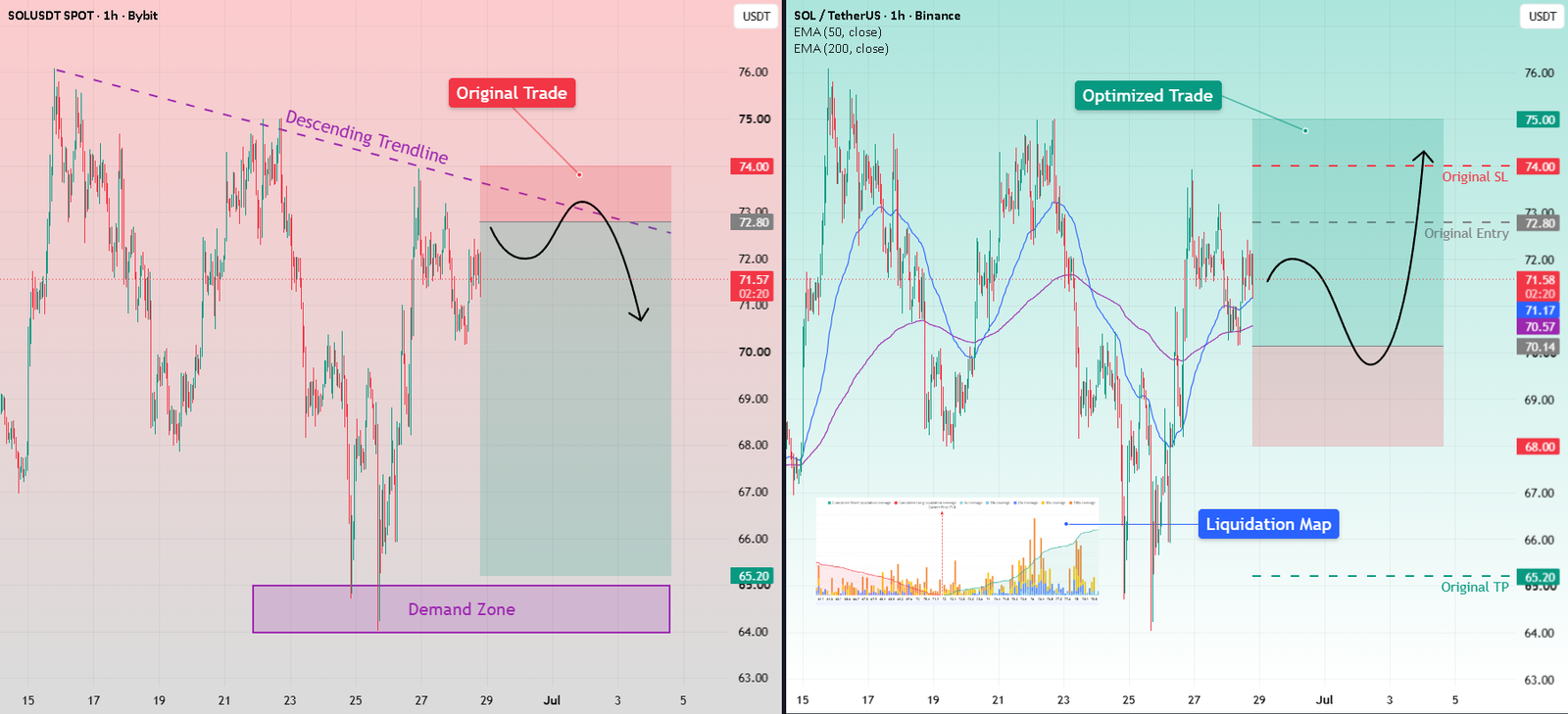
The original short thesis fights an hourly bullish regime. The EMA 50 at 71.1 sits above the EMA 200 at 70.53 following a confirmed golden cross. Shorting into this upward momentum is mathematically negative expected value.
The liquidation map reveals a heavy bullish bias with $285.65M of short risk above compared to $158.41M of long risk below. The baseline 74 stop sat inside a $27.32M resistance cluster, engineered to be hunted as exit liquidity.
Reaching the 65.2 target required breaking both macro EMAs and chewing through $146.98M of stacked support clusters.
The setup was flipped to a long entry at 70.14. This catches a liquidity sweep of immediate local support into the golden cross zone, placing the fill safely inside key support and just below the 70.53 macro EMA 200.
The invalidation criterion is a 1h close above 72.39 local resistance before the 70.14 bid fills. A premature breakout triggers an upside liquidation cascade, spending the fuel required to hit the macro target.
The take-profit was set to 75. This targets the lower boundary of a key resistance cluster holding $127.34M in trapped short risk, ensuring execution via forced market-buys from liquidated shorts.
The stop-loss was placed at 68, tucked inside a sterile void between clusters. Invalidating this level requires the market to chew through $70.37M of support and break the hourly golden cross structure.
The original 1:6.33 risk-to-reward offered a near-zero probability of success. The optimized 1:2.27 trades paper fantasy for structural reality by buying a sweep, hiding risk in a vacuum, and selling into forced buying.
It will be interesting to see which setup performs better in the live market.



