
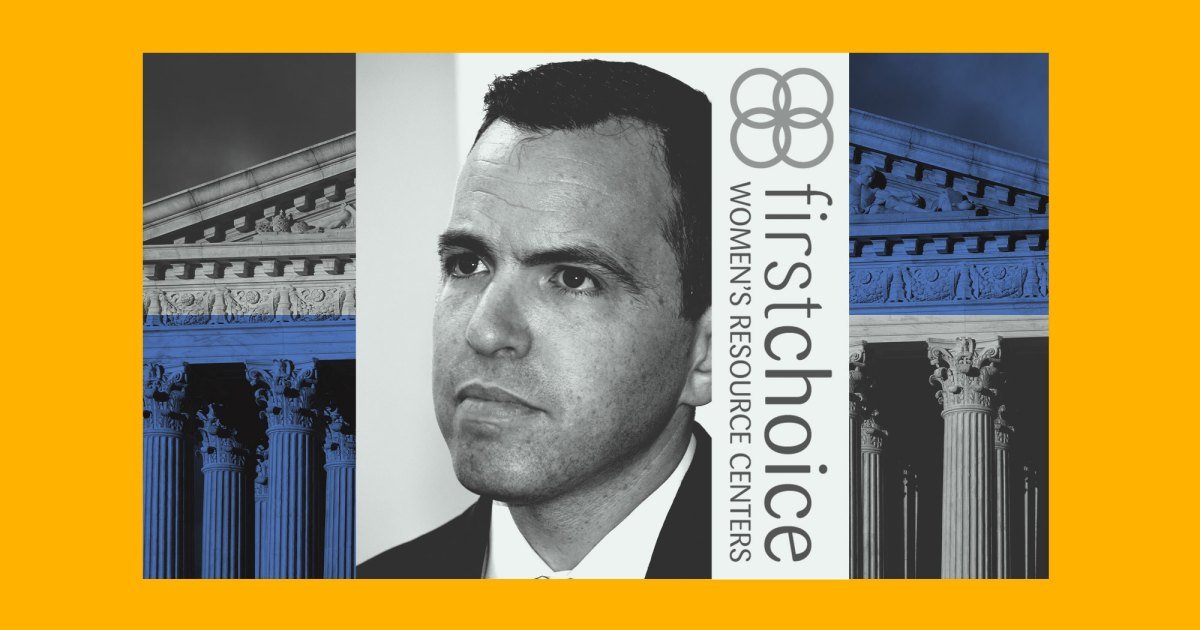
The Supreme Court ruled that New Jersey attorney general Matthew Platkin did not have the right to issue a sweeping subpoena against First Choice Women’s Resource CentersMother Jones illustration; Kyle Mazza/SOPA/AP; Getty
In an outcome that was widely expected, the US Supreme Court ruled Wednesday that New Jersey’s efforts to investigate an anti-abortion crisis pregnancy center for allegedly misleading consumers violated the First Amendment.
In a 9–0 decision, the justices said a sweeping subpoena by the state’s then-attorney general, Matthew Platkin, seeking information about donors to First Choice Women’s Resource Centers, a chain of anti-abortion pregnancy centers in northeastern New Jersey, “burdened First Choice’s associational rights.” The full opinion in the case can be found here.
The ruling clears the way for First Choice to proceed with a federal lawsuit challenging the subpoena. “Demands for private donor information…‘chill’ protected First Amendment associational rights even when those demands contemplate disclosure only to government officials and not ‘the general public,’” Justice Neil Gorsuch wrote for his fellow justices.
The opinion drew parallels between New Jersey’s demand for information and Alabama’s attempts in the 1950s to force the NAACP to turn over the names and addresses of all of its members in the state. The high court sided with the NAACP in the landmark 1958 ruling.
“Associational rights carry special significance for political, social, religious, and other minorities,” Gorsuch wrote. “Take that freedom away and ‘dissident expression’ stands particularly vulnerable to marginalization or outright ‘suppression by the majority,’ leaving all of society poorer for it.”
But Wednesday’s decision—the second major Supreme Court victory for the CPC industry in recent years—is likely to make it even harder for state lawmakers and attorneys general to investigate anti-abortion organizations. In 2018, the court blocked a California law that would have required pregnancy centers to inform patients about state-funded family-planning services, including abortion.
Crisis pregnancy centers, faith-based organizations whose mission is to deter women from having abortions, attract clients by offering free services such as pregnancy tests, ultrasounds, baby clothes, and diapers. But they also have a well-documented history of using misinformation and deception to dissuade abortion seekers from terminating their pregnancies. Like many CPCs, First Choice—which has served more than 36,000 clients in New Jersey since its founding in 1985—created different websites for donors and the general public, tailoring its anti-abortion message for each audience.
“Strip away the ability of individuals to work together free from governmental oversight and intrusion, and the freedom to associate may become no freedom at all.”
The question before the justices was narrow: Should First Choice be able to directly fight a state agency’s subpoena in federal court, or must it initially go to state courts? The long-accepted procedure for enforcing or challenging such a subpoena, New Jersey argued, is to first seek relief in state court, and then, should it be necessary, appeal to federal court.
But the conservative legal group Alliance Defending Freedom, which represented First Choice, accused Platkin of “selectively target[ing] the nonprofit based on its religious speech and pro-life views.” According to ADF, the Platkin subpoena had such serious implications that First Choice should be able to seek immediate relief in the federal courts, rather than having to expend time and resources litigating the issue first in state court.
Lining up behind First Choice was a predictable collection of anti-abortion and conservative groups. But they were joined by progressive groups, including the Reporters Committee for Freedom of the Press and the ACLU, which also raised concerns that the same type of subpoenas against First Choice could be weaponized against humanitarian groups, journalists, and protesters. In Wednesday’s ruling, the justices seemed to concur. As Gorsuch wrote, “Strip away the ability of individuals to work together free from governmental oversight and intrusion, and the freedom to associate may become no freedom at all—individuals deterred, groups diminished, and their protected advocacy suppressed.”
Anti-abortion groups hailed the decision. Erin Hawley, an attorney with Alliance Defending Freedom who argued the case before the Supreme Court in December, called the ruling a “resounding victory,” and blasted New Jersey’s investigation tactics as “blatantly unconstitutional.”
“This is a triumph for every faith-based ministry in America,” William Haun, senior counsel at Becket, a legal group that focuses on religious cases, said in a statement. “The Court made crystal clear that our First Amendment freedoms—including religious freedom—are ‘necessarily’ associative, and that keeps the federal courthouse doors open for religious groups to protect their governance from intrusive state bureaucrats.”
But Reproductive Health and Freedom Watch, a national group that focuses on the CPC industry, pointed out that the ruling didn’t address “the broader substance of New Jersey’s investigation,” including questions about training of staff and volunteers and protections for patient privacy. Answers to these questions, RHFW said, “are critical to safeguarding patients who seek care at unregulated pregnancy clinics like First Choice.”
This post has been updated to include comment from RHFW.



