
SYNCHRONIZE-MASLD trial design
We conducted a 48-week placebo-controlled trial (that included a 24-week dose-escalation period for uptitration of survodutide to 6.0 mg and a 24-week dose-maintenance period) in participants aged ≥18 years, with body mass index (BMI) ≥30 kg m−2 or BMI ≥27 kg m−2 and at least one metabolic obesity complication (hypertension, dyslipidemia, obstructive sleep apnea, cardiovascular disease and/or T2D), a history of at least one patient-reported unsuccessful dietary effort to lose body weight and at-risk MASLD as defined by hepatic steatosis (MRI-PDFF ≥8% at screening) with the exclusion of secondary causes of hepatic fat accumulation and one or more elevated NITs (see Methods for full list) or a history of biopsy-confirmed MASH within the past 3 years.
The co-primary endpoints were the percentage change in body weight and the proportion of participants with a ≥30% reduction in LFC as assessed by MRI-PDFF, each from baseline to week 48. The secondary and further endpoints (each assessed from baseline to week 48) included absolute and percentage change in LFC (%) and change in MRI-assessed liver volume (ml); hepatic and systemic inflammatory activity as assessed by circulating alanine aminotransferase (ALT; U l−1) and high-sensitivity C-reactive protein (hsCRP), respectively; metabolic function as predicted by waist circumference (cm) and homeostatic model assessment of insulin resistance (HOMA-IR); liver stiffness, a marker of liver fibrosis, as assessed by vibration-controlled transient elastography (VCTE; kPa) and magnetic resonance elastography (MRE; kPa); and changes in liver fibroinflammatory activity as determined by corrected T1 (cT1) levels and the proportion of participants with a ≥80-ms reduction in cT1.
Participants
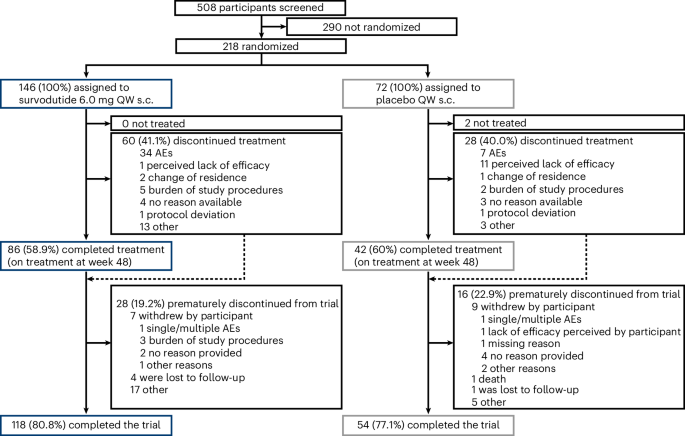
The trial was conducted between 2 April 2024 and 2 December 2025. Of the 508 participants assessed for eligibility, 218 with obesity and at-risk MASLD underwent randomization (2:1) to weekly survodutide 6.0 mg or placebo, and 216 received at least one dose of treatment (Fig. 1 and Extended Data Fig. 1). Overall, 172 of 216 participants (79.6%) completed the trial. Treatment discontinuation occurred at a similar frequency in the survodutide (41.1% (60/146)) and placebo (40.0% (28/72)) arms. Among participants randomized to survodutide who did not prematurely discontinue study treatment (n = 86), 80.2% maintained the target dose of 6.0 mg until the end of the treatment period; six participants (7.0%) ended the trial on a dose of 4.8 mg, five participants (5.8%) on a dose of 3.6 mg and six participants (7.0%) on a dose of 2.4 mg.
AE, adverse event; QW, once-weekly; s.c., subcutaneous.
Participant characteristics at baseline were similar across treatment groups (Table 1 and Extended Data Table 1). Mean age was 55.8 years, 60.6% were female, mean BMI was 39.6 kg m−2, mean body weight was 108.3 kg and mean waist circumference was 120.9 cm. Nearly all participants (94.4%) had at least one extra-hepatic metabolic complication, including 38.4% with T2D. At baseline, mean MRI-PDFF-assessed LFC was 16.9%.
Most trial participants (90.3%) had at-risk MASLD with NIT-based evidence of either no or mild-to-moderate fibrosis at baseline, and the remaining 9.7% had a history of biopsy-confirmed MASH within the past 3 years. The mean baseline liver stiffness as assessed by MRE was 2.8 kPa (stage F0 or F1), and the mean fibrosis-4 (FIB-4) score was 1.3. The mean baseline liver stiffness as assessed by VCTE was 10.3 kPa, and the enhanced liver fibrosis (ELF) score was 9.4, suggesting that the spectrum of liver fibrosis likely ranged from stage F1 to F2. The mean cT1 at baseline was 924.3 ms, consistent with fibroinflammation.
Change in LFC assessed by MRI-PDFF
Based on the efficacy estimand, 84.2% of participants treated with survodutide 6.0 mg weekly had a ≥30% reduction in LFC assessed by MRI-PDFF (co-primary endpoint) at week 48 compared to 24.3% receiving placebo (odds ratio = 17.3, 95% confidence interval: 7.5−39.9, P < 0.0001) (Fig. 2a). Using the treatment regimen estimand, 68.5% of participants in the survodutide 6.0 mg treatment arm had a ≥30% reduction in LFC compared to 28.6% of participants in the placebo arm (odds ratio = 5.9, 95% confidence interval: 2.9−11.9, P < 0.0001) (Fig. 2a).
a, Estimated proportion of participants who had an LFC (MRI-PDFF) reduction of ≥30% from baseline to week 48 (co-primary endpoint), derived from logistic regression (Rubin-based Wald t-test, two-sided P value). b, Estimated proportion of participants who had an LFC (MRI-PDFF) reduction of ≥50% and ≥70% from baseline to week 48, derived from logistic regression (Rubin-based Wald t-test, two-sided P value). c, LFC (MRI-PDFF) <5% at week 48, derived from logistic regression (Rubin-based Wald t-test, two-sided P value). d, Relative change in LFC (MRI-PDFF) from baseline to week 48, derived from MMRM (two-sided test). e, Percentage change in body weight over time (co-primary endpoint) (Rubin-based Wald t-test, two-sided test). f, Body weight reduction ≥5%, ≥10%, ≥15% and ≥20% from baseline to week 48, derived from logistic regression (Rubin-based Wald t-test, two-sided P value). No adjustments for multiple comparisons were done. In a, estimates for the treatment regimen estimand used multiple imputation based on the ‘follow the reference’ strategy, where trial participants in the survodutide arm were assumed to have an effect similar to that of the placebo arm while preserving information of any on-treatment and off-treatment data. In a–c, for the efficacy estimand, missing values of LFC (MRI-PDFF) were multiply imputed using a MAR assumption and dichotomized. In d, absolute change over time was derived from an MMRM analysis. In e, for the efficacy estimand, percentage body weight reduction was derived from an MMRM analysis. For the treatment regimen estimand, the left-hand side of the chart shows the observed mean percentage change in body weight over time; estimates on the right-hand side were derived from an ANCOVA model. ANCOVA, analysis of covariance; CI, confidence interval; ETD, estimated treatment difference; LFC, liver fat content; MAR, missing at random; MMRM, mixed models for repeated measures; MRI-PDFF, magnetic resonance imaging derived proton density fat fraction; OR, odds ratio.
Source data
Using the efficacy estimand, 75.3% of participants had an MRI-PDFF-assessed LFC reduction of ≥50% with survodutide 6.0 mg versus 8.6% with placebo, and 55.5% of participants in the survodutide arm had an LFC reduction of ≥70% versus 2.9% in the placebo arm (Fig. 2b). In addition, 61.0% of participants treated with survodutide had an LFC <5% at week 48 versus 5.7% treated with placebo (Fig. 2c). The mean relative change in LFC was −58.7% with survodutide 6.0 mg versus −9.5% with placebo (estimated treatment difference (ETD) −49.2%, 95% confidence interval: −61.7 to −36.7, P < 0.0001) (Fig. 2d). Descriptive subgroup analysis of MRI-PDFF-assessed LFC reduction of ≥30% by T2D, BMI, sex and age is shown in Extended Data Table 2.
Change in body weight
At week 48, the mean change in body weight (co-primary endpoint) was −12.2% with survodutide treatment versus −1.0% with placebo using the efficacy estimand, with an ETD of −11.2% (95% confidence interval: −13.4 to −9.0, P < 0.0001) (Fig. 2e). Using the treatment regimen estimand, the respective mean changes in body weight were −8.7% and −1.4% for the survodutide and placebo groups, respectively, with an ETD of −7.3% (95% confidence interval: −9.4 to −5.2, P < 0.0001) (Fig. 2e). More than three-fourths of participants (79.1%) had a body weight reduction of ≥5% with survodutide treatment versus 14.3% in the placebo-treated group (Fig. 2f). Descriptive subgroup analysis of percentage change in body weight by T2D, BMI, sex, and age is presented in Extended Data Table 3.
Additional measures of liver fat, fibrosis and inflammation
Additional measures determined at baseline and 48 weeks included liver volume assessed by MRI, which decreased by 408.3 ml with survodutide treatment compared to 17.3 ml with placebo (ETD −391.0 ml, 95% confidence interval: −492.1 to −289.8, P < 0.0001) (Extended Data Fig. 2). Liver stiffness assessed by VCTE was reduced by 28.7% after survodutide treatment versus by 9.2% in the placebo-treated group (ETD −19.6%, 95% confidence interval: −31.9 to −7.2, P = 0.0021) (Extended Data Fig. 3). Changes in liver stiffness assessed by MRE did not show a difference between the survodutide 6.0 mg and placebo groups (ETD −0.05, 95% confidence interval: −0.25 to 0.15, P = 0.6235). The ELF score decreased by 0.34 in the survodutide arm versus a 0.06 decrease with placebo (ETD −0.28, 95% confidence interval: −0.50 to −0.05, P = 0.0161).
There were greater improvements in markers of liver inflammation (cT1, ALT and aspartate aminotransferase (AST)) with survodutide treatment than with placebo (Fig. 3). At week 48, 63.0% of participants treated with survodutide had an absolute reduction in cT1 of ≥80 ms from baseline compared to 21.4% with placebo (Fig. 3a). The mean absolute change in cT1 was −116.8 ms with survodutide 6.0 mg versus −23.9 ms with placebo (Fig. 3b). The mean relative change in ALT from baseline to week 48 was −36.8% with survodutide treatment versus −11.0% with placebo, and the analogous changes in AST were −27.9% and −7.2%, respectively (Fig. 3c,d). Among participants with elevated ALT levels at baseline, 82.1% in the survodutide arm exhibited normalization of their ALT (<43 for females, <48 for males) at 48 weeks compared to 27.3% in the placebo group.
a, Estimated proportion of participants who had an absolute cT1 reduction ≥80 ms from baseline to week 48, derived from logistic regression (Rubin-based Wald t-test, two-sided P value). b, Absolute change in cT1 over time, derived from an MMRM analysis (two-sided test). c, Relative change in ALT over time, derived from an MMRM analysis (two-sided test). d, Relative change in AST over time, derived from an MMRM analysis (on-treatment) (two-sided test). a 80 ms is considered as a meaningful clinical response that corresponds to a histological 2-point decrease in the NAS score with no worsening in fibrosis34. b Measurements were analyzed on a log scale; therefore, only relative changes (as percentages) are reported. Descriptive statistics for absolute changes in ALT are mean ± s.d., −16.6 ± 25.9 U l−1 with survodutide 6.0 mg (n = 86) and −6.4 ± 23.5 U l−1 with placebo (n = 40) at week 48 (on-treatment). c Absolute change in AST −9.7 U l−1 with survodutide 6.0 mg and −4.5 U l−1 with placebo at week 48; ETD (95% CI) −5.1 (−10.5 to 0.2) (MMRM estimates, on-treatment). ALT, alanine aminotransferase; AST, aspartate aminotransferase; CI, confidence interval; cT1, iron-corrected T1; ETD, estimated treatment difference; MMRM, mixed models for repeated measures; NAS, nonalcoholic fatty liver disease activity score; OR, odds ratio.
Source data
Cardiometabolic risk factors and biomarkers
At week 48, mean waist circumference was reduced by 11.1 cm after survodutide compared to 1.9 cm after placebo (ETD −9.3, 95% confidence interval: −11.8 to −6.8, P < 0.0001) using the efficacy estimand. Significantly greater reductions in systolic blood pressure (SBP) and diastolic blood pressure (DBP) were seen with survodutide than with placebo, with a treatment difference of −7.4 mmHg (95% confidence interval: −11.3 to −3.4, P = 0.0003) for SBP and −2.7 mmHg (95% confidence interval: −5.3 to −0.03, P = 0.0478) for DBP (Table 2 and Extended Data Fig. 4). Improvements were also observed in glycated hemoglobin (HbA1c) and lipid levels (triglycerides, total cholesterol and very-low-density lipoprotein (VLDL) cholesterol) with survodutide 6.0 mg versus placebo (Table 2). Other cardiometabolic biomarkers, including HOMA-IR, uric acid and hsCRP, also improved after survodutide treatment to a greater degree than after placebo treatment (Table 2).
Safety
Overall, 87.0% of participants treated with survodutide and 78.6% of participants treated with placebo experienced at least one adverse event during the treatment period (Table 3). The most common adverse events were gastrointestinal in nature (predominantly nausea, vomiting, diarrhea and constipation) and were reported more frequently among participants treated with survodutide than with placebo (Table 3). These events occurred primarily during the dose-escalation period, were largely mild-to-moderate in intensity and resulted in treatment discontinuation in 19.9% of participants receiving survodutide versus 4.3% of those receiving placebo (Table 3). The incidence of serious adverse events was higher in the placebo group than in the survodutide treatment group.
Among the safety topics of interest (Table 3), there were no cases of adjudication-confirmed drug-induced liver injury, acute pancreatitis, pancreatic cancer or thyroid cancer in the survodutide group. Hypoglycemia and hyperglycemia events were reported in a higher frequency in the placebo group. At week 52, the mean change in heart rate from baseline was an increase of 3.6 beats per minute (BPM) in participants receiving survodutide compared to a 0.8-BPM increase in the placebo group (Extended Data Fig. 5). No participants experienced a newly occurring corrected QT using Fridericiaʼs formula (QTcF)27 interval >500 ms or a QTcF increase from baseline exceeding 60 ms.



