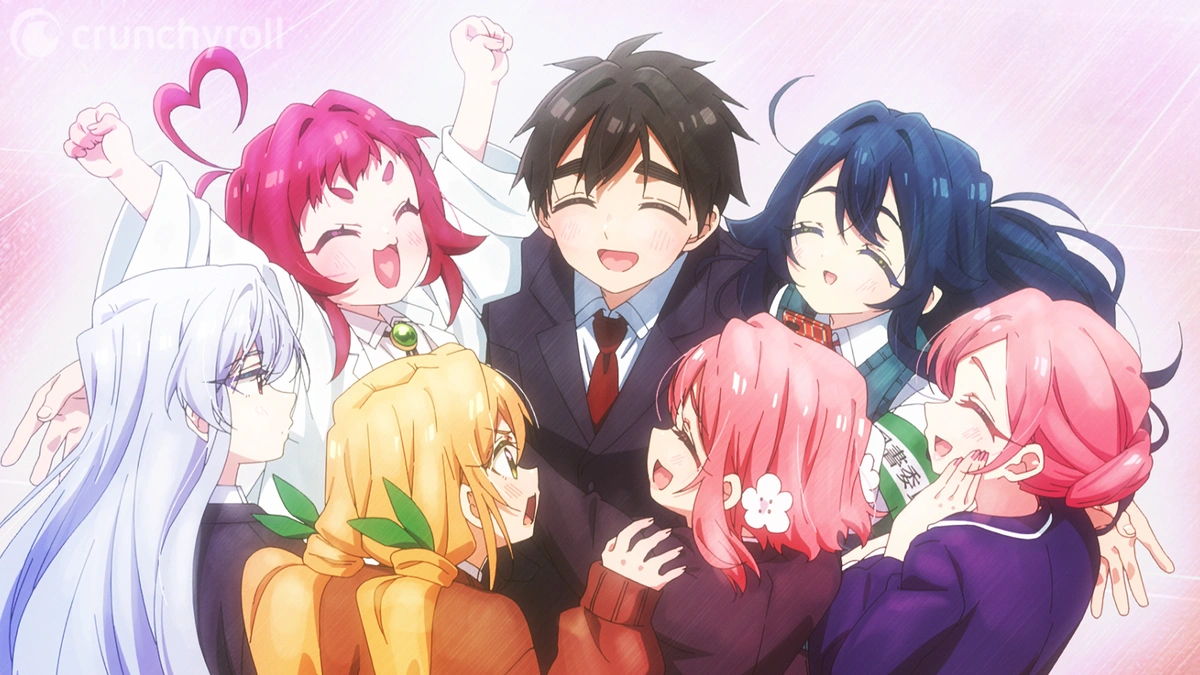
Harem anime is one of the staples of the industry, with titles in the category appearing quite frequently, despite the fact that recently the number of entries has somewhat decreased compared to the past. Based on a manga written by Rikito Nakamura and illustrated by Yukiko Nozawa, “The 100 Girlfriends Who Really, Really, Really, Really, Really Love You” is a genuine harem title which, as the title rather eloquently states, deals with a young man who eventually gets 100 girlfriends.
Watch This Title on Crunchyroll
by clicking on the image below
The “guilty” young man is Rentaro Aijo, who has confessed and been rejected by 100 girls in his lifetime, and that is only until the end of middle school. However, on his last day of middle school, he visits a shrine and prays that he will get a girlfriend during his time in high school. Suddenly, the God of Love appears and tells Rentaro that the reason for his non existent love life is because everyone is only supposed to have one soulmate in their life. Due to a clerical error on the God of Love’s part, however, Rentaro is destined to have 100, something that is supposed to begin when he enters high school.
This is exactly what happens, with one girlfriend appearing at a time, except on the first day of high school, when Rentaro meets the nymphomaniacal Hakari Hanazono and the tsundere Karane Inda, the first two soulmates. They experience love at first sight, but Rentaro cannot decide between the two. That evening, he revisits the God of Love and is informed that if he does not return the feelings of any of his 100 soulmates, they will die in an accident. Not wanting such a fate to befall the girls, Rentaro decides to date all of them simultaneously, beginning with Hakari and Karane with their blessing.
As the story continues, more girls are introduced and gradually become Rentaro’s girlfriends, establishing a polyamorous relationship called the “Rentaro Family”. Consequently, the narrative revolves around Rentaro meeting new girlfriends and the interactions between the members of this unusual group.
The first thing one will notice in the anime is that, despite the main premise of the story, Rentaro is actually a really, (really, really) nice guy who genuinely cares for all the girlfriends he eventually forms relationships with, constantly striving to better himself and become the perfect boyfriend. Over time, he comes to genuinely love each and every new girlfriend he meets and even intends to marry all of them once they are ready, with the girls agreeing to share him as part of the “Rentaro Family”.
This aspect becomes part of the main motif of the series, which frequently features episodes where Rentaro meets a new girl, they fall in love, get to know each other and become a couple, before he introduces her to the rest of his girlfriends, whose reactions differ significantly. In that regard, the first two, Hakari and Karane, have completely different responses, with the former always being open to new additions and the latter usually reacting negatively whenever a new “entry” appears in the harem. Their antithetical personalities extend to their overall characterization and even their physique, since Hakari is voluptuous while Karane is leaner. This contrast works particularly well in the first episodes, as their opposing attitudes and their equally intense love for Rentaro lead them to adopt different approaches in order to gain more affection from him, a dynamic that emerges as one of the best traits of the whole series and continues throughout the season.
At the same time, the style of the girlfriends that appear throughout the first season seems to aim at particular “tribes” of Japanese high school life, with Rentaro often helping them overcome the inherent issues of their respective groups. In this fashion, Shizuka is a bookworm with severe communication issues who cannot even speak properly, Nano is academically brilliant and obsessed with efficiency to the point that anything not contributing to progress is meaningless to her, while Kusuri, the master chemist, has the body of a child due to consuming a prototype drug that was supposed to stop her aging and make her immortal. The last girlfriend introduced in the season I will leave to be discovered, since this constitutes a genuine twist in the story.
This approach allows the narrative to become somewhat socially conscious, dealing with issues such as body shaming, lack of social skills, communication barriers, and even the discrimination that seems to exist in various layers of school life. At the same time, however, although the context is meaningful, the ecchi elements and fan service remain quite prominent as well, with director Hikaru Sato presenting what is probably one of the anime with the most kissing scenes ever. Furthermore, groping also becomes a recurring element, even when portrayed consensually, while the physique of several of the girls is emphasized in order to enhance the sensual tone of the series.
In that regard, Akane Yano’s character design is top notch, with the girls standing out clearly from one another both in terms of physique and the way they are dressed and presented. The obligatory pool episode, where they all appear in bikinis, highlights this aspect in the most evident fashion. Nevertheless, the presence of strong kawaii elements, particularly in Kusuri and Shizuka, prevents the series from becoming overly lewd.
The same applies to the colors and the backgrounds, which are bright, colorful and shiny, in perfect resonance with the cheerful narrative tone of the title. Initially, the episodes follow a structure similar to a “villain of the week” formula, although here the role of the villain is replaced by a new girlfriend. As the story progresses toward the final episodes, where the approach becomes somewhat more dramatic, the visual atmosphere also becomes darker, offering a welcome shift in tone. The animation by Bibury Animation Studios is also of high quality, particularly in the movement of the characters, which mostly follows realistic patterns without excessive exaggeration. Although occasional moments of deliberate extravagance appear, including the typical silly faces trope, the overall visual presentation remains relatively grounded.
Overall, “The 100 Girlfriends Who Really, Really, Really, Really, Really Love You” emerges as a very entertaining title that manages to move beyond the usual restrictions of the harem category by incorporating a number of social observations, while still embracing the amusing aspects of the genre. Lastly, the cliffhanger at the end significantly increases anticipation for the second season, which arrived two years later.