
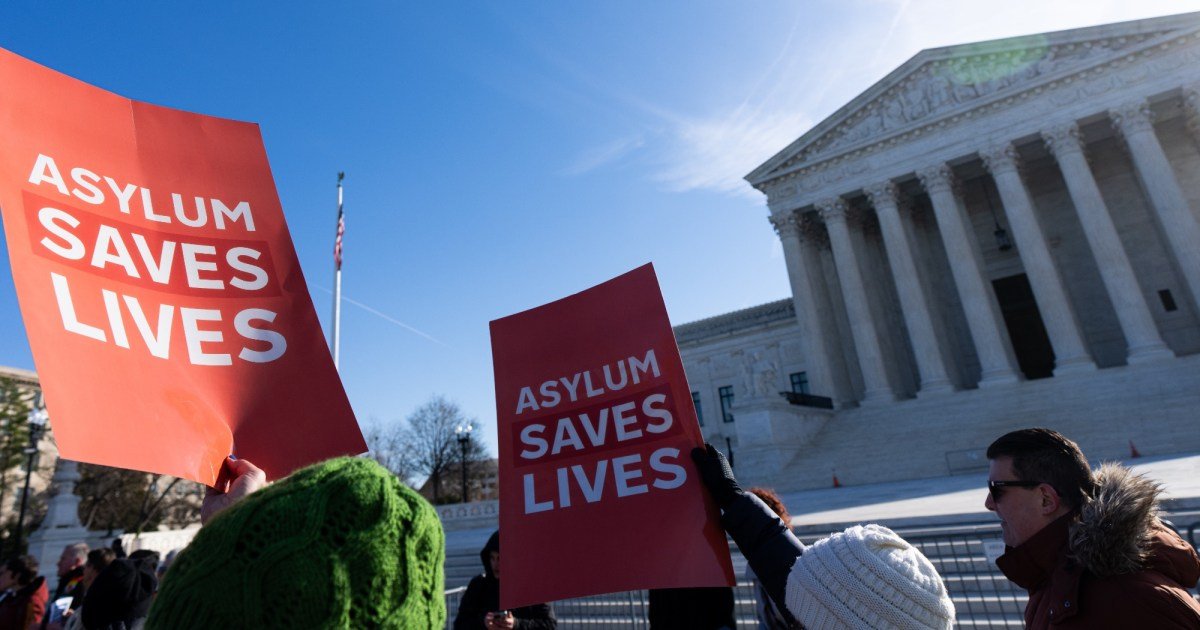
Faith-based groups hold a vigil at the court before a March hearing.Bill Clark/CQ/Roll Call
The Supreme Court made one thing plain this week: It is an anti-immigrant court. There were hints before—big ones, to be honest. But in three rulings this week, the Republican-appointed justices voted to green light Trump administration policies against immigrants that both defy federal law and carry a massive humanitarian toll. This week’s decisions display, at best, a callous disregard for the wellbeing and safety of millions of people. At worst, they signal that an anti-immigrant mindset has taken hold of the court’s conservative wing.
On Thursday, the court issued two decisions with shocking human consequences. First, in Mullin v. Al Otro Lado, the court allowed the administration to deny immigrants the right to apply for asylum simply by preventing them from technically crossing the border. The relevant law states that immigrants “arriving in” the US may apply for asylum. In a gotcha-type trick typical of a middle school bully, the administration claims that if it can prevent people from physically stepping across the border, they can ignore all the mandatory processes Congress set-up to process asylum seekers who come to the nation’s doorstep. The 6-3 majority agreed, using a juvenile grammatical argument to render the law contradictory and unenforceable. Because Congress used the preposition “in,” the administration is now free to defy the law and deny thousands of immigrants fleeing persecution their right to apply for asylum. The conclusion is as stupid as it is cruel.
Justice Samuel Alito’s majority opinion in the case, joined by the other five GOP appointees, ignores the policy’s devastating toll. But Justice Sonia Sotomayor’s dissent does not. She describes the violence visited upon immigrants as they endlessly wait in makeshift camps along the border to be able to apply for asylum, and the tragedy of mothers, fathers, and children drowning in the Rio Grande after being turned away from a port of entry.
“The consequences of today’s decision are predictable. More people will die.”
“The current asylum system developed in response to the international moral reckoning that followed the Holocaust and World War II,” Sotomayor wrote, joined by Justices Elena Kagan and Ketanji Brown Jackson. In 1939, the United States turned away the M.S. St. Louis carrying Jewish refugees. Forced to return to Europe, many of its passengers died in concentration camps. “Congress passed the Refugee Act in 1980 because it did not want this country to repeat the mistakes of its past,” she continued. “Yet if the refugees on the M.S. St. Louis were to walk up to a port of entry on our southern border today, the majority’s interpretation would allow immigration officers to refuse even to consider their asylum applications by physically blocking them from stepping foot onto U.S. soil.”
“The consequences of today’s decision are predictable,” she concluded. “More people will die. More people will attempt to cross the border illegally, and some will make it while others will not.” Like in 1939, the blame for that bloodshed will be on the United States. In place of the statutory scheme Congress erected to remedy past mistakes, the majority lets the Trump administration repeat them.
Whereas the asylum case allowed the Trump administration to turn away people seeking humanitarian relief, the next opinion gave it effectively unreviewable power to strip millions of immigrants of humanitarian relief they are already receiving in the US. Under federal law, the executive branch can grant people from crisis-torn countries what’s known as Temporary Protected Status, allowing them to legally stay in the US while their home countries remain unsafe. These TPS designations are periodically reviewed and can be extended or terminated depending on if conditions have improved.
In Alito’s opinion in Mullin v. Doe, the Supreme Court allowed the Trump administration to prematurely terminate TPS for 350,000 immigrants from Haiti and Syria. The decision frees the administration to strip legal status from 1.3 million immigrants from 17 countries.
In revoking TPS for Haitians, the administration made a mockery of the legally-required process. Yet the Roberts Court blessed that lawlessness on Thursday by finding that the decision to revoke TPS is generally unreviewable by courts. As a result, the rules Congress put into law to govern TPS designations are now mere suggestions. Just as in the case about blocking immigrants from ports of entry, the six justices in the majority gave the president the authority to run roughshod over the law. In both cases, mostly nonwhite immigrants will suffer the dire consequences.
While the decision left the door open for people stripped of TPS to make a constitutional claim, as Alito’s opinion shows, it’s unclear whether this court would ever agree there was a valid one. In this case, the plaintiffs argued the revocation was driven by racial animus in violation of the 14th Amendment’s equal protection mandate. The majority brushed aside the cascade of racial dog whistles and stereotypes Trump targeted at Haitians in the US. “None of the cited statements by either the President or the Secretary was overtly racial, and in substance all expressed policy views that could rest on race-neutral justifications,” Alito wrote.
In her dissent, Kagan accuses the majority of refusing to quote the presidential language that they claim is so innocent. So Kagan, joined by the other Democratic appointees, memorializes it in her dissent:
Haitians are “eating the dogs . . . . They’re eating the cats. They’re eating—they’re eating the pets of the people that live [in Springfield, Ohio].” And: Haitians are also eating “other things too that they’re not supposed to be.” And: Haitians in the United States “probably have AIDS.” And: Haiti is a “shithole country,” which is “filthy, dirty, [and] disgusting.” And: Haitian immigration is “like a death wish for our country.” And: Haitians, along with some others, are “poisoning the blood” of our country. And: “Why is it we only take people from shithole countries” like “Haiti [and] Somalia”? “Why cannot we have some people from Norway [and] Sweden?”
Under Supreme Court precedent, a plausible race-neutral justification is not enough to overcome evidence of a racist motive. And yet, just as it waved the law aside, the court waves away the pesky 14th Amendment (at least as it pertains to racial minorities). After oral arguments in the TPS case, the attorney for the Syrian plaintiffs, Ahilan Arulanantham, had said that the question before the court is whether the government can “ignore the law when it tries to take away someone’s immigration status.”
When it comes to TPS, the answer is yes. When it comes to asylum seekers, the answer is yes. And even for immigrants granted permanent residency, the Supreme Court placed executive caprice over the law.
In a third case this week, the Roberts Court also answered yes to demoting the status of green card holders, permanent residents who have lived in the United States for years, even decades. On Tuesday, in Blanche v. Lau, the same 6-3 majority gave border officials the discretion to take away a green card at a port of entry if they suspect that the legal permanent resident reentering the country may have committed a crime involving moral turpitude, a vague grouping of crimes in immigration law. As my colleague Isabela Dias wrote Tuesday, “agents at the border have just been given exceptional discretion to bypass protections generally afforded to green card holders.”
In her dissent, Jackson explained that the decision undermined the “benefits and security that come with having a green card,” empowering border officials to reclassify a permanent resident’s status on a hunch, then justify it later with “post hoc evidence.” Just as in the other two decisions from this week, in Lau the Supreme Court destabilizes the entire immigration system, relied upon not just by immigrants and their families—but also employers like hospitals and universities—by replacing the certainty of the law with the whims of the president and his agents.
With just a few days left before the justices begin their summer recess, we are still awaiting the court’s ruling on the meaning of birthright citizenship. The Trump administration is seeking to deny citizenship to thousands of people born in the US to parents of temporary visitors and undocumented immigrants. The justices are expected to reject this attempt and uphold the principle, written plainly in the Constitution, that virtually all people born in the US are citizens.
The justices may think that, by upholding birthright citizenship, they can wash their hands of the anti-immigrant stench from these three rulings. They may presume that their refusal to acknowledge Trump’s blatant racism will be cleansed when they sign an opinion bashing slavery and praising the principle of equality. They may hope that in recognizing the practical consequences of ending birthright citizenship, the cruel results of this week’s rulings will be overshadowed.
But no matter what happens in the birthright citizenship case, this court is a partner in the administration’s cruel, racist, anti-immigrant crusade. In just one week, the majority showed its true colors.



