
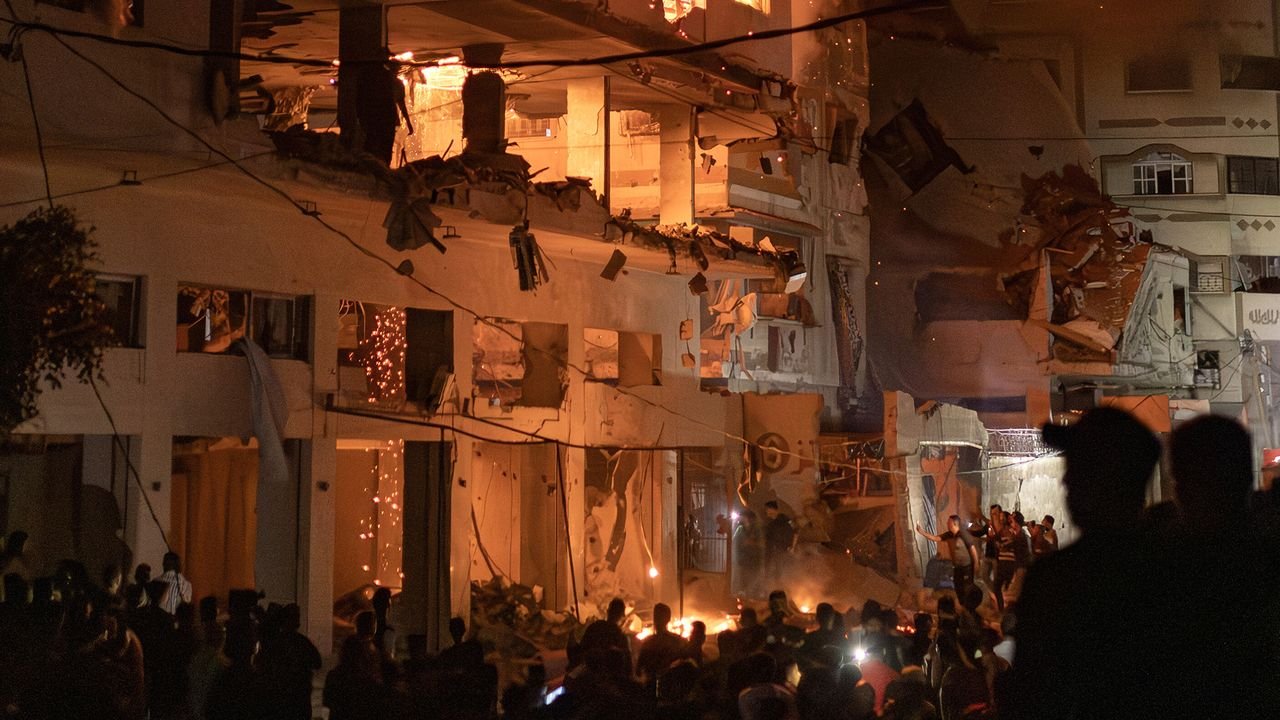
Seven months ago, Israel and Hamas reached an agreement for a ceasefire, largely ending the war in Gaza after two years of Israeli attacks and the deaths of more than seventy thousand Palestinians. The agreement, which was pushed on the Israeli government by the United States, involved a step-by-step process that would eventually lead to the disarmament of Hamas and the reconstruction of Gaza. These are still the things that the Trump Administration claims, via its Board of Peace, to want, but the situation remains unsettled, with Israel still striking the parts of Gaza that it does not control, killing more than seven hundred people since the ceasefire began. (Last weekend, three people were killed during an Israeli drone strike on a food-distribution center in Gaza.) Meanwhile, Hamas shows no signs that it plans to disarm.
I recently spoke by phone with Michael Milshtein, the head of the Palestinian Studies Forum at Tel Aviv University. Milshtein previously served as adviser to COGAT, which supervises civilian policy in the West Bank and in the Gaza Strip. He was also the head of the Department for Palestinian Affairs in the I.D.F.’s military-intelligence wing. During our conversation, which has been edited for length and clarity, we discussed the humanitarian situation in Gaza since the ceasefire, what a diminished Hamas is looking to accomplish, and whether the Israeli elections this fall could change the country’s policy in Gaza.
How would you describe the situation on the ground in Gaza now, and what, if anything, has changed since the ceasefire began late last year?
You know, nothing has changed. Since October, when the ceasefire started, we have been able to say one very clear thing, and this is that Hamas is the prominent player in Gaza. On the eve of the ceasefire, people spoke about how maybe there would be a kind of alternative government, or maybe Hamas would consider disarmament, or maybe even the Palestinian public would be more critical toward Hamas, and there would be protests against their rule. But right now Hamas has total control of the Palestinian side of Gaza. They control about forty per cent of the total territory of the Gaza Strip, which is the area that is not under Israeli control.
And now we are stuck. There has been no progress on the second phase of the ceasefire, which was supposed to be about disarmament and governance and the reconstruction process. But there has been nothing.
And what I can say about Israel is that it is standing in front of a T-shaped junction, with two options. And while all options may be bad, we need to choose the least bad one. One of those options is the one that people in the government talk about every day, which is to renew the war, defeat Hamas, and maybe occupy all of Gaza. That’s what people like Bezalel Smotrich, the far-right finance minister, want. They want to resettle Gaza, and maybe to push the Palestinians out of Gaza. But this desire depends on Donald Trump, and I don’t see Donald Trump right now permitting such a dramatic move.
And the other option is actually to accept this idea of a more bureaucratic Palestinian government. It may not be ideal, and Hamas would still exist in this scenario, but it is better than the alternative of occupying Gaza.
Right, the second phase of the ceasefire envisioned not just the disarmament of Hamas but also the beginnings of a kind of more bureaucratic government that would empower different Palestinian factions to oversee governance in Gaza. And then, perhaps over time, Israel would allow more autonomy in the territory. Was that the idea?
Yes, the government of Israel even promoted this idea after the ceasefire was pushed on them—that Hamas would give up its weapons, there would be a kind of alternative government, which would not will be affiliated with Hamas, and that we would promote a kind of reconstruction with the support of the United Arab Emirates and Saudi Arabia, and there would be the deradicalization of the Palestinians. It was utopian and, since Day One, a total illusion.
For one, if you asked Hamas about what they wanted, they were very clear that they were against disarmament, even after they said yes to Donald Trump’s plans. They said, O.K., we will accept this idea of the bureaucratic government. But they made clear that they would not abandon their weapons, and that this was important to who they were. So from Day One, it was obvious that there was a huge gap between the expectations of Israel, and maybe even the American Administration, and what Hamas wanted. So, you know, actually nothing is really surprising about the current situation and the fact that we are stuck right now in a very problematic place.
Not to be too cynical here—
That’s O.K.
But do both sides actually want this status quo?
Hamas, yes. But Israel, no. This settlement was forced on Netanyahu by Donald Trump. It’s obvious. If you could ask Netanyahu six months ago, before the ceasefire, if he wanted this, he would say, no, I want to continue the war. For him, it is an endless war. But his whole plan was really damaged by his idiotic attack against the leadership of Hamas in Qatar, because that caused Trump to pressure him to end the war.
What I meant was that, given Netanyahu’s inability to re-start the war without U.S. support, isn’t the status quo, with Israel controlling large swaths of Gaza, what he would prefer?
Yes, but both sides still hope they will get what they want. If you ask Hamas, they will tell you that they really hope that Donald Trump will push Israel to expand their withdrawal from the yellow line, where they are positioned, and to promote reconstruction. But that has not happened. And if you ask Netanyahu, he would say he wants that green light from Trump to renew the war, but so far that has not happened.
In a way, this is all very similar to what’s happening in Lebanon. The Americans are the only ones who can solve this, because if you depend on Israel and Hamas, or, in the Lebanese case, on Israel and Hezbollah, there is no way to bridge the gap. There have been all kinds of negotiations with the Lebanese government and Israel, but the only one who could really get a ceasefire right now is Donald Trump, by saying to Israel that this is what he demands.



