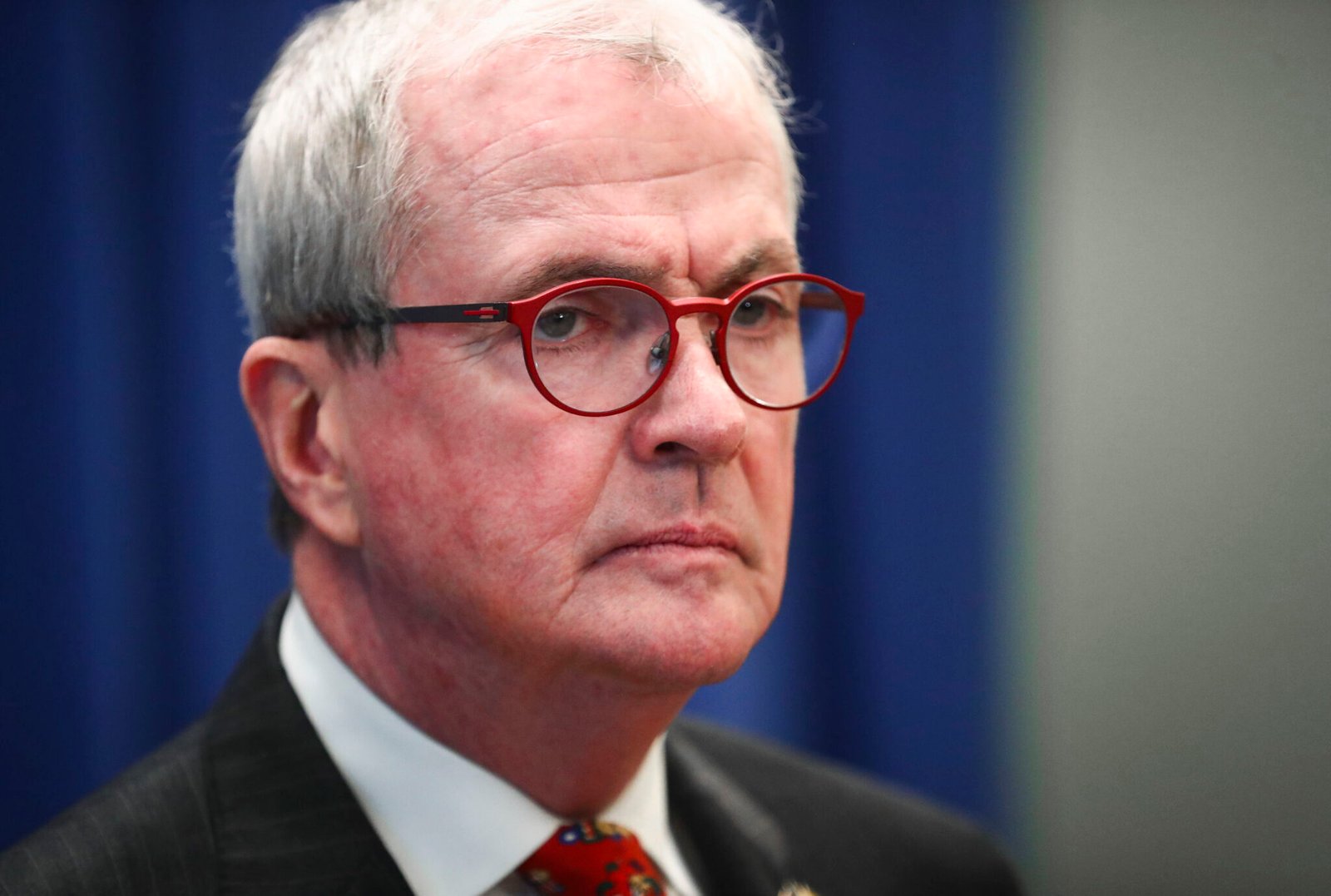
Phil Murphy left office Tuesday at noon after eight years as New Jersey’s governor, two terms highlighted by tumult.
His first years in office were marked by political scandal and Democratic infighting. He was among the first governors forced to deal with COVID-19, which began spreading while he was hospitalized for cancer surgery. In 2021, he became the first Democratic governor in nearly 50 years to win reelection. He helped lead a bungled attempt to get his wife elected to the U.S. Senate, a move that not only killed her political ambitions but also destroyed the county line. And he landed in the crosshairs of the second Trump administration when he appeared to say he’d hide an undocumented immigrant in his Middletown mansion.
We sat down with Murphy recently to ask him about the highlights and lowlights of the last eight years. His left office at noon, with Gov. Mikie Sherrill (D) succeeding him.
Good: Pensions
Even Republicans who hate most of Murphy’s budgetary ideas give him kudos for his commitment to boosting the health of our state’s pension fund. Murphy’s predecessors of both parties either ignored the fund or contributed little so that they could spend elsewhere, but Murphy boosted annual pension payments to record highs.
Under Murphy these payments amounted to about $47 billion over eight years, more than twice the $22.7 billion paid by other governors since the 1997 fiscal year. The health of our pension funding is still bad compared to other states, but it’s far healthier than it was when Murphy took over.
“I am very proud we are who we said we would be, and I know that sounds corny, but that doesn’t happen that often in this line of business. We campaigned a certain way, and we have governed largely, if not overwhelmingly, in that way,” Murphy said.
Bad: Transparency
Murphy caved to legislators who made it their mission in recent years to make sure the public knows less about what their elected officials and political candidates are up to, by signing a rewrite of the Open Public Records Act that makes it harder to gain access to government documents.
Murphy waived away his responsibility for the OPRA rewrite, loathed by journalists and citizen watchdogs as a transparent attempt to put roadblocks in front of anyone trying to uncover malfeasance in government, by saying it wasn’t his idea.
“I didn’t run to reform OPRA. Others had a higher passion for that than I did, and you sort of make tradeoffs,” Murphy said.
I have no doubt lawmakers desperate to keep their records away from our prying eyes tried to hold the rest of Murphy’s agenda hostage in exchange for his signature on this bill. He should have resisted.
In-between: COVID-19
Murphy won a lot of praise from Democrats during the early months of the COVID-19 crisis as he sought to limit the spread of the virus by closing businesses and schools, restricting the size of public gatherings, cutting the prison population, and more.
There were naysayers then, as there are now. Some of them, I think, forget the sheer magnitude of this unprecedented crisis, with bodies piling up in hospitals and medical professionals stretched to their limit.
But surely, I thought, in hindsight Murphy could name one or two things he would have done differently?
Nope. Murphy could not cite a single thing. When I asked whether he thought his administration’s strategy on nursing homes deserved a second look, he called the premise of my question faulty.
As a reminder, on March 31, 2020, the Murphy administration ordered nursing homes to readmit patients who tested positive for COVID-19, as long as the homes could separate them from the general population. This doomed many of our seniors. More than 10,000 nursing home residents died in the first four months of the pandemic.
Murphy insists that nursing home operators are at fault for not obeying the administration’s directive to separate sick patients from well ones.
“We said, you’ve got to do three things. It’s either: minimum, a different floor; better, a different wing; even better, a different building. And by the way, you can’t take care of, as a health care professional, one group over here and one group over there. We were crystal, crystal, crystal clear,” he said.
The independent review Murphy ordered of his administration’s response to the pandemic says too few nursing homes “could readmit such patients while following infection control guidance and maintaining safety protocols.” In the weeks following the Murphy administration’s readmission directive, the virus ran rampant in nursing homes, and the directive was retracted on April 13, 2020, the report says. COVID-positive nursing home patients were moved to separate facilities.
At least one lawsuit filed against the Murphy administration by the families of three people who died in nursing homes in the first wave of COVID was dismissed because, the judge said, the administration acted “at a time that it was not sufficiently clear to a reasonable official that what he or she was doing violated” anyone’s rights. That may be true, and to look back on it all now and deny you could have done anything differently may be legally sound. But it is not morally sound.
Good: pardons
It took Murphy seven years to issue a pardon, but once he did, he couldn’t stop, pardoning or commuting sentences for more than 450 people in the last 13 months. Plus, unlike with pardons issued by presidents like Joe Biden or Donald Trump, most of Murphy’s orders don’t reek of favor-trading. He created a clemency board to review pardon and commutation requests to make sure that the people receiving them had reformed or had been punished too severely for their actions and deserved a break.
Murphy said he takes a number of things into consideration when deciding whether to grant clemency to someone.
“How good a citizen have you been in the system? Or if you’re looking for a pardon or a commute from lifetime parole, how’s your life been once you’re out of the system? Are you offense-free? So there’s a lot of things you have to consider,” he said. “We talk about when you pardon someone or commute their sentence or commute their parole, you put a family back together again, because the family has been challenged in their — and I always add, by the way, we take the victims’ side of that as seriously, in terms of what their family looks like, and the impact on their families.”
Bad: NJ Transit
NJ Transit is no doubt in a better place than it was when Murphy was elected governor after campaigning to fix it.
But its service is still so unreliable that I don’t use it because I don’t know if it’ll take me to my destination or, say, drop me off eight stops from where I started and then tell me the train has been canceled so I’ll have to figure out a way to New York City on my own (that happened recently to one of my colleagues, and she still hasn’t gotten a refund). Yet Murphy acts like he’s fixed the agency.
“On-time performance, customer satisfaction, safety are all dramatically different and better than they were when we first got here,” he said, later adding, “Someone independently studied the time it took to move people into Taylor Swift and out of Taylor Swift in every North American concert she did, and we were far and away the winner.”
It’s great for Taylor Swift fans that NJ Transit aced it on three days in May 2023. But we need that kind of performance every day. I hope Sherrill takes NJ Transit more than Murphy does — that may be the only way the agency becomes as good as we need it to be.

In-between: Trenton’s political culture
It feels a bit unfair to lay the blame for Trenton’s often noxious political culture on Murphy, since only a miracle worker could make that kind of change in eight years.
But he certainly didn’t make it better, rolling over for legislative leaders who wanted to avoid paying steep fines for political misbehavior and also kneecap watchdogs seeking their emails.
Murphy said he does not agree with progressive Democrats who view the New Jersey Statehouse as a haven for corruption. What they see as corruption, Murphy said, he sees as normal politics.
“If you are a purist and you cannot countenance compromise, this is not your state. I suspect politics should not be your chosen line of business either, because it’s a little bit like, you know, Bogart/Claude Rains in ‘Casablanca,’ where there’s gambling going around the back room. You have to compromise. You have to get around a table, and sometimes you have to accept stuff,” he said.
So, using Murphy’s own analogy, one side of Trenton’s Democratic power structure is cinema’s most famous saloon owner, and the other is … cinema’s most famous Nazi collaborator. Let us pray.
GET THE MORNING HEADLINES.