
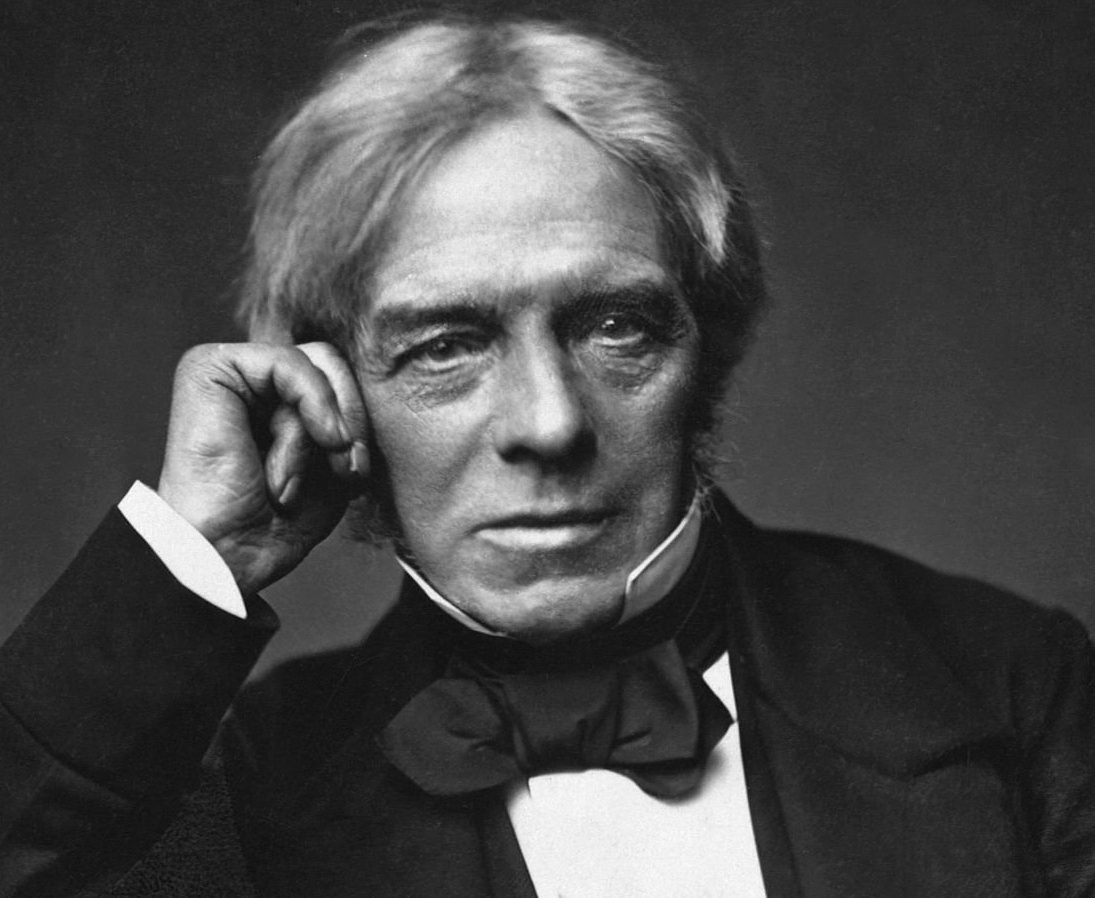
Let’s start the conversation with a question – who knows what a Faraday Bag is? We will get back to that.
Time to start from the beginning.
Michael Faraday didn’t come from privilege. Rather, he was born into a very poor London family that literally didn’t have enough money to put a sturdy roof over their heads. When I say poor, Michael literally went without meals at times. Michael’s first job was in a book bindery; as a young teenager, he swept floors and folded pages. But every night he read the books that were being bound in that plant, and his curiosity grew by the hour.
One day a customer handed him a ticket to attend a lecture by Sir Humphry Davy, who was the hot shot celebrity scientist of that time. Faraday attended the lecture and took copious notes of the groundbreaking lecture. Soon after, Michael was hired by Davy, and the kid with no formal training was off to the races. In no time, the seemingly uneducated teenager was rewriting the book on physics.
Faraday discovered electromagnetic induction, built the first electric motor, and created the first generator. He showed that electricity and magnetism were part of the same force—the electromagnetic field. And he built the first Faraday cage, proving that a conductive enclosure could block external signals.
That idea– a 19th-century experiment involving metal mesh and static electricity — is now baked into the Faraday bags used by modern leaders, CEOs, diplomats, and politicians around the world. To answer the question more fully—Faraday bags are used today by smart people around the world. These leaders use signal-blocking pouches to place their phones or laptops, preventing hacking, tracking, or eavesdropping. Every time a head of state steps into a secure room, every time a CEO meets behind closed doors, a Faraday bag is nearby.
What is the lesson here—
Faraday wasn’t the smartest person on paper. He wasn’t the most educated. He wasn’t polished, but he was relentless with curiosity and humility, and he had an uncanny ability to explain complex ideas in plain language. Faraday believed if you truly understood something, you should be able to teach it to anyone.
Modern-day leaders could use that.
We have plenty of people with credentials, titles, and talking points. But the ones who change things—in politics, business, or anywhere else—are the ones who stay curious, keep learning, and don’t pretend to have all the answers. The listen. They experiment. The adapt.
Faraday didn’t wait for permission to lead. He led by example. He showed that brilliance can come from anywhere, and he taught us that the world moves forward when someone asks a question everyone overlooked.
Today’s leaders may carry Faraday bags, but the smarter ones carry Faraday’s mindset as well.
Class dismissed.



