
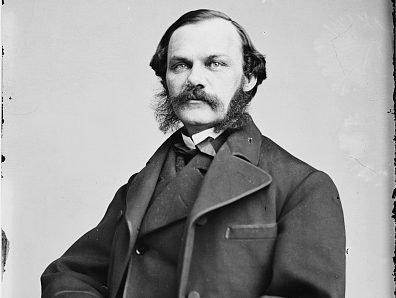
The founder of the New York Times was a Republican politician from New York who was a close personal friend and political ally of Col. John Kean of New Jersey.
Henry Jarvis Raymond founded the New York Times in 1851 while serving as a New York assemblyman and served as its editor until he died in 1869.
Raymond and Jarvis together played an integral role in founding the Republican Party in 1856.
While serving as the New York Times editor, Raymond was the lieutenant governor of New York, the Republican National Chairman – he was Abraham Lincoln’s pick when he sought re-election in 1864 – and a GOP congressman.
The connection between Raymond and the Kean family was even deeper. Kean’s sister, Jula, was married to Hamilton Fish, a New York Republican and one of Raymond’s best friends. Fish served as a congressman, governor, U.S. Senator, and later, after Raymond’s death, as U.S. Secretary of State.
Kean is the great-great-grandfather of Rep. Thomas Kean, Jr. (R-Westfield). His title of Colonel, which he used for decades, was an honorific one awarded by Gov. William Pennington after Kean served as his secretary, a post now known as chief of staff.
Kean was an insider’s insider. He was the grandson of John Kean, who served in the Continental Congress, and was the great-great-nephew of New Jersey’s first governor, William Livingston.
He was a shareholder in railroads in Camden, Middlesex, Union, and Somerset counties, and the owner of a bank and gas and water utility companies. He owned three water-powered mills on the Elizabeth River. Two of his sons became U.S. Senators.
In the 1860 presidential election, New Jersey backed a favorite son for the Republican nomination, with former U.S. Senator William Dayton receiving 14 votes from New Jersey GOP delegates on the first ballot.
Kean was supposed to deliver New Jersey’s delegates to New York Senator William Seward on the second ballot, but he wound up cutting a deal with Lincoln.
He lost four New Jersey delegates to Lincoln on the second ballot. On the third ballot, New Jersey gave Lincoln eight votes, with five going to William Seward and just one going to Dayton. Lincoln won the nomination on the third ballot.
Five weeks into the Lincoln presidency, the Civil War began. Kean received a no-bid contract from the War Department to manufacture gun parts for the Union Army.
That’s where the first conflict between Kean and the family of future Rep. Tom Malinowski (D-Ringoes) began.
The Secretary of War who approved the Kean contract was Simon Cameron, a former U.S. Senator from Pennsylvania and the great-great-grandfather of Malinowski’s stepfather, Blair Clark.
During the first year of Lincoln’s presidency, Kean had a conflict with Cameron. At one point, he was forced to take a train to Washington to see Lincoln and complain that Cameron was too slow at paying invoices to the Union Army. Lincoln wound up replacing Cameron with Edwin Stanton a couple of months later.
Raymond left Congress after one term after the New York Times’ support of President Andrew Johnson led to criticism and loss of readership during Reconstruction.



