
This is an edition of The Atlantic Daily, a newsletter that guides you through the biggest stories of the day, helps you discover new ideas, and recommends the best in culture. Sign up for it here.
The first thing you should know about the New World screwworm is that it isn’t actually a worm; it’s a fly. At the larva stage, it twists into the flesh of its host, devouring it from within. These wormlike maggots feed on all kinds of warm-blooded animals (the fly’s scientific name is Cochliomyia hominivorax, or “man-eater”), but they pose a serious threat to livestock, and to cattle in particular.
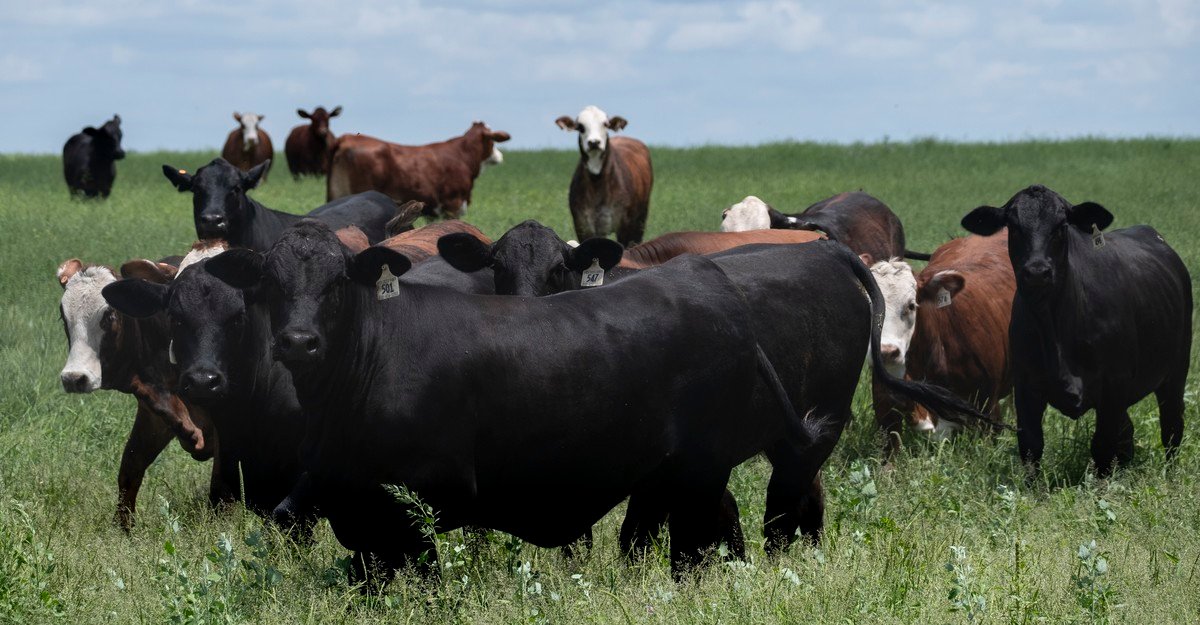
The second thing you should know about the New World screwworm is that it’s back. Last week, 60 years after the United States was declared free of the fly, the Department of Agriculture announced that it had found larvae in a three-week-old calf in rural Zavala County, Texas, not far from the Mexican border. Four more infected animals have since been identified across Texas and New Mexico: two calves, a goat, and a dog. The U.S. cattle herd is already the smallest it’s been since 1951 (in part because of drought), and the value of cattle is soaring. As meat-packers pay more for the few animals that remain, they’re passing those costs down the supply chain to beef consumers. To meet the demand, the industry will need to invest in new calves and build up the herd. But the White House’s mixed messages on tariffs has made farmers skittish, and the resurgence of a parasite that eats their animals alive may only make things worse.
Since the 1950s, the Department of Agriculture has been warding off the screwworm with a tried-and-true strategy. Workers raise batches of the flies themselves, sterilize them with radiation, and then air-drop them over affected areas each week. Wild flies mate with the sterile ones, slowly eroding the population over time. It’s one of those quietly effective taxpayer-funded programs that’s had an enormous impact in past decades: Before the sterile-insect technique repelled screwworms from the southern U.S., the pests had been costing cattle farmers tens of millions of dollars every year.
The insect population was eventually pushed south through Mexico and past the Darién Gap, the roadless rainforest on the border between Panama and Colombia, where it was held at bay until 2022. Then it began its march northward, speeding up in 2024, perhaps thanks to illegal cattle trafficking. The U.S. first closed its border to Mexican calves in November of that year, further reducing the size of the American herd and pushing up beef prices. Sally DeNotta, a professor of veterinary medicine at the University of Florida, told me that because the flies have already made it to the U.S., they’re unlikely to be fully eliminated for “months to years.” Many hundreds of millions of sterile flies need to be dropped onto these screwworm populations each week to have an effect. The USDA began investing in production and dispersal facilities for sterile flies last year, but right now, the only place in North America capable of producing sterile flies en masse is a Panamanian facility that produces just 100 million a week.
Officials are already pointing fingers. Democrats have been blaming DOGE, which reportedly cut funding for screwworm-monitoring programs in Central America last year (although it’s not clear that the programs would have done much to stop the spread). The Trump administration is blaming the Biden administration. Texas state officials are critiquing the USDA’s response, and the USDA is critiquing state officials. USDA Secretary Brooke Rollins called Texas’s agriculture commissioner, Sid Miller, “unserious” after he suggested that he might not report an outbreak among his own livestock. If ranchers do try to manage infections on their own in an attempt to avoid costly quarantines, they could inadvertently encourage the parasite’s spread.
Despite high cattle prices, the screwworm arrives at a moment of instability for American ranchers. The decision to raise a calf is effectively a bet on its future value; each animal takes about nine months to breed and about two years to raise. Ranchers are going to invest only if they’re relatively sure what the market is going to look like—a tough ask in a policy environment that seems to shift every few months. The cattle industry rejoiced when Donald Trump announced strict tariffs on beef imports last summer (which benefited ranchers by curbing foreign competition), and it balked when he later rolled back a tariff affecting Brazilian beef. The president quadrupled the quota for Argentinian beef imports earlier this year; he was planning to sign an executive order that would have removed even more tariffs on imported beef, but he punted at the last minute. Politico reported that Rollins helped stop the order because she didn’t want to anger ranchers.
Farmers are an important constituency for this White House, and Trump has made plenty of overtures to American cattle ranchers since his return to office. But in trying to lower beef prices amid a broader affordability crisis, his administration has created a rift. The rising price of cattle has in some ways played to ranchers’ advantage, allowing them to negotiate higher prices from the feedlots where these animals are sent to fatten up before slaughter. That’s helped push the price of ground beef up 14 percent since last year. Amid rising steak prices, some barbecue restaurants have struggled to stay open.
With screwworms on the move, the industry’s supply and pricing issues have become only more urgent. Demand has yet to drop off—but most people also can’t tell the difference between an imported rib eye and a domestic one. If the administration’s push to bring back imports does end up curbing grocery-store prices, ranchers’ loss will be consumers’ gain.
Related:
Here are three new stories from The Atlantic:
Today’s News
- The United States Central Command said that it launched new strikes on Iran in response to the country shooting down an American military helicopter yesterday. A U.S. official told NBC News that the aircraft may have been brought down by an Iranian drone; the two crew members were rescued and reportedly have no serious injuries.
- The House passed a bill funding ICE and Customs and Border Protection through the end of President Trump’s term, ending a four-month funding lapse and sending the measure to his desk. The legislation provides nearly $70 billion for the agencies and passed largely along party lines after weeks of GOP disputes.
- Voters in Maine, South Carolina, Nevada, and North Dakota began casting primary ballots today; the spotlight is on Maine’s Democratic Senate race, in which Graham Platner remains favored to win despite recent controversies.
Evening Read
The Americans Shelling Out Five Figures for a Coat of Arms
By Helen Lewis
Founded in 1484, the College of Arms operates as part of the Royal Household, answering to the monarch. Its main functions are determining whether someone is entitled to use an existing coat of arms, and granting new arms to individuals and corporations. In Britain, having a coat of arms is still part of public life; you cannot join the Order of the Garter, a personal club of worthies curated by the sovereign, without one. For a fee of about $12,000, the college will perform the genealogical research and design work necessary to grant you arms. But the college also caters to an unlikely group of would-be knights-errant: Americans.
Read the full article.
More From The Atlantic
Culture Break

Watch (or skip). Steven Spielberg makes a plea for empathy with Disclosure Day (out now in theaters), an alien movie for a post-truth moment.
Reminisce. Marjane Satrapi, the author of the best-selling graphic memoir Persepolis, made rebellion into a lifelong project, Hillary Chute writes.
Play our daily crossword.
Rafaela Jinich contributed to this newsletter.
When you buy a book using a link in this newsletter, we receive a commission. Thank you for supporting The Atlantic.



