
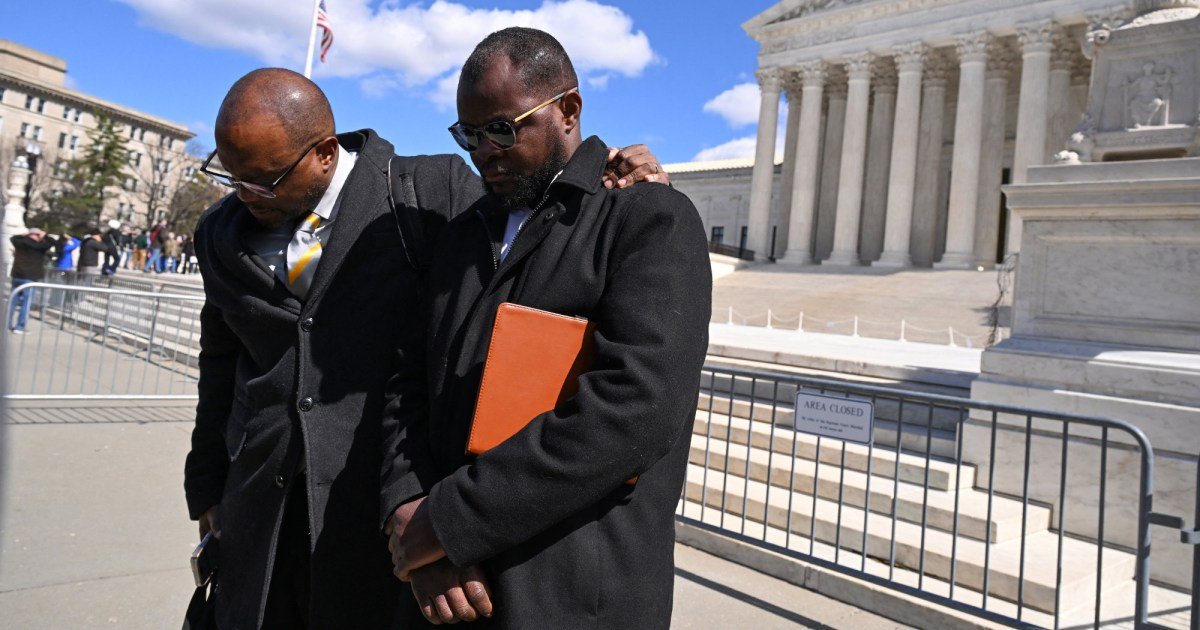
Vilès Dorsainvil has thought a lot about desperation recently. Specifically, what desperation forces people to do, and the tragedy it seems to attract. As a Haitian immigrant and the executive director of the Haitian Support Center in Springfield, Ohio, he has seen a desperate community seeking stability in the United States, only to find that the ground has shifted.
Dorsainvil has lived in the US since December 2020, when his mother insisted that he leave Haiti after he began receiving anonymous threats and demands for funds. He landed in Fort Lauderdale with just enough money for his rent and the burden of supporting a family back home. The only person he knew when he reached his destination was his nephew who lived in Springfield, Ohio. Within 72 hours, Dorsainvil went there.
Dorsainvil arrived in Springfield, a small city of about 60,000 residents an hour west of the state capital, before the Haitian population began to soar. The island country had never recovered from the 7.0-magnitude earthquake in 2010 that devastated it and created the circumstances for subsequent prolonged food insecurity, rising gang violence, and deteriorating access to medical care. When Haitian President Jovenel Moïse was assassinated in July 2021, Dorsainvil was relatively settled as a factory worker in Springfield. Given the chaos back home, he applied for and was granted Temporary Protected Status, a humanitarian designation that protects people from deportation if their country is deemed unsafe. It meant that as long as the Secretary of Homeland Security renewed Haiti’s TPS, Dorsainvil could live and work in Springfield.
After Moïse’s assassination, more than 100,000 people living in Haiti became eligible for TPS, and eventually about 15,000 Haitians settled in Springfield. They paid taxes, raised their children, started businesses, and worked many jobs that others wouldn’t take. They also became the lightning rods for much of the free-floating anti-migrant sentiment fomented by Trump’s 2024 campaign and then his administration.
Soon after baselessly claiming that Haitians were “eating the pets” of Springfield residents during a presidential debate in September 2024, Trump vowed that should he be reelected, he would deport Haitians. That November, Trump won Clark County, of which Springfield is the seat, with nearly two-thirds of the vote. During his second term, he came close to fulfilling his promise when then-Homeland Security Secretary Kristi Noem began the process of terminating Temporary Protective Status for countries that came up for review, including Venezuela, Afghanistan, and Haiti. Established by Congress in 1990, TPS grants legal status to people fleeing war, natural disasters, or unrest, and is designated in 6-, 12-, or 18-month increments. Many countries’ designations have been renewed continuously for years, if not decades, because conditions remain unlikely to improve. After Noem announced she wouldn’t renew Haiti’s TPS, Haitians and Springfield itself prepared for ICE to descend soon after the designation was set to expire on February 3, 2026.

But the ICE wave never came. Haitian TPS holders, including Dorsainvil’s younger brother, had sued the administration, and on the eve of Haiti’s TPS expiration, a federal judge postponed it. Since then, more than 330,000 Haitians living in the US with TPS have been in legal limbo as they wait for the Supreme Court to decide whether to allow their protections to expire. State by state, the ramifications quickly appeared. In Ohio, for example, the driver’s licenses of Haitian TPS holders expired in mid-March, and they have been unable to renew them. Until June 5, when a federal judge in Rhode Island ruled against the Trump administration, the federal government also stopped issuing work permits and processing asylum claims from Haiti and 38 other Latin American, Asian, and African countries and Palestine.
“I call it, ‘To leave or not to leave,’ because where are you going to go? If you leave to go somewhere else in the USA, you will still be a target.”
“Our immigration system prior to Trump has suffered from really long backlogs for people seeking asylum specifically,” said Emily Brown, director of the Ohio State University law school’s Immigration Clinic, which provides free legal representation to immigrants facing deportation. The sweeping halt of immigration processes only exacerbates that, Brown said, and has also closed a vital path to family reunification. Immigrants who have fled their home countries can petition for immediate family to join them only once they are granted asylum or refugee status. Many immigrants who have been in the US for years, Brown’s clients included, have been stuck on the threshold of approval—some have completed the steps and only need an asylum officer’s sign-off.
As Haitians and TPS holders around the country wait for the Supreme Court’s decision on whether to allow the Trump administration to end their legal status, in Springfield, they’ve retreated into the shadows. Haitians are leaving the city, Dorsainvil says, though it’s been far from a “mass exodus.” Some have attempted to go to Canada, others to Columbus. “I call it, ‘To leave or not to leave,’ because where are you going to go?” Dorsainvil tells me. “If you leave to go somewhere else in the USA, you will still be a target.”

If you aren’t looking for Springfield’s Haitian Support Center, you likely won’t find it. It’s tucked discreetly in the back of a church on the city’s east side, surrounded by single-family homes on one of the city’s main thoroughfares. The sole indicator of the center’s presence is a sign on a locked door bearing its logo and welcoming visitors in English and Haitian Creole. When I arrived on a recent Friday afternoon, just two other people were there. Neither was Dorsainvil.
About 45 minutes later, he arrived and ushered me into a windowless room he shares with a colleague, their desks an arm’s length away from each other. Between two laptops and a desktop, notebooks and files, and more than a dozen yellow sticky notes plastered beside his screens and along his walls, Dorsainvil’s desk is as cluttered as his to-do list. As he answered his ringing phone, I studied the back wall of the office, where a framed print bears a simple inscription: “Piti piti zwazo fè nich li.” It’s a Haitian proverb meaning “little by little, the bird builds its nest.”
As thousands of Haitians flocked to his city, Dorsainvil realized Springfield had no nest, or even a branch to land on. He helped found the Haitian Support Center to serve as a “bridge” between Haitians and legal, financial, and material resources, particularly because immigrants are vulnerable to scams and exploitation.
When we met, he had just returned from a failed attempt to recover a $1,900 security deposit a rental agency was holding for a woman who had moved to New York. She took a Greyhound bus back to Springfield when neither she nor Dorsainvil could reach her property manager. When the pair showed up to the agency’s office that morning, the property manager was nowhere to be found. “Come back Monday,” agency staff told the woman. She boarded a Greyhound back to New York, unable to miss work to wait until Monday. Dorsainvil promised to return to the agency himself.
This same woman, Dorsainvil told me, tried to help her younger brother apply for asylum. A New York firm told her they’d do it for $24,000. She put down $3,000 for a service nonprofits and immigration clinics, like Ohio State’s, can do for free. Brown noted that while some firms charge “exorbitant fees,” the cost of litigating asylum claims has risen as backlogs make cases lengthier and more complex. “Good attorneys are cost-prohibitive for a lot of people,” Brown said, “and it leads them to having to choose between funding their legal case and their basic needs.”
“Good attorneys are cost-prohibitive for a lot of people, and it leads them to having to choose between funding their legal case and their basic needs.”
Dorsainvil’s cases are a litany of awful experiences: women and men vulnerable to human trafficking because they lost their work authorizations; families coming home to eviction notices with less than $20 in their bank accounts; people who have “nothing” and nowhere to go. There is parallel desperation between Haitian immigrants and the families they support back home that Dorsainvil can’t ignore; if a Haitian in the US gets detained or deported, it’s a matter of “life and death” for them and every person in Haiti who relies on them.
Because the Haitian Support Center’s reach is restricted to the Springfield community, he cannot help recover the $3,000 from the “predatory law firm” the woman who moved to New York engaged; nor can he help the immigrants frequently calling from Columbus or elsewhere in the state. Money flows to the center through small donations, some as little as $5. And, like Dorsainvil, most of its staff are Haitian immigrants. Should TPS expire, they face the same fate as the people they help.
Dorsainvil doesn’t know how much longer the Haitian Support Center can continue its work, including paying people’s rents and utility bills. But he feels obligated to continue until he’s forced to stop. He acknowledged that his work and status as a high-profile Haitian TPS holder place him at significant risk, but he calls it the “ultimate sacrifice.”

Of the 1.3 million TPS holders in the US, 97 percent are from just five countries, with the lion’s share coming from Venezuela and Haiti. Less than three weeks after Trump retook office, Noem announced her decision to terminate TPS for Venezuelans and began moving down the list soon after. By August 2025, DHS announced its intent to terminate TPS for more than a third of the 17 countries with active designations, Honduras, Nicaragua, Afghanistan, and Haiti among them. When the Supreme Court ruled in October 2025 that the Trump administration could terminate Venezuelans’ TPS designation even as litigation continued, the unsigned and unreasoned order offered no guidance for the wave of lawsuits behind it.
Haitians have been granted TPS continuously, either through DHS or court order, since the 2010 earthquake. Especially after 2021, thousands have flocked to Springfield, drawn by the promises of stable factory and warehouse work, a relatively low cost of living, and a burgeoning community of fellow resettled Haitians.
Many Haitians who were trained as physicians back home have taken nursing and other healthcare jobs in Clark County, including serving as interpreters. Vilès Dorsainvil’s younger brother, Vilbrun, is one such physician who became a nurse and worked at Springfield Regional Hospital. Vilbrun is a lead plaintiff in the TPS case before the Supreme Court; Vilès, who was already a plaintiff in a separate federal case challenging the termination of TPS, recruited him.
Like countless other Rust Belt cities, Springfield struggled with decades of depopulation as manufacturers moved out. And like other Ohio towns, particularly in the western part of the state, Springfield was devastated by the opioid epidemic, ranking consistently among US cities with the highest rates of fatal overdose. With thousands of new residents more than eager to work hard jobs for low pay, Springfield’s tax revenue increased, its unemployment rate decreased, and nearly a dozen Haitian-owned businesses opened in town.
Even with the benefits that may have come to the city, anti-Haitian sentiment in Springfield started long before Trump and Ohio’s own Sen. JD Vance capitalized on it during the 2024 campaign. The spark that ignited the flame came in August 2023, when a Haitian TPS-holder crashed into a school bus near Springfield, killing an 11-year-old boy. The driver, Hermanio Joseph, did not have a valid US driver’s license, because, he testified, he had not yet gathered the required documents. In May 2024, a jury convicted him of involuntary manslaughter and vehicular homicide, both felonies, and he was sentenced to 9 to 13 years in prison.
Joseph’s arrest and conviction only fueled the growing resentment against Haitians in Springfield. By the time Vance claimed in early September 2024 that his office was fielding reports of pets and wildlife being “abducted by Haitian migrants,” outraged residents had already swarmed city commission meetings, claiming Haitians were “invading” the community, driving up housing costs, and bringing a “flood of drugs” with them. The Blood Tribe, a neo-Nazi group Springfield is currently suing, descended on the city multiple times that summer, lobbing racial slurs at city officials and insisting the influx of Haitians threatened the city’s “good White residents.”
Trump’s targeting of Haitians has splintered Ohio’s Republicans. In the House of Representatives, Springfield-area’s two Republicans joined Democrats in April in voting to extend Haitians’ TPS through April 2029. But they remain largely loyal to Trump’s immigration crackdown, following Ohio’s two Republican senators voting to give ICE and Customs and Border Protection $70 billion over the next three years. One of those senators, former Lt. Gov. Jon Husted, is opposing the man who appointed him to replace Vance.
Gov. Mike DeWine, who with his wife helped establish a network of free schools in Port-au-Prince that closed due to violence, has repeatedly defended Ohio’s Haitian immigrants and called ending TPS the “wrong” choice. The situation in Haiti has “never been worse,” DeWine told reporters in February. After a federal judge halted the TPS termination from going into effect, First Lady Fran DeWine said she and the governor were “happy” for both Haitians and Springfield at large, noting immigrants’ contributions to the economy and community. “We’re just all praying for good things to happen in Springfield for everyone,” she said.
“He’s acting like, ‘Well, there’s nothing I can do, I’m just the governor of Ohio.’”
The governor’s prayers and verbal support fall flat to immigrants and advocates, however, when followed by inaction; even as he opposes ending TPS for Haitians, DeWine has clarified that Ohio would “follow” whatever the court decides. “He’s acting like, ‘Well, there’s nothing I can do, I’m just the governor of Ohio,’” Lynn Tramonte, executive director of the Ohio Immigrant Alliance, said. She compared DeWine to Illinois’ Democratic Gov. JB Pritzker, whose “fire-in-the-belly” response to ICE enforcement included calling Trump’s bluff on his arrest threat and standing behind legislation protecting immigrants at courthouses and hospitals, even as the federal government fights it. In Ohio, in contrast, immigrants rights advocates told me of asylum seekers, Haitian or otherwise, detained at their immigration check-ins, shuttled off to private prisons and county jails in the northeastern and southwestern corners of the state, and deported.

“There are people who will be glad they’re gone,” Marjory Wentworth, a Springfield resident and organizer with the local immigrant rights organization G92, told me. There is a burgeoning housing and homelessness crisis in Springfield, which some city officials have blamed, in part, on out-of-state companies buying properties and jacking up rents. The anger and blame may be wrongfully placed on immigrants, Wentworth said, but she can understand the dynamic.
The city has also faced serious consequences from the national attention sparked by the Trump administration’s attacks. It extends beyond the dozens of bomb threats made on schools, houses of worship, and government buildings. Within months of Trump assuming office, Clark County lost $4.25 million in federal funding, including $2.7 million from a Health and Human Services critical disease grant. Without that grant, the county health department laid off crucial staff, including disease investigators and medical translators, and had to abandon its plans for a new health facility and mobile clinic—important steps in improving access to primary and preventative care, especially in an area with little to no public transportation.
Now, with Haitians unable to lawfully work, Springfield’s economic outlook has deteriorated. Federal data show that the Springfield metropolitan area lost more jobs than any other area in Ohio, losing more than 1,000 between 2024 and 2025, nearly all from the manufacturing industry. Between 2021 and 2022, as large numbers of Haitians began settling in Springfield and tax policies shifted to accommodate remote work, the city generated $9.2 million in income taxes; between 2023 and 2025, income tax revenue was only $3 million. By June 2025, Springfield’s city finance director asserted Springfield’s economy was at a “critical juncture”: Income tax revenue, the “backbone” of the municipal budget, sharply declined and then stagnated. Between the loss of income taxes and the exhaustion of federal pandemic rescue funds, “Our general fund is under real strain,” Finance Director Katie Eviston told the city commission last June.
Publicity, as Wentworth and other Springfield activists have learned, is a double-edged sword; not only have Haitians been the targets of death threats and vandalism, but advocates themselves have faced harassment, including a social media conspiracy campaign that claimed local churches and community organizations were running a human trafficking scheme, stealing donations, and working with ICE to convince Haitians to self-deport. After the district court postponed Haitian’sTPS expiration, schools and government offices closed due to a renewed wave of bomb threats.
“There is no safe place in Haiti.”
G92 and the Haitian Support Center are part of a sprawling web of community organizations advocating for Haitian immigrants in the Springfield area. They’ve offered rental assistance, food drives, transportation, and know-your-rights training to immigrants and advocates anticipating ICE activity. But beyond material support and prayers, Wentworth acknowledges there’s nothing advocates can do when Haitians’ futures ultimately lie in the hands of nine Supreme Court justices.
In late April, the court heard oral arguments in Trump v. Miot and Mullin v. Doe, cases brought by Haitian and Syrian TPS holders, respectively. The TPS holders argue that Noem ignored the necessary process in her review of TPS for both countries, including consulting other agencies about conditions in those nations. In ending TPS for Haitians, Noem insisted that renewing humanitarian protections would be “contrary to the national interest of the United States,” because Haiti lacks a central government to flag criminals attempting to enter the US. Even as the State Department maintains a “do not travel” advisory for risk of kidnappings, sexual assault, and robbery in Haiti, Noem declared the country acceptable for immigrants to repatriate to. Haitians will face the same dangers if deported back, Dorsainvil emphasizes: “There is no safe place in Haiti.”
Trump administration lawyers argue that all aspects of Noem’s determination are immune from judicial review. Ruling otherwise would open a hole “a truck could be driven through,” Solicitor General John Sauer told the justices. TPS holders’ attorneys, meanwhile, insisted that siding with the Trump administration would write it a “blank check” to enact federal policies without following required steps to prevent politicization and abuse.
And in Haitians’ case, attorney Geoffrey Pipoly argued, Noem’s decision was motivated by Trump’s racist views and his “bare dislike of Haitians in particular.” While the administration bolsters a refugee program for white South Africans, the president has called Haiti a “shithole country” whose immigrants, alongside those from other nonwhite countries, are “poisoning the blood” of America. “He vowed that he would terminate Haiti’s TPS, and that is exactly what happened,” Pipoly said.

The court is expected to issue its opinion in late June or early July. Springfield advocates aren’t feeling optimistic, but even if the court sides with TPS holders, Wentworth said it will not feel like a win. “The administration is making it as difficult as possible” for Haitians to remain and communities to support them. Ohio State’s Brown agreed, describing the Trump administration’s immigration policy generally as a “mass delegalization” project with one goal: “They are trying to push people into the shadows and encourage people to just give up and leave,” she said.
For most of our conversation, Dorsainvil spoke in soft, yet emphatic, tones indicative of his theological training as a Moravian pastor. But when he recalled the vulnerable, desperate people he’s helped in just the past week, he sounded exasperated. “Why is the administration doing that?” he often asks himself. He supplies the answer: In the Trump administration’s view, “I see you as the other, and once I see you that way, your life, your misery, and your experience don’t matter to me.”



