
Over the course of six seasons, the Hulu series The Handmaid’s Tale became known for its brutality. Women who revealed any hint of rebellion against their oppressors, including the government officials to whom some were forcibly betrothed, lost their eyes, their tongue, and sometimes their life. The image of red-cloaked women bowing their head to the ground is used as a blunt visual shorthand for female oppression in what the series depicts as a dystopian, totalitarian America.
The Handmaid’s Tale focuses on vicious persecution. Hulu’s sequel, The Testaments—which, like its predecessor, is based on a Margaret Atwood novel—examines a subtler tool for discipline: aspiration. The series, set four years after the events in The Handmaid’s Tale, unfolds in the authoritarian state that replaced the United States, which has been renamed Gilead. It follows a young, impressionable group of characters: the daughters of the ruling aristocracy. This group of teen girls is referred to as “Plums”; they are nubile and always immaculately dressed, and hope to become perfect wives to the nation’s most powerful men. To that end, they undergo strict training in how to be prim, proper, and hyperfeminine.
Gilead convinces its youth that this system is not just necessary but ideal. Here, The Testaments offers a shrewd observation: It’s easier to control people to whom subjugation seems desirable. The illusion of desirability does not hold for long, however. The more viewers see of the girls’ training—which toggles between simple and coercive, even violent—the clearer it becomes that Gilead’s messaging obscures a sadistic reality.
The Testaments unfolds amid a worldwide fertility crisis, which Gilead’s leaders have used as justification to establish a new, ultraconservative government order that strips women of their agency. Reproduction is a core value, and Gilead’s enforcers believe that their country’s survival depends on deploying a kind of soft power to influence its teen girls and convince them that homemaking is the only path to a life of godly bliss. The regime also resorts to more savage tactics: Fertile women must act as surrogates for wealthy couples struggling to get pregnant, and endure ritualized sexual assaults each month until they conceive.
The nation’s patriarchal values are baked into its school curriculum. Instead of English, science, and math, the Plums learn subjects such as embroidery, culinary arts, and scripture. Each girl seems to share the same desire: to marry a man who can provide stability and security, so that she worries only about running the home.
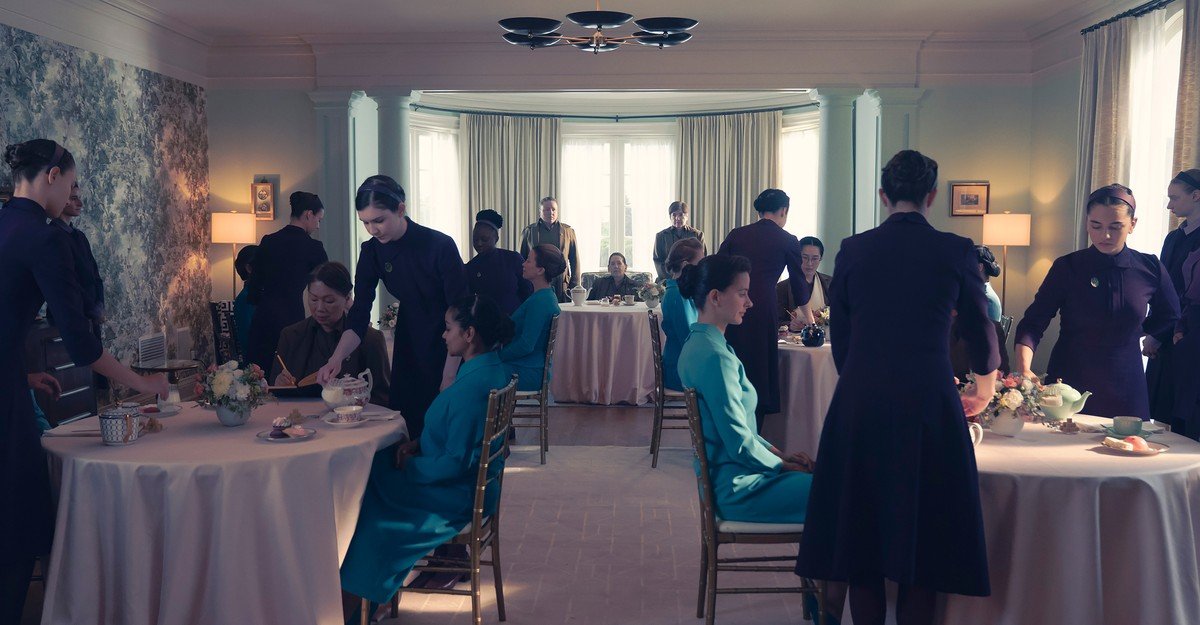
As part of their education, the Plums host elaborate functions for their peers and superiors—events that are, in fact, high-stakes sessions meant to rehearse the girls’ married lives, when they’ll be expected to throw party after party to proselytize about the joys of domesticity. During one crucial mixer, the girls offer carefully brewed beverages and fancy sweets to a roomful of matriarchs and instructors, all of whom have gathered to judge the Plums’ taste and poise. The adult women will decide which of the students has proved herself worthy of a high-status husband; thus the shortbread and tea cakes are conspicuously fussy, and reflect the obsessiveness that Gilead’s elite demands of its housewives. When one of the Plums trips on a rug while serving tea, she breaks into tears, convinced that her future could be ruined. Moments like these remind viewers that for all of their competitiveness and one-upmanship, the Plums are really just scared little girls.
The parties also test the Plums’ management skills. Although the spotlight is on the aspiring housewives, the show makes clear that each one has a household staff quietly handling the grunt work. Despite their anxiety over pastries, the girls don’t even bake the sweets—their servants do. And the stress takes a toll not only on the teens but also on their hired help—as when one student berates her servant for improperly preparing the tea.
It’s difficult to watch The Testaments without thinking about another group of women known for their performative hyper-domesticity: “tradwife” influencers, known for cultivating an internet persona based on their supposedly covetable, quaint home life. The show’s focus on the illusion of authenticity may recall, for some viewers, the real content creators who have been accused of disingenuousness about their lifestyle—by leaning on a robust staff, obscuring the use of prepackaged ingredients even as they claim to painstakingly make everything from scratch, or pretending to be someone they’re not. (Tradwives do differ from the Plums in one respect: Many rake in astronomical amounts of money through brand deals.)
Although the Plums enjoy a level of privilege, they clearly struggle to adhere to the standards that Gilead has set for them. And when they stumble, the regime’s harshest tactics bubble to the surface. If a wife-in-training breaks a rule (by, say, cursing at or hitting another girl), the administrators demand that her classmates participate in her shaming and corporal punishment. The message is clear: Anything less than perfection results in more pain. Still, fear is only one-half of the formula. Gilead needs its high-status women to want to live this way. When the wealthiest young girls embrace the regime’s customs, they create an aspirational reflection of its principles—inspiring others to want the same.
This is why the Plums’ day-to-day lives are full of social gatherings, designed to illustrate the emotional and—more important—material perks of marriage. At one point, a married former classmate invites several girls over for a home tour that may seem familiar to any viewer who has watched an influencer show off her airy, well-appointed house. Although the Plums fantasize about finding husbands, they spend just as much time imagining all of the luxurious accessories that will soon follow: The bluntest girl among them says that she wants triplets because when one of their peers had twins, “her husband bought her a Mercedes and diamond earrings.”
Relying on marriage for security leaves these women’s fates entirely in their husband’s hands—and like The Handmaid’s Tale before it, The Testaments is not optimistic about how the men will use that power. In the series, a dentist abuses his young patients; fathers barely know their daughters; old men make suggestive jokes about the teenagers they’re trying to marry. By the end, one of the Plums has committed murder after having a world-shattering realization.
A lesser show might have taken a sneering approach, casting judgment on Gilead’s aristocratic wives for the Faustian bargain they’ve made. Instead, it evokes empathy, and in doing so lands a more nuanced point. Whenever someone’s life begins to look like an advertisement, it’s worth asking what, precisely, the product is—and if it will really benefit the buyer.



