
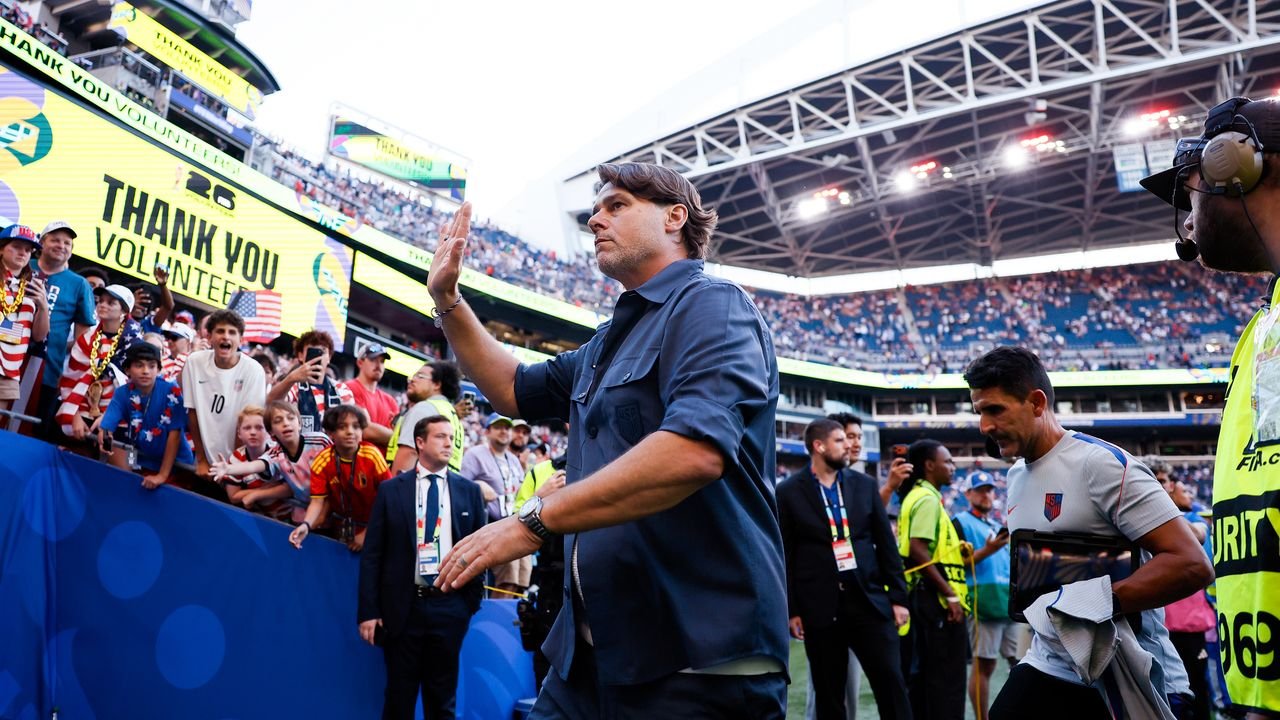
Still, it wasn’t possible to disassociate Trump’s meddling from the U.S.M.N.T. altogether. It’s possible that Trump, who, during his comments to the press, joked about taking credit for the two-hundred-and-fiftieth anniversary of the United States, had less of an impact on FIFA’s decision to let Balogun play than he liked to imply. (Infantino, like Trump, clearly wants stars on television—and the money that goes with that. A few months earlier, FIFA had suspended a suspension of Portugal’s Cristiano Ronaldo, after he received a red card during the World Cup qualifying round, so that he could play in Portugal’s first two World Cup games.) Historically, FIFA has been known for its, let’s say, flexible approach to ethics, but, even so, there was no real precedent for this kind of naked political involvement in matters directly related to the flow of a particular game. What did it mean for the integrity of the tournament?
Not everyone was conflicted. “We celebrate the decision,” Pochettino declared. No doubt—the U.S. had their best goal scorer for their biggest game. And they could tell themselves that leaders from other countries would have tried to do the same, which is almost certainly true. Before kickoff, as I watched fans fill Seattle’s Pioneer Square, I couldn’t see much of a difference from what I’d witnessed when the U.S. team played Australia in the group stage. The fans marched. Everyone seemed to be wearing red, white, and blue. There were spontaneous chants of “U.S.A.!,” face paint, flags as capes. Inside the stadium, Balogun got a huge cheer when he was announced. “The Star-Spangled Banner” was sung with gusto. And loud boos greeted the Belgians the first few times they touched the ball.
But the enthusiasm was fragile. Within the first minute, a Belgian charged down the field and rocketed the ball toward the goal; the keeper, Matt Freese, had to dive for the save. The pressure continued in front of the U.S. goal, and less than ten minutes into the match, the U.S. defense ground to a stop, and Belgium scored. The crowd gasped, then reeled, as if sucker-punched.
It was a bloodbath. When the U.S. tried to press, Belgium played through it. When the U.S. tried to move the ball up through the channels, they gave it away. Christian Pulisic, long the team’s most prominent and important player, had eleven turnovers in the first half alone—more than anyone else had all game. But he was hardly the only culprit. The midfield, which had been the team’s strength, its purring engine, was disorganized. Dribbles were loose, and easily deflected. The back line was under siege.
The Red Devils, meanwhile, were sailing. Their coach, Rudi Garcia, showed some tactical daring, holding out two of his more prominent players until partway through the second half, injecting some energy into the game when the starters began to flag. The team seemed united, galvanized—the opposite of the U.S. team, which showed little urgency. Thirty minutes into the match, it felt like Belgium could have been up by seven goals. But, abruptly, a penalty was called, and, for the second time in two games, Malik Tillman netted a free kick to even the score. The U.S. were in it—for some fifty more seconds. Then Belgium scored again. Pochettino kicked over a water carrier. (So much for good energy.) Greater humiliation was still coming. In the second half, Freese stepped off his line to control a ball, hesitated, stubbed his foot against the ground, and lost the ball. Belgium’s Hans Vanaken thumped it into the goal past the defender Tim Ream, who flailed lamely as Belgium scored. The home crowd jeered.



