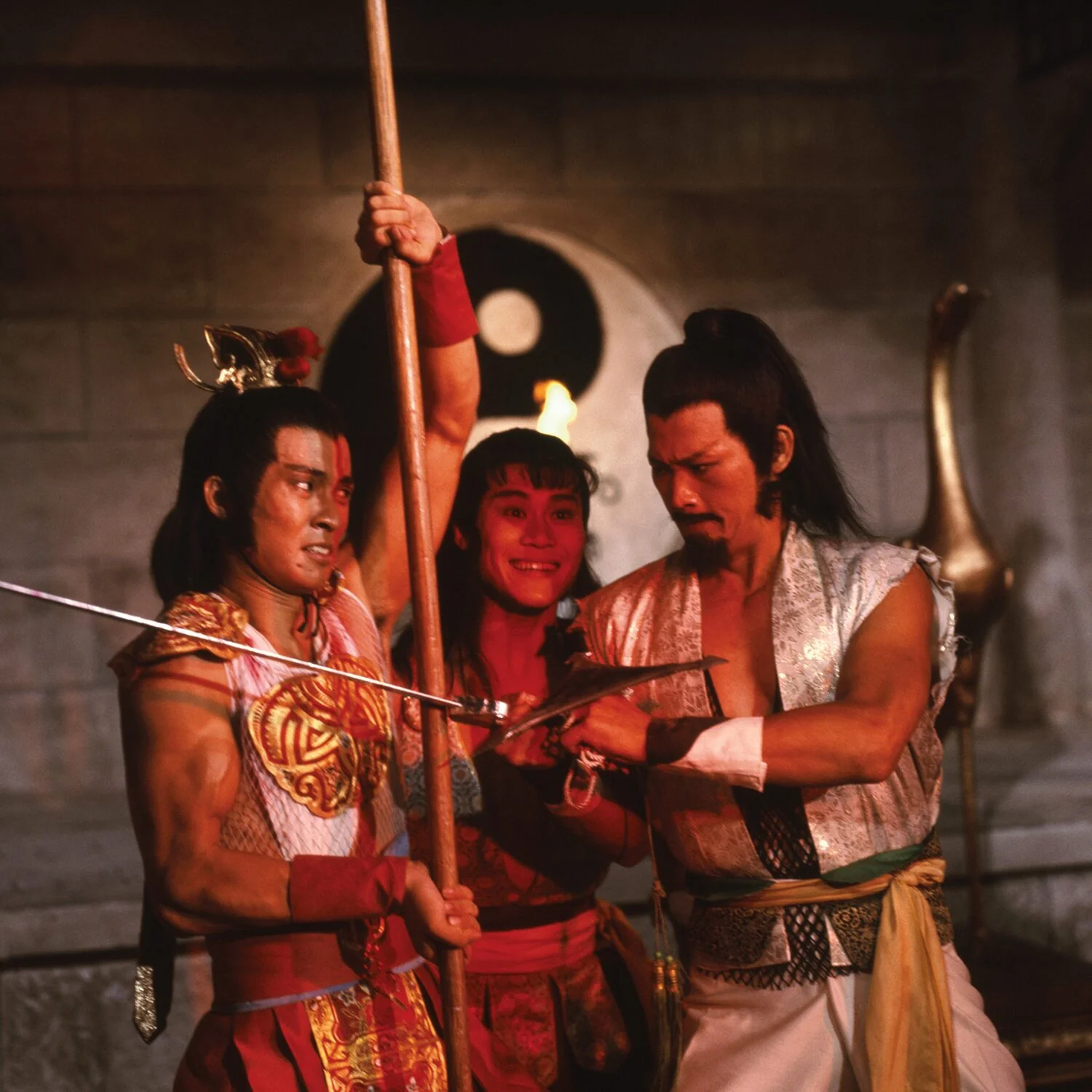
“The Weird Man” is a 1983 Hong Kong martial arts fantasy directed by the legendary Chang Cheh and produced by Shaw Brothers Studio. The picture stars Cheng Tien Chi alongside Chao Kuo and Wong Lik, drawing inspiration from historical legends about the Taoist mystic Yu Ji and the warlord Sun Ce during the late Eastern Han dynasty. Known for his influential work in martial arts cinema, Chang Cheh incorporates elements of folklore, Taoist mysticism and slapstick fantasy, creating an unusual blend of wuxia spectacle and supernatural comedy. The production also adapts motifs from the classic Chinese historical novel “Romance of the Three Kingdoms”, whose characters and stories were widely familiar to Chinese audiences at the time.
Released during the final years of Shaw Brothers’ dominance in Hong Kong cinema, “The Weird Man” stands as the last production Chang Cheh directed for the studio. Unlike many of the studio’s more successful martial arts titles, the picture performed poorly at the box office, earning roughly HK$460,000 and finishing near the bottom of the annual Hong Kong box office rankings. Although it received no major awards, it remains notable as a curious late entry in Chang Cheh’s career, combining martial arts action with trickster fantasy elements that reflect both traditional Chinese mythology and the changing cinematic landscape of early 1980s Hong Kong.
Buy This Title
by clicking on the image below
In ancient China, the Taoist priest Yu Ji spends his days healing the sick and gaining the reverence of the local population. His growing popularity angers the ambitious warlord Sun Ce, who believes that the loyalty of the people should belong solely to him. Manipulated by the scheming magistrate Xu Gong, Sun Ce orders the priest’s execution. Yu Ji accepts his fate calmly, warning his disciples not to interfere because his death will allow his spirit to become even more powerful.
After Yu Ji is beheaded, his spirit is released from his mortal body and transforms into a mischievous supernatural presence. Now free from physical limitations, he begins haunting Sun Ce and those around him, possessing bodies, creating illusions and using magical tricks to disrupt the general’s authority. Taking on a youthful form, he becomes a playful and unpredictable figure whose supernatural abilities allow him to confuse soldiers, manipulate events and undermine the conspiracies unfolding around him.As Sun Ce struggles to maintain control while enemies plot against him, Yu Ji’s spirit continues to interfere with both the general and his corrupt advisors.
Chang Cheh’s approach to the material is rather unusual, even by the standards of late Shaw Brothers productions, and there are moments when the viewer will wonder if, considering this was his last movie at the company, he actually cared. On one hand, the story contains clear mythological influences. Yu Ji’s transformation after death evokes the notion of transcendence found in Taoist lore, while the mischievous nature of his spirit recalls the trickster archetype most famously embodied by the Monkey King in Chinese literature. In this regard, the narrative blends Chinese folklore, historical legend and fantasy spectacle into something that often feels deliberately or neglectably chaotic.
The connection to the classic novel “Romance of the Three Kingdoms” is particularly significant. The historical figures of Sun Ce, Cao Cao and other characters appear throughout the story, and Chinese audiences of the time would likely have been familiar with their legends. The novel itself, composed in the 14th century, is structured as a collection of interconnected episodes recounting the political and military struggles of the late Han dynasty. “The Weird Man” borrows freely from these tales, particularly the folklore surrounding the mystic Yu Ji. For viewers unfamiliar with these stories, however, the narrative can feel somewhat baffling, as the historical context and character motivations are often taken for granted rather than explained.
Visually, the production offers a mixture of traditional martial arts choreography and surprisingly inventive in-camera effects. Many of the supernatural moments rely on practical tricks rather than elaborate post-production, resulting in a style that feels both charming and dated. Particularly the sudden appearance/disappearence trick is used repeatedly, and watched in this day and age, is defininitely amusing to watch. At the same time, the sets are as impressive as usually in Shaw Bros productions, with their maximalism and intricacy being particularly appealing to the eye. The occasional reds that fill the screen also work well, adding to the visual appeal.
The fight scenes themselves are relatively sparse compared to Chang Cheh’s earlier classics, but increase in frequence and intricacy as the movie progresses, with the final ones in particular, including the rope one, being particularly impressive. Furthermore, Cheh leans heavily into slapstick fantasy, where the result is a series of sequences that are equally amusing, absurd and illogical, with the last element actually defining the whole
At the center of it all stands Cheng Tien-chi as Yu Ji’s reincarnated spirit. His performance is intentionally exaggerated, as are his different instances, with the hairy one definitely staying on mind, emphasizing the mischievous nature of the character. Whether this works depends largely on the viewer’s tolerance for the film’s brand of humor. The perpetual smirk and playful antics can quickly become grating, yet they also contribute to the bizarre charm that defines the experience. The supporting cast, portraying warlords, officials and soldiers caught in the priest’s supernatural games, mostly function as straight men reacting to the chaos around them, while their appearance on occasion, as in the case of them wearing shorts for some reasons, will definitely put a smirk on the face of any viewer..
“The Weird Man” feels like an odd footnote in Chang Cheh’s career. Known primarily for intense martial arts dramas and heroic bloodshed narratives, the director here embraces a far more eccentric tone. The mixture of historical figures, Taoist mysticism, slapstick comedy and supernatural spectacle creates something that is undeniably strange. At times the whole enterprise borders on the ridiculous, yet it also possesses a certain fascination that makes it difficult to look away. Even when the narrative falters or the humor misses its mark, the sheer unpredictability of the spectacle keeps the viewer engaged, while the action scenes will satisfy, to a point at least, fans of the martial arts films.