Welcome back to World Brief, where we’re looking at U.S. threats toward Greenland, the U.S. seizure of two sanctioned tankers carrying Venezuelan crude, and China’s new dual-use export ban on Japan.
A Matter of ‘National Security’
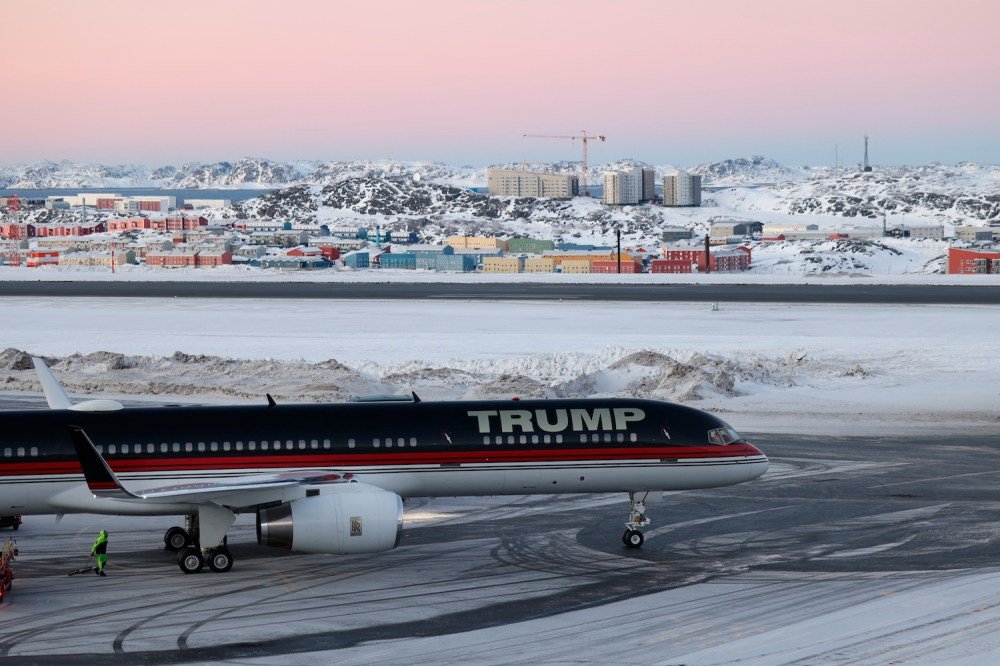
U.S. President Donald Trump has made it abundantly clear that the White House seeks to acquire Greenland, a semi-autonomous region of Denmark known for its vast critical minerals and strategic Arctic location. Just how the United States plans to do this, though, remains unclear—even among senior U.S. officials.
Welcome back to World Brief, where we’re looking at U.S. threats toward Greenland, the U.S. seizure of two sanctioned tankers carrying Venezuelan crude, and China’s new dual-use export ban on Japan.
A Matter of ‘National Security’
U.S. President Donald Trump has made it abundantly clear that the White House seeks to acquire Greenland, a semi-autonomous region of Denmark known for its vast critical minerals and strategic Arctic location. Just how the United States plans to do this, though, remains unclear—even among senior U.S. officials.
In recent days, Trump has doubled down on his imperial ambitions, calling U.S. ownership of the Danish territory a matter of “national security.” This is despite Copenhagen being a member of NATO, and despite the United States having legally recognized Danish sovereignty over Greenland since 1916 in exchange for Denmark selling the Danish West Indies (now the U.S. Virgin Islands) to the United States.
Trump has previously refused to rule out the use of military force or economic coercion to accomplish his agenda. However, when Trump’s staff has been asked about the United States’ specific plan for the island, the messaging has been mixed. During a closed briefing with lawmakers on Monday, U.S. Secretary of State Marco Rubio reportedly said that the White House aims to buy Greenland—downplaying military action amid warnings from Danish Prime Minister Mette Frederiksen that such an operation would endanger NATO’s very existence.
However, that same day, U.S. deputy chief of staff Stephen Miller told CNN that “nobody’s going to fight the United States militarily over the future of Greenland.” And on Tuesday, White House press secretary Karoline Leavitt reiterated that Trump intends to acquire Greenland one way or the other, adding that “the U.S. military is always an option at the commander in chief’s disposal.”
After months of brushing off Trump’s comments, Greenland’s European allies appear to finally be taking action. On Tuesday, the leaders of seven NATO countries issued a joint statement condemning U.S. ambitions to annex Greenland. “Greenland belongs to its people,” they wrote. “It is for Denmark and Greenland, and them only, to decide on matters concerning Denmark and Greenland.”
On Wednesday, French Foreign Minister Jean-Noël Barrot told local media that the issue is also being discussed with his European counterparts. “We want to take action, but we want to do so together with our European partners,” he said on France Inter radio. A senior European official told Reuters on Wednesday that Denmark must lead this effort but that “the Danes have yet to communicate to their European allies what kind of concrete support they wish to receive.”
Following the U.S. capture of Venezuelan President Nicolás Maduro over the weekend, some NATO officials have expressed concern that Greenland could be the next target of U.S. military action. Barrot on Wednesday said that he had spoken with Rubio, who “discarded the idea that what just happened in Venezuela could happen in Greenland.” That same day, U.S. House Speaker Mike Johnson also said that while “the U.S. always has military options for everything, I think with Greenland, it’s very clear that we are working through diplomatic channels.”
European officials have called for the issue to be raised at NATO’s next North Atlantic Council meeting, scheduled for Thursday. Meanwhile, Rubio is expected to meet with Danish Foreign Minister Lars Lokke Rasmussen next week to discuss Greenland’s future.
Today’s Most Read
What We’re Following
Who controls Venezuela’s oil? U.S. forces seized a Russian-flagged oil tanker in the Atlantic Ocean on Wednesday, ending a dramatic weekslong chase to capture the sanctioned vessel. The Marinera, previously named Bella 1, had evaded a U.S. blockade targeting Venezuelan crude that first took effect last month. Moscow called Washington’s operation on Wednesday a violation of maritime law.
According to U.S. Southern Command on Wednesday, the United States also seized the M/T Sophia, another sanctioned oil tanker that it accused of “conducting illicit activities in the Caribbean Sea,” including carrying Venezuelan crude.
The seizure of both vessels marks another major flash point in the White House’s efforts to control Venezuela’s oil. Following U.S. strikes inside Venezuela over the weekend, Trump announced on Tuesday that Caracas will send 30 million to 50 million barrels of oil to Washington. It is unclear how Trump will force interim Venezuelan leader Delcy Rodríguez to comply with the order, which amounts to roughly two months’ worth of daily production and costs as much as $3 billion at current market prices.
Export ban. Tokyo denounced Beijing’s new ban on exports of Chinese dual-use goods to Japan on Wednesday, calling it “absolutely unacceptable” and a drastic departure from international practices. The order, first announced on Tuesday, blocks the export of items, software, and technology that have both civilian and military applications, including certain critical minerals that can be used to make drones and semiconductor chips. China’s Commerce Ministry has vowed to punish any person or entity that defies the order no matter where they are.
The export ban is in response to Japanese Prime Minister Sanae Takaichi’s repeated remarks that Tokyo could aid Taiwan in the event of a Chinese invasion. And it follows Beijing unveiling a series of export restrictions last year that largely targeted heavy rare earths, though China has since agreed to suspend their implementation until late 2026.
This week’s ban could still have sweeping implications for Tokyo, even as Japan has sought to diversify its supply chains in recent months. According to CNN calculations, Japan relied on China for 63 percent of its rare-earth imports in 2024.
Assault on Aden. Saudi Arabia launched airstrikes on southern Yemen on Wednesday to target Aidarous al-Zubaidi, the leader of the Southern Transitional Council (STC), a United Arab Emirates-backed secessionist group. According to Maj. Gen. Turki al-Malki, a spokesperson for the Saudi-led coalition, the operation was “preemptive” in response to Riyadh receiving “intelligence indicating that Zubaidi had moved a large force—including armored vehicles, combat vehicles, heavy and light weapons, and ammunition.”
The STC is the most powerful armed group in southern Yemen and seeks to establish an independent state there, as existed before the 1990 unification of the countries of North and South Yemen. Last month, Zubaidi led a lightning offensive across southern Yemen to seize large swaths of strategic territory.
Zubaidi was supposed to travel to Riyadh this week for talks; however, the STC leader refused to board his flight. STC officials have denied that Zubaidi has fled the country, saying he remains in the Yemeni city of Aden. Meanwhile, local media reported on Wednesday that Saudi-backed forces have seized Aden’s presidential palace as well as entry and exit points into the STC stronghold.
Odds and Ends
Don your white jumpsuit and style your pompadour. Rock and roll enthusiasts kicked off their journey on Wednesday to the annual Elvis Festival, held in the Australian town of Parkes. The seven-hour train ride, beginning in Sydney, features a continuous lineup of Elvis-themed enjoyment, from tribute bands to gourmet dining. Here’s to a little less conversation and a little more jailhouse rock.