
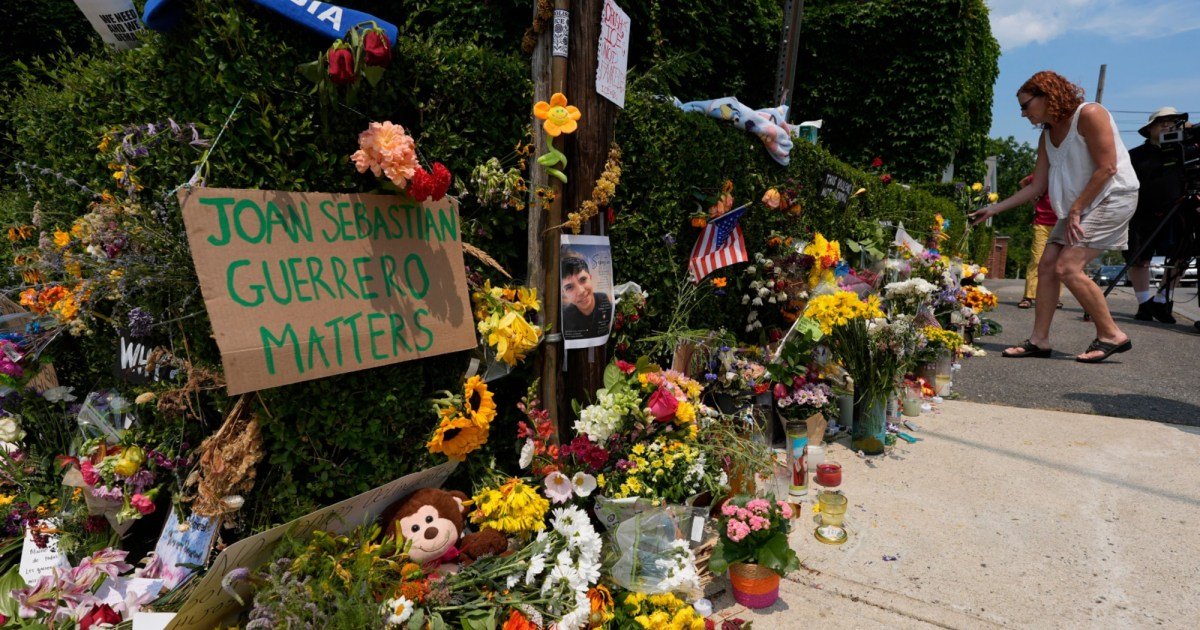
A woman places flowers at a makeshift memorial in Biddeford, Maine.Robert F. Bukaty/AP
In the span of a week, immigration officers shot and killed two people in the streets of American cities. And a third person died on Tuesday in Florida after being struck by a tractor-trailer while running from an encounter with federal agents.
Last week, Lorenzo Salgado Araujo, his brother, and two others were driving to work at a construction site in Houston when ICE stopped their van. An agent then reportedly fired into the passenger window, fatally hitting Araujo. He was not, however, the intended target of ICE’s operation.
Fifty-two-year-old Araujo was a father of three from Mexico and had lived in the United States for 35 years. He was in the process of obtaining lawful status. His son, Ronaldo Salgado, learned about the shooting from a video on social media. Speaking at a press conference the following day, he described his father as a family man who, after a hard day at work, liked to spend the evenings resting on his porch, listening to music, and petting his dog.
“He did not deserve to die,” Salgado told reporters. “He did not deserve to be reduced to a headline of ‘Mexican Man Shot and Killed by ICE.’”
As the Araujo family grieved, another casualty made the headlines. On Monday, July 13, an ICE agent shot and killed 25-year-old Johan Sebastián Durán Guerrero inside a vehicle in Biddeford, Maine. The Colombian-born father of a three-year-old girl worked two jobs as a food delivery driver and a cleaner at a veterinary clinic. Like Araujo, Guerrero apparently wasn’t ICE’s initial target either.
In both shootings, the agents involved wore no body cameras. The Department of Homeland Security has claimed, without providing evidence, that Araujo had “attempted to evade arrest” and “weaponized” his vehicle against law enforcement. About Guerrero, DHS said he “attempted to flee the scene” and the officer, “fearing for public safety,” fired his weapon.
Araujo and Guerrero are among some 20 people who have been shot at by immigration agents since September, according to the New York Times. And there have been at least 17 shootings of motorists by federal immigration officers during Trump’s second term, the Washington Post found.
“When you see now people losing their lives,” said Naureen Shah, the ACLU’s Director of Government Affairs, Equality Division, “it’s not surprising that it’s happening. It’s totally foreseeable in the most tragic way.”
“A pattern of civil rights violations arising from immigration enforcement—at a scale and severity without precedent in our nation’s history.”
A new ACLU report co-authored by Shah documents how these deadly ICE shootings were not only predictable; they fit into a broader pattern of reckless misconduct by the Trump administration’s immigration enforcement machine. Entitled “Agents of Chaos and Cruelty,” the report analyzes the ways in which this national deportation policing force has inflicted harm in communities around the United States.
The killings of Alex Pretti and Renee Good in Minneapolis, the report’s authors note, “were not the excesses of a few rogue officers.” They were “part of a pattern of civil rights violations arising from immigration enforcement—at a scale and severity without precedent in our nation’s history.”
After reviewing more than 1,200 immigration enforcement-related incidents across eight US states between January and December 2025, the ACLU found for instance:
- 432 incidents of misconduct by agents, including use of threatened force, intimidation tactics, and retaliation against observers and witnesses;
- 437 incidents likely involving racial profiling;
- 418 times agents pushed, shoved, tackled, or pinned people;
- 375 incidents involving use of force or threatened force by agents;
- 361 times agents deployed chemical irritants—132 of which were directed at individuals;
- Dozens of instances of excessive use of physical force that could have been deadly, including 52 times agents pressed knees and hands on people’s backs and necks;
- 76 times agents pulled people from cars.
“The incidents we reviewed,” the authors write, “indicate agents used force and the threat of force as default tactics and tools to coerce immediate compliance rather than to respond to a threat.” In more than 370 of the reviewed incidents, the agents were masked.
The comprehensive report paints a damning, albeit incomplete, picture of a policing force—made up of more than 50,000 agents among ICE, Customs and Border Protection (CBP), and other federal, state, and local law enforcement—acting with few guardrails and increasingly unlimited resources.
In the last year and a half, the Trump administration revoked policies that limited immigration enforcement in areas such as schools, places of faith, and courthouses and set priorities for arrests. In the words of Stephen Miller, the White House deputy chief of staff for policy and architect of the immigration crackdown, “Everyone is fair game.”
Enabled by billions of dollars awarded by Congress, ICE went on a recruiting spree, adding about 12,000 agents to its force, while lowering hiring and training standards. At the same time, the administration gutted DHS’s internal watchdog. DHS whistleblowers warned Congress earlier this year that without oversight, the number of deaths and injuries in detention and as a result of excessive use of force would rise, as they have.
The ACLU report’s authors attribute the pattern of misconduct not to the actions of “a few bad apples”—individual agents—but rather to a “systemic breakdown in professional norms and standards” and “a culture of abuse, practices designed to evade accountability, and direct orders and encouragement of abuse by senior administration officials.”
Their findings also reinforce how no one, anywhere, is safe. The documented immigration enforcement incidents took place on highways, at bus stops, in grocery stores, car washes, restaurants, and construction sites. And the people impacted included US citizens, green card holders, DACA recipients, as well as those with humanitarian protections. The authors also counted 214 children who experienced or were exposed to law enforcement misconduct.
“While the administration has tried to make it seem like they are now taking a quieter, smarter approach to immigration enforcement, they actually haven’t changed the way they’re behaving day to day.”
“While the administration has tried to make it seem like they are now taking a quieter, smarter approach to immigration enforcement, they actually haven’t changed the way they’re behaving day to day,” Shah said. “We still have these agents who are causing chaos wherever they go. These street arrests are creating danger zones out of places of daily life, like bus stops and gas stations and small town intersections, and that’s what we just saw in these shootings, and that’s also what we’ve seen around the country in many occurrences that just haven’t broken through in the national headlines over many months.”
In the report, Shah and her co-author warn that the abuses and practices they documented offer a blueprint for authoritarianism, including the suppression of protests, retaliation and intimidation of observers and witnesses, and the use of federal law enforcement agencies as an “internal security force.”
“We should think about this mass deportation drive as a project of the authoritarian slide that we’re in,” Shah said. “And if we want to future-proof our democracy against authoritarianism, we have to fix the system.”
Following the killings of Araujo and Guerrero, the Trump administration ordered ICE to halt most vehicle stops. But in an interview with Fox News, border czar Tom Homan said the pause would be temporary while ICE leadership and DHS looked into the incidents: “Is there something that could have been done better? Is there any training that can be improved? Or is ICE simply doing its job, and bad things happen when people don’t comply with law enforcement officers?”
Homan said the “noise” wouldn’t affect ICE’s arrests moving forward and called it a “bump in the road.” On Wednesday, Trump also indicated that he had no intention of slowing down the immigration crackdown surge, posting on Truth Social that ICE should “go back and do your very important job.”
“These officers aren’t getting enough training on how to distinguish the circumstances of an arrest to know when they should be engaging in it,” said Ryan Schwank, a former attorney and instructor for ICE who became a whistleblower. “What we’re seeing is officers are rushing to make arrests. They’re being pressured to get high numbers. And as a result of that, they’re looking for the opportunity to get the arrest done quickly.”
Schwank said the “escalation” of action by agents in the recent fatal shootings doesn’t “fit their training and it doesn’t fit their operational practices historically.” He added: “I don’t think that an agency like ICE stops a practice like vehicle stops, which is so critical to its operations, without having internally already decided that something was going wrong, that there’s clearly a failure if they’re having this many fatalities, this many incidents…They know this is not working, and they’re going to keep doing it anyway because they’ve been ordered to do so.”



