
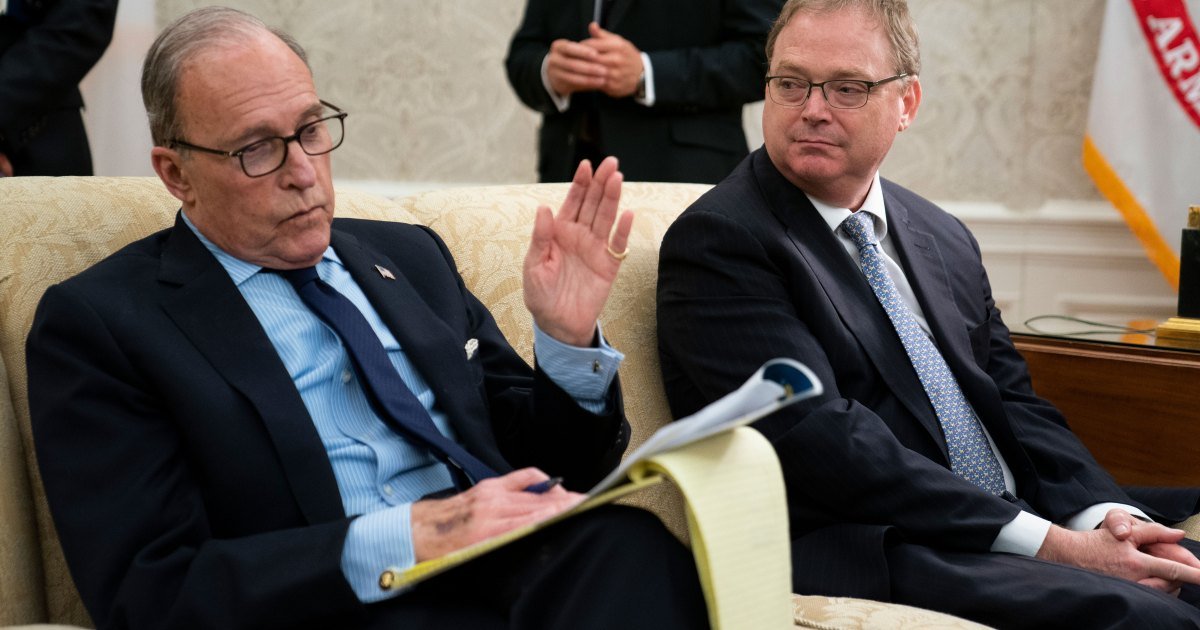
Larry Kudlow, left, and Kevin Hassett at an Oval Office meeting in April 2020, during President Donald Trump’s first term.Evan Vucci/AP
Donald Trump apparently wants to cut taxes for the rich yet again. Is this some kind of twisted midterms strategy? Hard to say. But as Timothy Noah points out in The New Republic, the current and former National Economic Council directors Kevin Hassett and Larry Kudlow were on Fox News last week talking about two tax proposals the president is mulling, and both are pretty misguided.
The first one, which they would likely try and sell as a middle-class tax cut, is to expand the current (fairly generous) capital gains exclusion on profits from home sales. Under current law, when a couple sells their residence for more than they paid, the first $500,000 in gains is nontaxable. Kudlow seemed to be advocating for a $2 million exclusion.
Now, some kind of means-tested relief for people who have owned their primary residence for decades may be reasonable, but a $2 million exclusion, let’s be honest, doesn’t exactly scream middle class. Especially when you consider that the rule also applies to second homes. That means the Van Doughs, after unloading their $10 million Aspen ski chalet for $12 million, won’t pay a dime on the proceeds.
We’re already paying handsomely for the smaller exclusion. I reported in June that this $500,000 tax break, combined with the mortgage interest deduction for first and second homes, will cost the government $574 billion from 2025-2029. That’s according to the Joint Committee on Taxation (JCT). And since we talk about budgets in 10-year terms, we can say it will add at least $1.15 trillion to the national debt—which, in case you haven’t heard, just passed $40 trillion.
Quadrupling this real-estate tax break is not gonna help with that.
A more appropriate response to out-of-control deficits would be to repeal the ill-conceived tax giveaways in Trump’s One Big Beautiful Bill, legislation that the nonprofit Bipartisan Policy Center calculated will cost the federal government $4.5 trillion in lost revenues over a decade. DOGE’s mindless cuts to the federal workforce, executed with Trump blessing and encouragement, will cost America a fortune as well.
And now Trump wants to double down on all the losses he’s created with his profligate policies, pet construction projects, and inept military adventures?
The second proposal, indexing capital gains to inflation, is even stupider. I wrote about this idea last summer, after none other than Reagan-era anti-tax crusader Grover Norquist told the Washington Post that he’d urged Trump to make it happen with an executive order.
Here’s the thing: Taxes on capital gains are already wildly discounted relative to taxes on labor, discounts that, based on the JCT’s numbers, will cost the government at least $2.5 trillion in lost revenue over 10 years. The current top rate for capital gains is 23.8 percent, which includes a 3.8 percent surcharge enacted to help cover the cost of the Affordable Care Act. By contrast, as I wrote previously:
A couple reporting $1,000,000 in salary income pays an effective rate of about 30 percent. That’s a huge difference, and part of why families whose money comes primarily from asset growth have amassed wealth so much faster than working families have. It’s no lefty exaggeration to say America’s economic system is rigged against workers and in favor of investors. It’s right there in the tax code.
Also…
Indexing capital gains to inflation, according to 2018 estimates from the Tax Policy Center and the Penn Wharton Budget Model, would add yet another $100 billion to $200 billion to the [deficit]—with the richest 1 percent reaping 86 percent of the benefits.
TNR’s Noah, citing more recent estimates from the Yale Budget Lab, writes that “indexing capital gains would cost $170 billion over 10 years if it applied only to assets purchased after 2025, and almost $1 trillion if it applied to all assets.”
All of which is to say that these hare-brained proposals, apart from being likely unconstitutional due to their sidestepping of Congress on tax issues, would exacerbate Dickensian wealth disparities and make our bloated federal deficit even worse, just as borrowing costs have reached a two-decade high.
Those midterms cannot come soon enough.



