
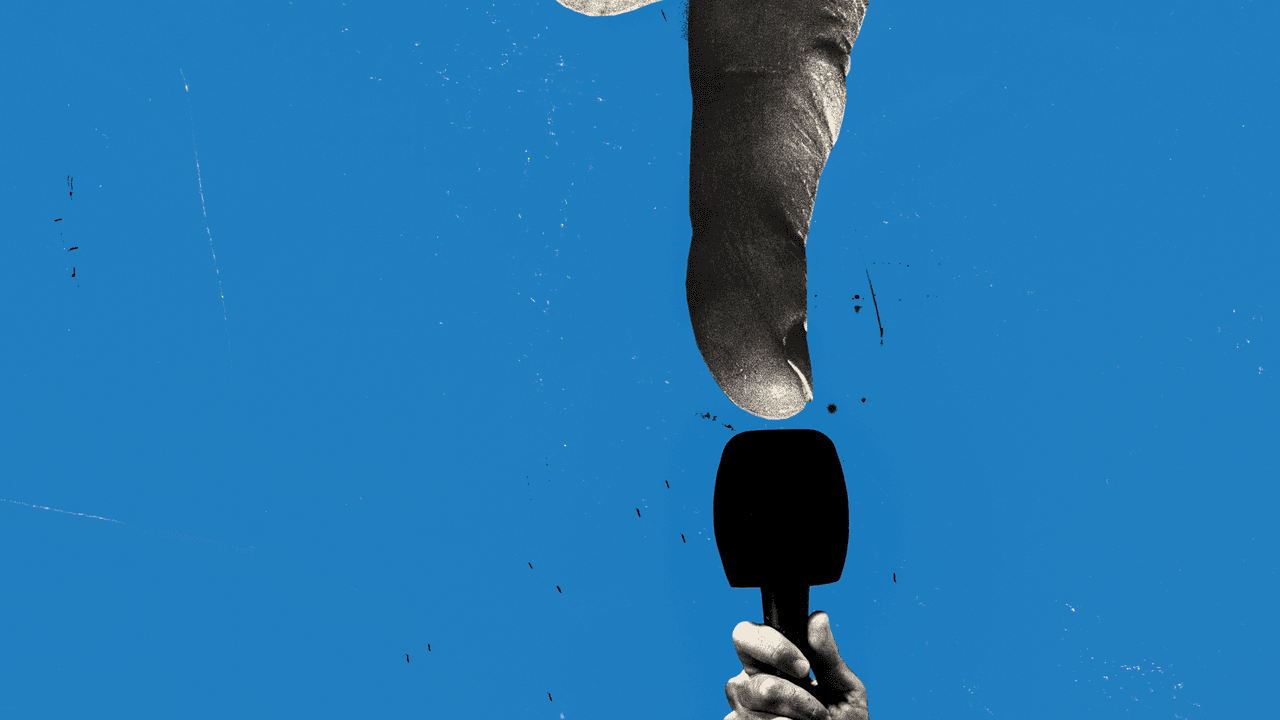
For years now, in office and out, Donald Trump has been unabashed about his desire to see reporters behind bars. The President’s fantasies can, at times, take on a lurid tone. Campaigning for Republican candidates during the 2022 midterms, Trump assailed the leak of the Supreme Court’s draft opinion in Dobbs, the landmark abortion case, and outlined his preferred approach to identifying the source: “The reporter goes to jail. When the reporter learns that he’s going to be married in two days to a certain prisoner that’s extremely strong, tough, and mean, he will say, he or she, ‘I think I’m going to give you the information. Here’s the leaker, get me the hell out of here.’ ” This April, after it was reported that a crew member was missing from an American fighter jet that had been shot down in Iran, Trump vowed that the person who had spoken to the press would be quickly outed: “We’re going to go to the media company that released it, and we’re going to say, ‘National security. Give it up or go to jail.’ ”
No one went to jail, but Trump has seized on another opportunity to threaten journalists. Earlier this month, the Times reported that he was forced to ditch his new Air Force One, given to him by the Qataris, for part of the ride home from the NATO summit in Turkey; the plane allegedly lacked anti-missile capabilities. (Trump had claimed that he was taking a last spin in the previous Air Force One “for old time’s sake.”) According to the Times, a senior F.B.I. official asked the newspaper to hold the story, citing national security. The Times declined to comply. Two days later, three journalists received subpoenas to appear before a federal grand jury in Manhattan. The Times later reported that the White House had instructed the director of the F.B.I., Kash Patel, to oversee an investigation into the leak, and that Patel had spent the day the subpoenas were issued holed up at the White House—not the ordinary locus for a law-enforcement operation. The Times, in a sealed filing that it sought to have publicly released, moved to quash the subpoenas, saying that they were “brought in bad faith to punish The Times for its coverage.”
The Justice Department has depicted the subpoenas as a benign move. “We’re not targeting reporters. They’re material witnesses, just like a reporter would be a material witness to a car crash,” Todd Blanche, the acting Attorney General, said at his confirmation hearing Wednesday. “The question we want to ask them is who provided them with classified national-security information.” That is scant comfort. Journalists’ access to information will evaporate if they cannot assure their sources of confidentiality. This risk is omnipresent, but it is heightened in the current moment, when reporting about the inner workings of government is more crucial than ever, and when Administration officials appear determined to close off any channels of information that are not officially sanctioned. As the Times’ executive editor, Joseph Kahn, explained, in a video, “There’s nothing more important that an independent news media does in a democracy than reporting fully and fairly on the way public officials protect national security and use taxpayer dollars.” Was Trump, reportedly livid over the Air Force One leak, concerned about the risk to security—or about the prospect of personal embarrassment due to the failings of a questionable gift that had cost taxpayers tens of millions of dollars to upgrade?
When it comes to the media, Trump appears to be moving from the unsettling rhetoric that began during the 2016 election (“scum,” “enemy of the American people”) to his long-promised assault. He has continued to file a barrage of defamation lawsuits—with some news organizations choosing to capitulate rather than risk harm to planned mergers or broadcast licenses. Trump is also now harnessing the processes of criminal law to intimidate and punish. In the early-morning hours of January 14th, F.B.I. agents arrived at the home of the Washington Post reporter Hannah Natanson and seized her computers and phones, as part of an investigation into a government contractor charged with retaining classified information. So far, judges have blocked the Justice Department’s efforts to gain unsupervised access to Natanson’s devices. In recent months, the department subpoenaed reporters from the Washington Post and the Wall Street Journal in national-security cases. The subpoenas were withdrawn after the news organizations challenged them. Media lawyers fear that the Administration could deploy a nuclear option: using the Espionage Act to prosecute journalists themselves for publishing classified information. Bruce Brown, the president of the Reporters Committee for Freedom of the Press, told me, “Short of prosecuting a reporter under the Espionage Act, the word ‘escalates’ doesn’t mean anything anymore. It’s just open season now.”



