
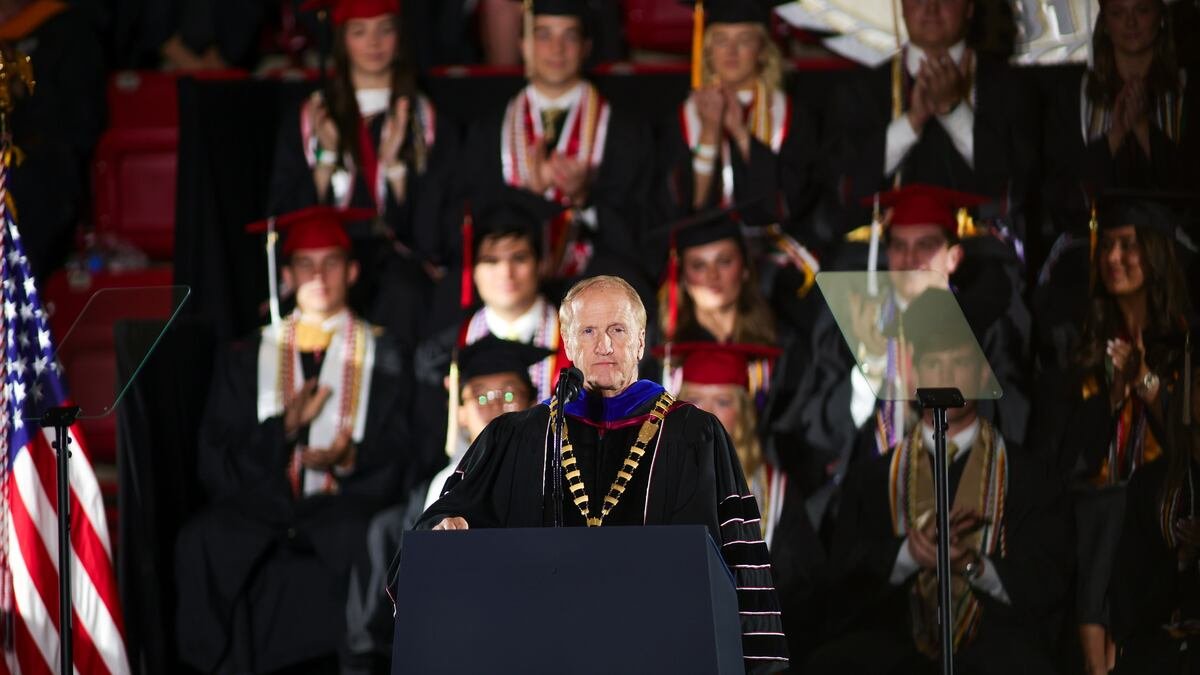
TALLAHASSEE — After a bruising two-year stretch defined by political controversy, leadership instability and a botched presidential hire, the University of Florida has zeroed in on a veteran red-state academic leader as its next president: longtime University of Alabama President Stuart Bell.
UF’s presidential search committee on Monday named Bell the sole finalist to lead the state’s flagship campus, signaling a sharp shift away from the politically combustible choices that defined the eras of Ben Sasse and Santa Ono.
The search committee’s selection sends a clear message: After the turbulence surrounding Sasse and Ono, UF wanted a president already steeped in the realities of leading a flagship university in the conservative South.
Bell spent a decade steering Alabama through the culture-war battles reshaping public higher education, including fights over diversity initiatives, campus speech, athletics and pressure from Republican lawmakers. That background is likely to reassure Florida officials seeking a leader who can navigate the state’s increasingly ideological higher education environment without becoming consumed by it. And Bell already has an endorsement from Gov. Ron DeSantis.
“Dr. Bell did much to elevate the University of Alabama when he was the president in Tuscaloosa and I have no doubt that he will help UF reach new heights during his tenure in Gainesville,” DeSantis said on social media. “He is a great selection and has my full support!”
Bell emerged from another closely guarded search process that produced only one public finalist — now a common feature of Florida presidential searches.
His selection is also notable for whom trustees did not choose.
Interim President Donald Landry had been widely viewed as a serious contender for the permanent role. Recruited to UF by DeSantis, Landry developed strong ties to Florida’s Republican higher education establishment during his stopgap tenure, making him a natural internal candidate as DeSantis allies expanded their influence over public universities.
But Landry’s administrative résumé remained relatively thin for a flagship university presidency. Though respected as a Harvard-trained scientist and administrator, he had never previously served as president or chancellor of a major research university.
If Bell’s nomination is approved by UF’s Board of Trustees and later ratified by the State University System’s Board of Governors, he would become UF’s 14th president and inherit a campus still unsettled by years of upheaval.
Unlike Sasse — a first-time flagship university administrator whose selection was driven largely by his national political profile — Bell arrives with decades of higher education leadership experience. And unlike Ono, whose candidacy collapsed under conservative backlash, Bell has spent years operating comfortably within Republican political power structures.
UF officials touted Bell’s research prowess, leadership bona fides and experience leading a major Southeastern Conference university in announcing his selection.
The chairman of UF’s Board of Trustees, Mori Hosseini, praised the search committee for advancing “a candidate whose academic achievements and experience at a flagship state university makes him the obvious choice to lead UF going forward.”
Bell’s arrival follows one of the most turbulent leadership stretches at UF in recent memory.
Sasse, a former Republican U.S. senator from Nebraska, was selected in 2022 after a controversial search that also yielded him as the only finalist. Faculty leaders criticized the process as opaque and politically driven, while students protested his conservative positions on LGBTQ+ issues and higher education.
Trustees nevertheless celebrated Sasse as a transformative figure who could deepen UF’s ties to Republican leaders in Tallahassee and raise the university’s national profile.
But Sasse never fully won over campus critics, clashed with UF’s leadership establishment and faced scrutiny over spending tied to politically connected hires. He also frustrated many at UF by publicly questioning the importance of U.S. News & World Report college rankings — treated in Gainesville as a north star for academic excellence.
Sasse announced his resignation in July 2024 after less than two years in office, citing his wife’s epilepsy diagnosis and family health concerns.
Former UF President Kent Fuchs returned on an interim basis while trustees launched another national search.
That search initially appeared to produce a blockbuster hire. Trustees rallied around Ono, the nationally known Michigan president and biomedical researcher who had also led the University of British Columbia and the University of Cincinnati.
But Ono quickly became a political lightning rod.
Conservative activists and Republican officials attacked him over past support for diversity, equity and inclusion programs and comments tied to campus protests and university governance. Though Ono distanced himself from some earlier positions and praised Florida’s higher education reforms, opposition hardened among influential conservatives and members of the Board of Governors.
In a stunning rebuke, the Board of Governors rejected his appointment, forcing UF to restart the search and deepening concerns among faculty and alumni that ideological alignment now outweighs academic credentials in Florida university leadership. Bell’s candidacy appears calibrated for that reality.
His selection also reflects how presidential searches are evolving at flagship public universities in conservative states. Trustees increasingly want leaders capable of navigating not only fundraising and research growth, but also the political battles reshaping higher education.
Questions about the search process, however, are unlikely to disappear.
Florida law shields presidential applicants from public disclosure until finalists are named, a system supporters say attracts stronger candidates and critics argue reduces transparency at taxpayer-funded universities. UF’s latest search again produced only one public candidate.
Bell is expected to visit Gainesville in the coming days for meetings with trustees, faculty and students before the UF Board of Trustees votes on his appointment. The final decision would then move to the Board of Governors — the same body that rejected Ono.



