
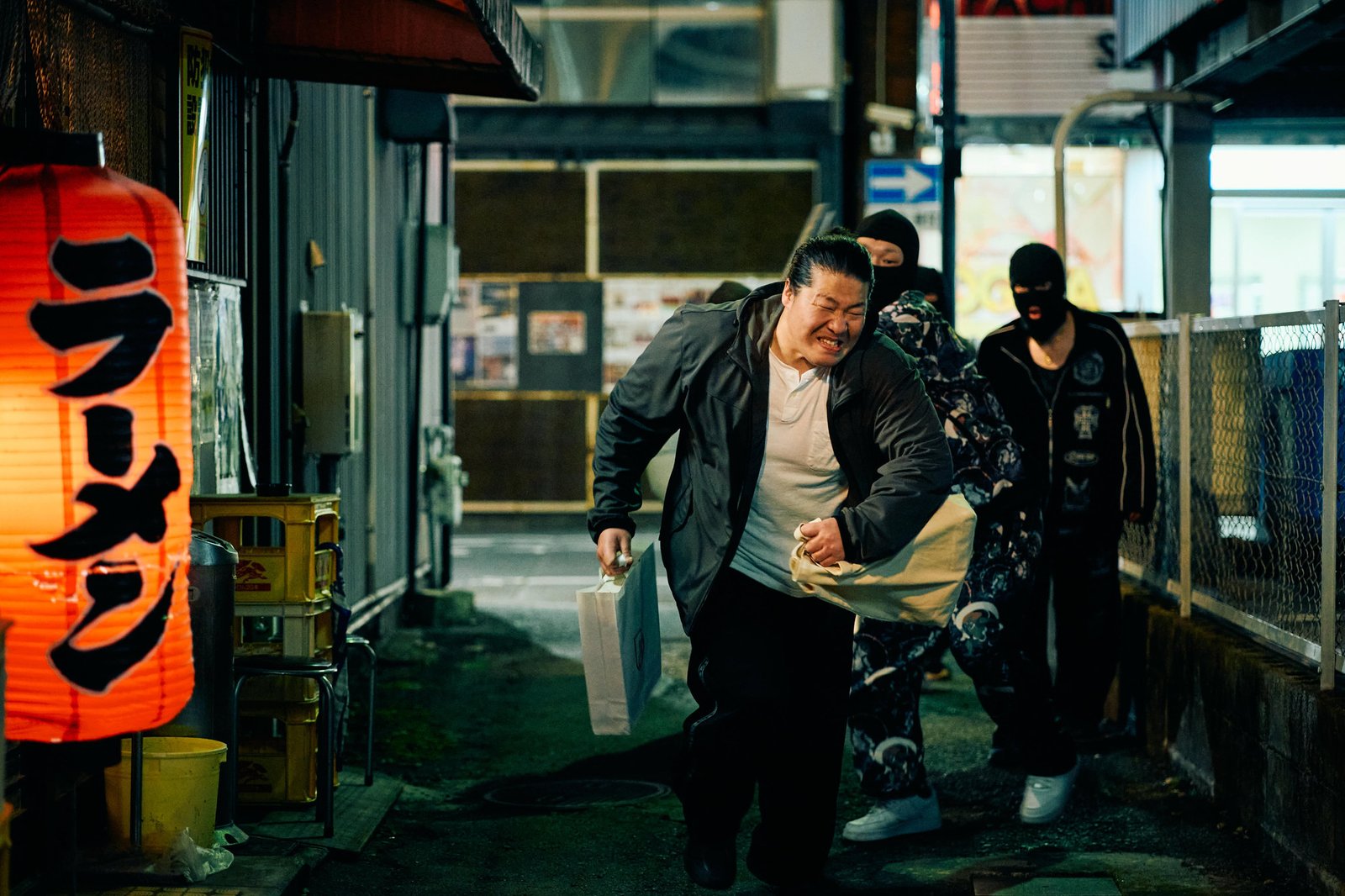
Keisuke Yoshida has built a reputation for focusing on characters living at the margins of society—individuals often overlooked or dismissed. With “Unchained”, he returns to similar territory, this time focusing on bullying and young offenders, a subject not unfamiliar to Japanese cinema, yet approached here from a distinctive angle. The film had its world premiere at the Udine Far East Film Festival.
The narrative revolves around a small group of characters, most notably Nishi (Wataru Ichinose), an imposing figure who initially appears to resemble a gang member but is, in fact, the head of a rehabilitation centre for troubled adolescents. A former criminal who has served time in prison for violent offences, Nishi is now a firm believer in the possibility of change. His centre, Mirai no Sato, is built on the conviction that young offenders can be re-educated through teamwork and practical activities such as farming and carpentry, though his methods are far from conventional. In an era increasingly concerned over political correctness, Nishi unashamedly admits to using physical punishment when necessary, arguing that experiencing pain can help these youths understand the consequences of their actions.
Parallel to this is the story of a schoolteacher (Kaho) deeply concerned about one of her students, Kaito (Kohsaka Hayato), a particularly violent bully who proves resistant to any form of discipline or dialogue. Kaito displays an alarming lack of empathy, lashing out in uncontrollable bursts of rage against classmates, family members, and even animals, seemingly incapable of grasping the harm he causes. Eventually, persuaded by Nishi’s public advocacy of his methods, the teacher convinces Kaito’s mother to send him to Mirai no Sato. Once there, Kaito struggles to integrate, his behaviour continuing to disrupt the fragile balance of the group. At the same time, Nishi’s growing notoriety—fuelled by the controversial nature of his approach—draws increasing public attention, and as a journalist begins to investigate his past, long-buried details resurface.
Yoshida’s direction carries his distinctly personal tone, one that blends intensity with an unexpected, almost accidental sense of humour. His characters are compelling, driven by rage and raw emotion, yet they often reveal moments of unintended comedy. However, many of them are deeply unpleasant, even repellent. Kaito, in particular, emerges as a chillingly psychopathic presence, a character the audience is not invited to empathise with in any conventional sense. This deliberate refusal to offer easy emotional alignment creates a constant tension.
Yoshida places the viewer in an uncomfortable position, where it becomes increasingly difficult to draw clear moral boundaries. Even Nishi remains an enigmatic figure, suspended between his violent past and his present conviction that change is possible. And yet, in his determination, Nishi comes across as someone who is not only trying to save the children, but also, in a sense, trying to save himself.
Throughout the film, a recurring concern emerges: the irreversibility of harm. Victims carry permanent scars, and the narrative repeatedly questions whether repentance can ever truly compensate for past actions. It is, ultimately, a question without a clear answer, one the film deliberately leaves unresolved, keeping the audience in a state of moral unease.
Guilt looms large over the film, an ever-present force that shapes each character in different ways. It weighs on the offenders for the harm they have inflicted, but also on the parents of the bullies, who are left wondering whether they bear some responsibility for the violence their children enact. Even the teacher is not immune, burdened by the uneasy awareness that the attention demanded by these troubled students inevitably comes at the expense of others. In this sense, the film exposes a paradox: those who cause the most damage often receive the most care, while those who do not risk being overlooked.
And yet the movie ultimately allows for a small measure of hope, even if for much of its duration the audience is left waiting for change that is repeatedly disrupted by setbacks. This faint sense of resolution arrives discreetly, and the film has the good judgment to stop at precisely the right moment, without overextending itself or spelling out what the future might hold, instead leaving it open to interpretation. “Mirai no Sato” means “village of the future”, though the notion of the future here remains ambiguous.
The performances are consistently strong. Wataru Ichinose as Nishi—previously brought to wider attention through the popular TV series “Sanctuary”, in which he portrayed a sumo wrestler—delivers an impressive central performance. His presence is striking not only because of his physicality, but also due to the intensity of his conviction and the force of his will. Opposite him, the young newcomer Hayato Kohsaka provides a fitting counterpoint as Kaito: a chilling, unsettling figure who lacks any trace of the innocence or hope typically associated with his age, making him all the more disturbing and effective within the narrative. Kaho, as the troubled teacher, delivers a strong performance, balancing fragility with a stern refusal to give in.
In the end, Keisuke Yoshida delivers another emotionally charged and critical portrait of society, built around an unforgettable eccentric lead character. “Unchained” remains a morally complex work that offers no simple answers, only questions that linger over issues of responsibility, guilt, and the possibility of change.



